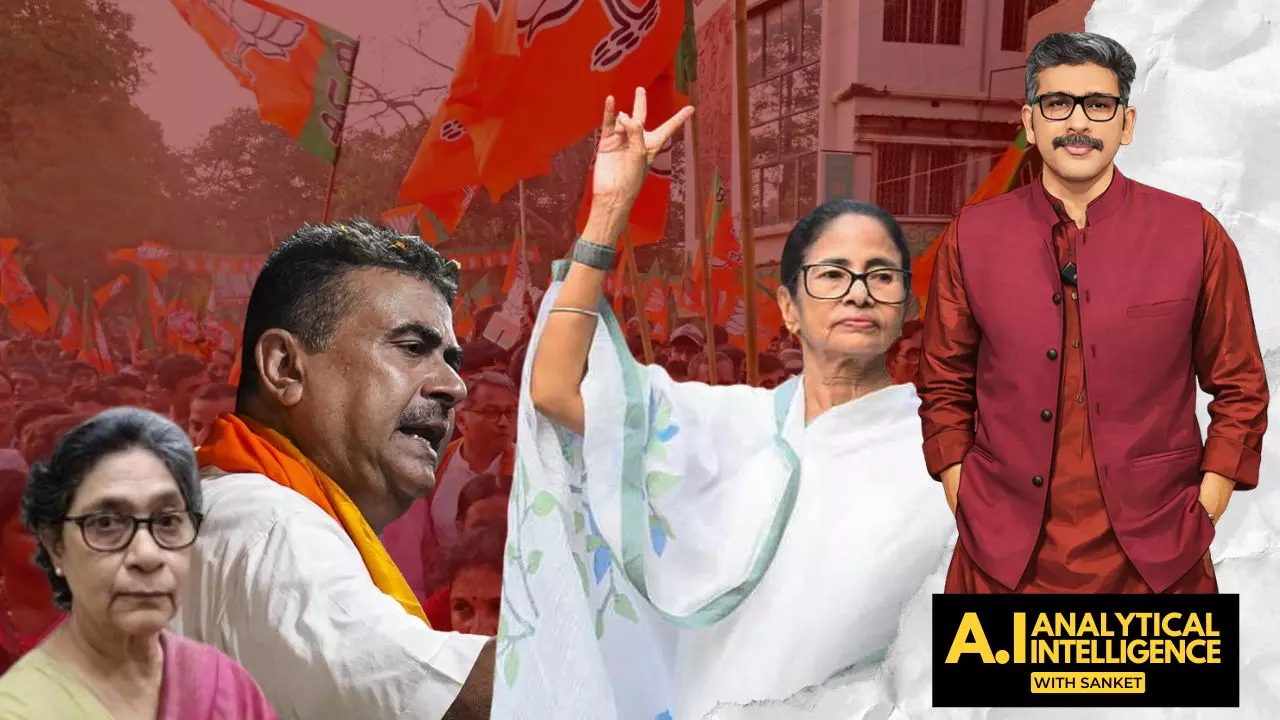
Why did BJP skip personal attack on Mamata in Bengal campaigning? | AI With Sanket
As BJP sheds its 'newcomer' tag and TMC shifts from personality to 'State vs Centre' narrative, senior journalist Shikha Mukherjee decodes Bengal election build-up

“This election lacks the usual Bengal excitement — there is both anti-incumbency and a sense of political exhaustion,” says senior journalist Shikha Mukherjee, underlining a surprisingly subdued start to the 2026 West Bengal Assembly poll season.
Also read: Has EC’s Bengal reshuffle crossed the line? | Jawhar Sircar interview
With the Bharatiya Janata Party (BJP) no longer a “new phenomenon” in the state politics and the ruling Trinamool Congress (TMC) banking on identity politics and welfare, the contest appears more complex than ever. The Federal spoke with Mukherjee in the latest episode of AI With Sanket to decode why this election feels different, how strategies are shifting, and whether the BJP’s new approach can work.
Here are some excerpts from the interview:
Do you agree that this election lacks the usual Bengal election fervour? Why?
I entirely agree. This election lacks the usual excitement, anticipation, and anxiety that we associate with polls in Bengal.
There are two reasons for this. One is that the TMC government has been in power for three terms, so there is both anti-incumbency and a sense of exhaustion with the ruling party.
The second reason is the BJP. It appears extremely eager and even desperate to somehow turn Bengal into a “double-engine” state.
Also read: TMC packs a punch with new faces, ticket reshuffle, and social coalition boost
If you look at the BJP’s trajectory, it surged in 2019 with 18 Lok Sabha seats, and its vote share jumped dramatically. But in 2021, that momentum did not fully translate into power. There was a disconnect between expectations and actual performance.
Then in 2024, the BJP’s numbers dropped to 12 seats. Between 2021 and 2026, there has also been erosion in its political strength.
So, the frenzy that existed earlier — when people were curious about this “new phenomenon” called the BJP — is no longer there. The BJP is now seen as a regular opposition party, not an exciting new entrant.
Is the BJP’s ‘double-engine government’ pitch counterproductive in Bengal?
Yes, it is counterproductive for two reasons.
First, Bengal has a long political history shaped by a deep sense of Centre versus state tension. There has always been a feeling that the Centre has discriminated against the state — from Partition and refugee rehabilitation to industrialisation and planning policies.
Also read: Assembly polls 2026: EC's U-turn, shorter-phase polls and bigger controversies
There were also major conflicts between state governments and the Centre in the past, including when the Congress and the Left ruled. These tensions even led to the formation of the Sarkaria Commission (1983) and discussions on cooperative federalism.
So, there is a deeply rooted distrust of the Centre in Bengal.
Second, the TMC has smartly framed the election as a “Bengal versus Centre” battle. Their slogan essentially says that no matter how much you attack, Bengal will win.
Interestingly, they are not projecting their supremo and the state's chief minister, Mamata Banerjee, as the sole defender. Instead, they are presenting it as Bengal-itself-versus-the-Centre narrative.
This strategy taps into emotional issues. For instance, the migration crisis — where Bengali-speaking people were targeted and labelled as Bangladeshis — became a very sensitive issue.
Even describing Bengali as a “Bangladeshi language” triggered outrage across all sections of society.
Then there is the SIR (Special Intensive Revision) issue, where large numbers of people are being asked to prove their identity. This again feeds into the Centre-versus-state narrative, because institutions like the Election Commission are seen as aligned with the Centre.
This perception is not new — it existed even during the time of Jyoti Basu, Bengal's longest-serving chief minister (1977-2000).
Has the BJP changed its strategy by avoiding personal attacks on Mamata Banerjee?
Of course, it has. If you look at the prime minister’s recent speech, he did not take Chief Minister Mamata Banerjee’s name even once. He did not even refer to her as the chief minister.
Instead, he spoke about “Nirman Sarkar” (a development-focused government) — a play of words — and focused on governance issues rather than personal attacks.
This is a clear shift from earlier campaigns, where individual-centric remarks such as “Didi O Didi” were made.
There are two reasons for this change. One, those personal attacks backfired badly.
Also read: Bengal elections: Trinamool scoffs at BJP's Suvendu Adhikari over dual-seat candidacy
Second, Mamata has now acquired the stature of a senior leader. She still hits the streets, leads protests, and remains politically active. It is no longer easy to attack her personally.
Now, the BJP is trying to attack her on governance — corruption, misgovernance, abuse of power — rather than her personality.
Is it even possible to separate Mamata Banerjee from the TMC?
No, it is not possible.
Mamata founded the TMC after leaving the Congress decades ago. She is the party.
At the same time, she has merged her identity with Bengal itself.
If you go back to the slogan I mentioned, any attack on her can be projected as an attack on Bengal.
That makes it extremely difficult to separate the person from the party or from the state’s identity.
Does the BJP lack a strong local leadership in Bengal? What about Suvendu Adhikari?
There is no leader in the BJP who comes close to Mamata’s level of acceptance across all sections of the Bengali society.
Even in the case of Suvendu Adhikari, the dynamics have changed. In 2021, Mamata went to Nandigram to take him on directly.
Also read: Bengal elections: SIR row, two-phase polling dominate debate | AI With Sanket
This time, she is not doing that. Instead, he has come to her stronghold. That itself shows a difference in political positioning. More importantly, the BJP is still seen as a party controlled by leaders from the Centre, such as Narendra Modi and Amit Shah.
That creates discomfort in Bengal, which has a tradition of strong, independent state leaders — from Bidhan Chandra Roy to Basu.
Is ideology also a factor in this election?
Yes, very much so.
This is not just a political contest — it is a clash of two different ideas of India and nationalism.
In Bengal, most parties emphasise a syncretic culture — inclusive traditions, shared festivals, and a composite identity.
Also read: TMC under pressure as welfare politics meets voter frustration in Bengal
The BJP, on the other hand, focuses on issues such as infiltration, demographic change, and religious identity.
However, Bengal’s historical context is different. It became part of India because it was a Hindu-majority region after Partition.
So, narratives about demographic takeover or infiltration do not resonate the same way. In fact, they can alienate sections of the population.
Will the BJP’s shift to attacking governance instead of Mamata work?
This remains an open question until voting happens.
There is definitely anti-incumbency against the TMC government. But Mamata has managed to counter it effectively.
Issues such as migration, identity, and language have shifted attention away from anti-incumbency.
At the same time, the BJP is trying to use anti-incumbency to counter those narratives.
But if you look at the ground reality, it is difficult to see Mamata being dislodged for two key reasons.
First is the women’s vote. She commands a significant share, and recent increases in direct cash transfers strengthen that support.
Also read: Five elections, and a moment of reckoning for Congress, BJP and EC
Second, the youth vote. Schemes such as 'Yuvasathi' may not provide jobs, but they provide financial support.
There is a sentiment among young people that while jobs are scarce, the government still provides some form of security from “cradle to grave”.
This includes everything, from childcare schemes to even support for cremation costs.
So, even if employment remains a concern, welfare politics continues to play a major role.
The content above has been transcribed from video using a fine-tuned AI model. To ensure accuracy, quality, and editorial integrity, we employ a Human-In-The-Loop (HITL) process. While AI assists in creating the initial draft, our experienced editorial team carefully reviews, edits, and refines the content before publication. At The Federal, we combine the efficiency of AI with the expertise of human editors to deliver reliable and insightful journalism.