The Chief Election Commissioner’s promise to include all eligible voters and exclude the ineligible will remain mere words unless the Commission, especially Kumar, walks the talk
In the current round of Assembly elections in four states and one Union Territory, so far clouded by the questionable manner of conducting the Special Intensive Revision (SIR) of electoral rolls, the polling schedule announced by the Election Commission of India was against expected lines.
In contrast to the trend of polling being mostly held in various states in increasing number of phases, especially those politically ‘problematic’ for the BJP (West Bengal for instance: 2014 LS polls – 5 phases; 2016 Assembly polls – 6 phases; 2019 LS polls – 7 phases; 2021 Assembly polls – 8 phases and 2024 LS polls – 7 phases), the ECI has decided to complete polling in this state in just two phases: 152 seats in the first round and the remaining 142 seats in the second.
Campaign window cut short
This drastic reduction in the number of phases in West Bengal, a decision which was considerably appreciated by the Trinamool Congress despite its consistent criticism of the Commission on the SIR issue, is not the only instance in the ECI’s change in approach. The number of phases in Assam too has been reduced from three in 2021 to just one.
Also read | Five elections, and a moment of reckoning for Congress, BJP and EC
Additionally, polling will be over in Assam, Kerala and Puducherry on April 9, effectively reducing campaigning (along with time to finalise candidate names, scrutinise nomination papers and withdrawal of nominations) to the minimum requirement of 24 days.
This is being done by issuing the formal Gazette Notification within a day of the ECI press conference, as against the past practice of legally notifying the polls a few days after the initial press announcement.
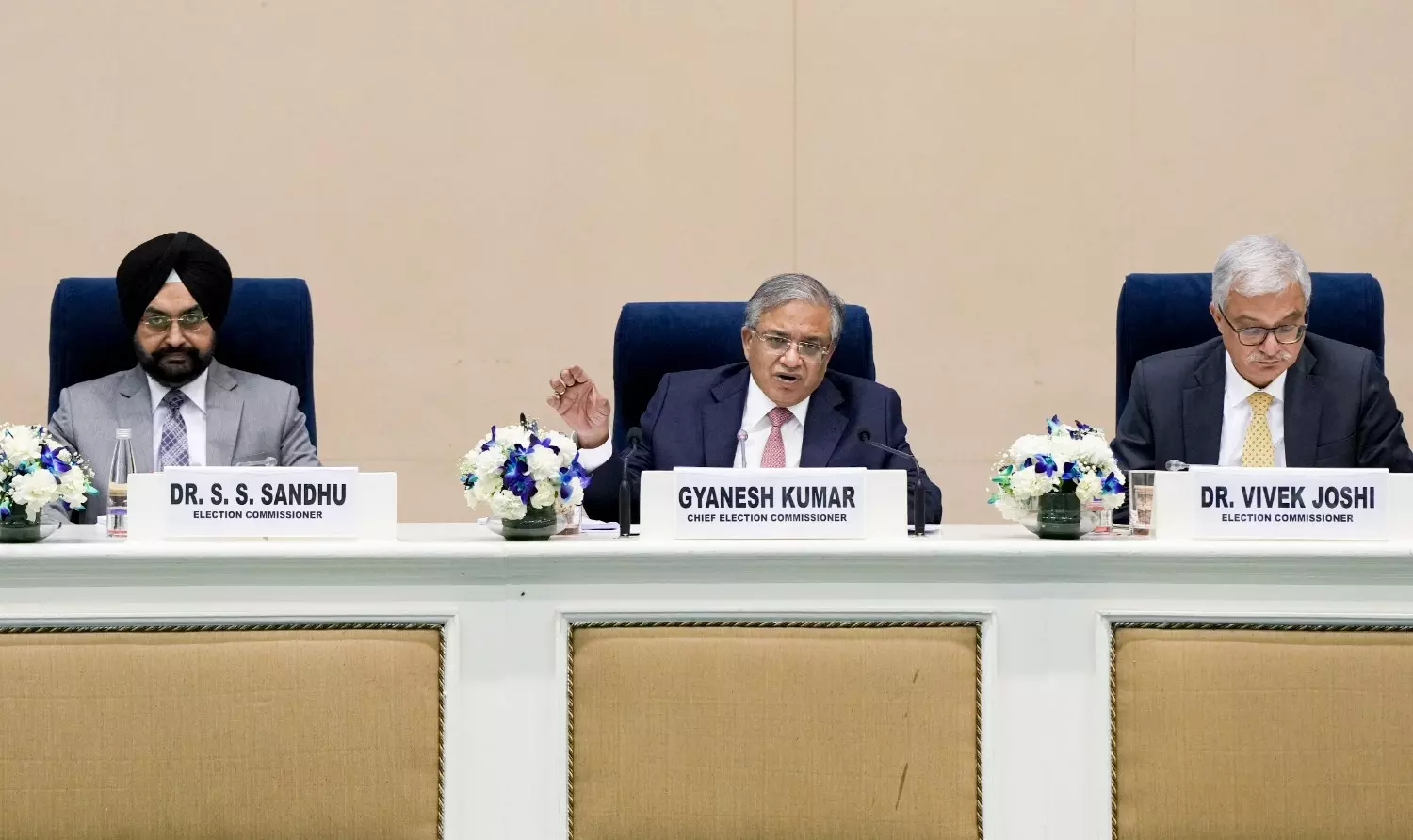
While answering a query on the reduced number of phases of polling, Chief Election Commissioner Gyanesh Kumar stated that this was done after “detailed deliberations” with various stakeholders, including political parties and security forces. He also said that reducing the duration of the electoral calendar was “convenient for everyone.” But, it remains to be seen if the short campaign period in Assam, Kerala and Puducherry is adequate for parties and specifically candidates.
ECI’s explanation faces scrutiny
In Kerala, other parties will have to follow the path of the Left Democratic Front (LDF). Its two major alliance partners, the Communist Party of India (CPI) and the CPI (Marxist) announced their candidates within an hour of the proclamation of polling on April 9 in the state. Immediately, the party’s units in constituencies launched campaigns for the chosen candidates.
In contrast, the Congress and Indian Union Muslim League (IUML) remain embroiled in negotiations over seat-sharing.
But, on the issue of reducing the number of phases of polling, the ECI’s explanations appear inadequate. In 2021 for instance, the ECI cited the following reasons for the record 8-phased elections in WB:
• Concerns over security and poll violence
• COVID-19 related issues
• Necessity to manage logistics
• Geographical complexity of the state
• Diverse demographic complexity in WB
Likewise in Assam, the ECI in 2021, cited security situation, deployment of Central Armed Police Forces, challenges stemming from COVID-19 and inadequate manpower as reasons for having 3-phased elections.
Fewer phases, more questions
While fears of poll violence and the challenge of making necessary security arrangements were a genuine concern, COVID-19, although it officially began in mid-February 2021, became a full-blown national crisis between late March and mid-April 2021, much after the elections were called in late February.
Given that the ECI has progressively, since 2014, become a less autonomous institution in self-imagination, it is reasonable to argue that the ruling party pushed for multiple phases to enable it to manage election booths adequately, and this was “discreetly conveyed” to people in Nirvachan Sadan.
Importantly, after the poll schedule was announced in 2021, the TMC brusquely criticised the ECI while the BJP lavished praise on the poll panel.
Kumar’s failure to provide adequate reasons for reducing the number of phases in West Bengal and Assam raises the question of whether, after coming under fire from Opposition parties and facing an impeachment motion, he aimed to project a ‘better’ image for himself and the institution.
But, in the backdrop of the controversies dogging the SIR, the Chief Election Commissioner’s promise that “no eligible voter” will be left out and “no ineligible person” is included in the electoral roll, will remain mere words for the record, unless the Commission, especially Kumar, walks the talk.
Voter eligibility remains unclear
On SIR, the biggest challenge facing the ECI is in West Bengal where eligibility of nearly 60 lakh previous voters is under adjudication. There are also big questions in Tamil Nadu.
Not unexpectedly, Kumar declared that as the Supreme Court has directed, the ECI working under the supervision of High Court of Calcutta, will be bringing out the supplementary lists. And, as and when the supplementary lists and names come out, they shall be included with the existing electors.
Also read | ‘Don’t dare question judicial officers’: SC warns West Bengal govt, ECI over SIR
The 500-odd judicial officers, appointed under the apex court’s order of February 20, are caught in the race against time as they examine cases of voters declared ineligible. In normal course, voters can be added to the electoral rolls till the deadline of filing nominations papers – April 6 and April 9 for the two phases in West Bengal.
What is currently unfolding in West Bengal has no precedent. Once the supplementary lists are finalised, including the names of these voters could become a tricky matter, especially if it occurs after the prescribed dates. This will certainly be a major issue in elections.
Poll announcement sparks debate
The announcement of election dates this time is inordinately late, especially when juxtaposed with the previous polls. In 2021, the then CEC and his team of officials, called the polls on February 26, more than a fortnight before this year.
No explanation was provided, nor were any questions raised on this matter. Political leaders, especially those in the Opposition, however, are likely to refer to this during campaign.
The ECI also faces the charge that it announced the polls on Sunday only after Prime Minister Narendra Modi’s four-day inauguration drive in the four states was completed, and the poll body received the ‘green signal’.
Modi’s four-day visits from March 11 to 14 focused on a massive infrastructure push across Southern, North-Eastern, and Eastern India, with projects totaling over ₹82,000 crore.
Modi’s infra push in states
The PM first visited Tamil Nadu and Kerala on March 11, launching projects worth approximately ₹16,450 crore. Thereafter, he spent two-days in Assam followed by a day-long visit to West Bengal, which included a massive public rally in Kolkata for which considerable preparation were done by the state and national units of the party.
Modi’s engagements during this period are noteworthy for being a significant push into the poll-bound states. In his speech in Tiruchirappalli after inaugurating projects worth ₹5,650 crore, Modi emphasised on the “future of Tamil Nadu” and the central government’s commitment to the state’s industrial and urban development.
During his visit to Assam, Modi’s speech in Kokrajhar was delivered online due to “bad weather” as he informed over the network. Despite not being able to address the people live, Modi mounted a sharp attack on the Congress. He accused his adversaries of keeping “many generations of Bodoland entangled in false dreams.”
In Guwahati, Modi performed Bhoomi Poojan for projects worth ₹19,680 crore, including the Kamakhya Temple ropeway. In his speech, Modi invoked the blessings of Maa Kamakhya ahead of Navratri.
The PM also visited Silchar in the Barak Valley where he used the official inaugurations to mount a political campaign.
West Bengal poll showdown
But it was his speech in Kolkata which was highly charged and accusative. He asserted that the Trinamool Congress had not protected the interests of the Hindus by opposing the Citizenship Amendment Act, passed in 2019.
Also read | EC sacks top bureaucrats, senior cops in poll-bound Bengal; Mamata to hit the streets
Modi’s high-pitched attack on Mamata Banerjee personally and her party is understandable, as West Bengal remains the ‘last frontier’ in the BJP’s push in eastern India.
Every state going to the polls is important for various parties and leaders, as it could influence the national scenario in the run-up to the 2029 Lok Sabha elections. However, the maximum attention will be on West Bengal, as it will be a ‘direct’ contest between Modi and Mamata Banerjee.
It will also be the arena where two contrasting ideas are pitched against each other: The TMC’s slogan of ‘protecting’ Bengali asmita (identity) by keeping ‘outsiders’ out, versus the BJP’s all-encompassing notion of parivartan (change).
(The Federal seeks to present views and opinions from all sides of the spectrum. The information, ideas or opinions in the articles are of the author and do not necessarily reflect the views of The Federal.)