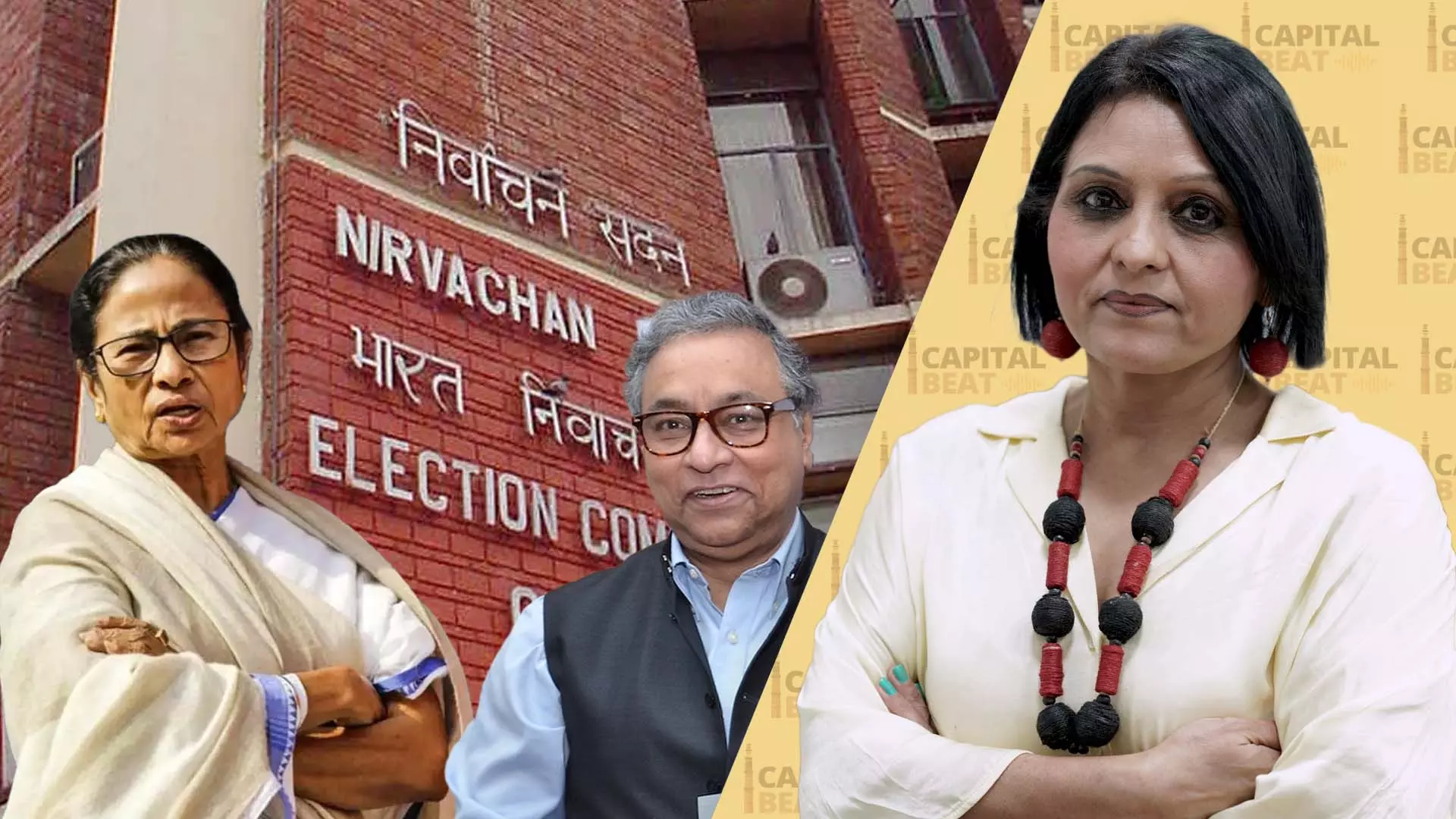
Has EC’s Bengal reshuffle crossed the line? | Jawhar Sircar interview
Former Rajya Sabha MP questions scale, timing and neutrality of Election Commission’s sweeping bureaucratic transgers ahead of the Assembly polls

West Bengal’s political landscape has been stirred by sweeping administrative reshuffles ordered by the Election Commission of India ahead of Assembly elections. The scale and timing of these transfers have sparked a sharp debate on neutrality, federalism, and electoral fairness.
The Federal spoke to former Trinamool Congress Rajya Sabha MP, Jawhar Sircar, in a Capital Beat episode to understand whether the Election Commission’s actions are justified and what they mean for the state’s political climate.
Are these large-scale transfers by the Election Commission unprecedented or justified?
This scale and level of transfers are certainly eye-catching. It has not happened before that a chief secretary is removed by the Election Commission. I tried to look up past data, but there is no precedent.
The removal of a state’s administrative head sends a strong signal. People will interpret it in their own way. The Election Commission’s powers begin once the Model Code of Conduct is in force, so the timing is legally valid.
Also Read: TMC packs a punch with new faces, ticket reshuffle, and social coalition boost
However, the situation with the chief secretary in West Bengal is also unusual. The appointment itself was striking—someone superseded three batches of officers to become chief secretary after being in relatively marginal postings. That may have drawn the Commission’s attention, possibly based on reports regarding neutrality.
At the same time, the scale of transfers—covering multiple police commissioners and senior officials—is an overreach. While such transfers have happened before, the speed and extent suggest a premeditated plan.
Is the Election Commission acting within its legal powers under Article 324?
Yes, the Commission has the power. But having power does not mean it should always be exercised in this manner.
Many institutions have wide powers, but restraint is equally important. My concern is whether such large-scale, demonstrative transfers are applied uniformly.
How often does the Commission take similar action in BJP-ruled states? Since 2018–19, there have been increasing concerns about bias, particularly during the tenure of Sunil Arora.
So while the legal authority exists, the pattern of its use raises questions.
Do Mamata Banerjee’s allegations of political bias and conspiracy hold weight?
Some of the claims sound exaggerated. Linking transfers directly to riots or large-scale disruption does not align with administrative realities. I have served in the state for decades, and it does not work that way.
Many institutions have wide powers, but restraint is equally important. My concern is whether such large-scale, demonstrative transfers are applied uniformly.
However, the fear of communal polarization is not unfounded. There is a historical pattern where certain political forces benefit from polarization. Many in Bengal do believe that triggering unrest can influence voting patterns.
The Election Commission works in consultation with the Home Ministry. In recent elections, the number of central forces deployed has increased significantly.
At the same time, it must be noted that the state government itself has transferred 60–70 officers in the last 15 days. So both sides are engaging in large-scale reshuffles.
Does this situation undermine cooperative federalism?
Yes, to an extent. In earlier times, there was coordination between the Election Commission and the state administration. The Commission would communicate concerns, and the state would act accordingly.
Now, there is clear hostility. The lack of working relations between the two sides will cost the state.
What is the usual criteria for transferring officials during elections?
Typically, officers who have spent a long time in one place are moved to prevent bias or undue influence. Intelligence inputs also play a role.
But the scale we are seeing now—from both the state government and the Election Commission—is unusual. Such widespread transfers disrupt administrative continuity and affect officials’ personal lives as well.
It creates confusion in governance when officers are suddenly relocated across long distances.
Is there merit in concerns about excessive deployment of central forces?
The Election Commission works in consultation with the Home Ministry. In recent elections, the number of central forces deployed has increased significantly.
Potentially 25–30 lakh voters may not be able to vote if their cases remain unresolved. This is a serious and tragic situation
In fact, in the last elections, central forces at one point outnumbered the state police. This trend appears to be continuing.
The stated aim is to ensure free and fair voting, but it also creates a perception of overwhelming presence, which raises concerns.
What about allegations of voter list deletions and pending adjudications?
There is an unprecedented situation in West Bengal regarding voter list adjudications.
A large number of objections—particularly through Form 7—have been filed, reportedly targeting specific communities. This has led to a massive number of pending cases.
As a result, potentially 25–30 lakh voters may not be able to vote if their cases remain unresolved. This is a serious and tragic situation.
What happens to candidates whose names are under adjudication?
Candidates will likely be given some form of fast-track relief. They can present themselves before the adjudicating officer and resolve issues quickly.
The only major concern that could arise is related to citizenship status, but otherwise, provisions will likely be made for candidates to contest.
Should Chief Election Commissioner Gyanesh Kumar step aside amid controversy?
Gyanesh Kumar has acted in ways that are not typical for a senior civil servant.
The Election Commission has had a strong reputation for decades, but recent actions have raised concerns. Even one individual can damage institutional credibility.
Given the impeachment motion, he should step aside until the matter is resolved.
The content above has been transcribed using a fine-tuned AI model. To ensure accuracy, quality, and editorial integrity, we employ a Human-In-The-Loop (HITL) process. While AI assists in creating the initial draft, our experienced editorial team carefully reviews, edits, and refines the content before publication. At The Federal, we combine the efficiency of AI with the expertise of human editors to deliver reliable and insightful journalism.