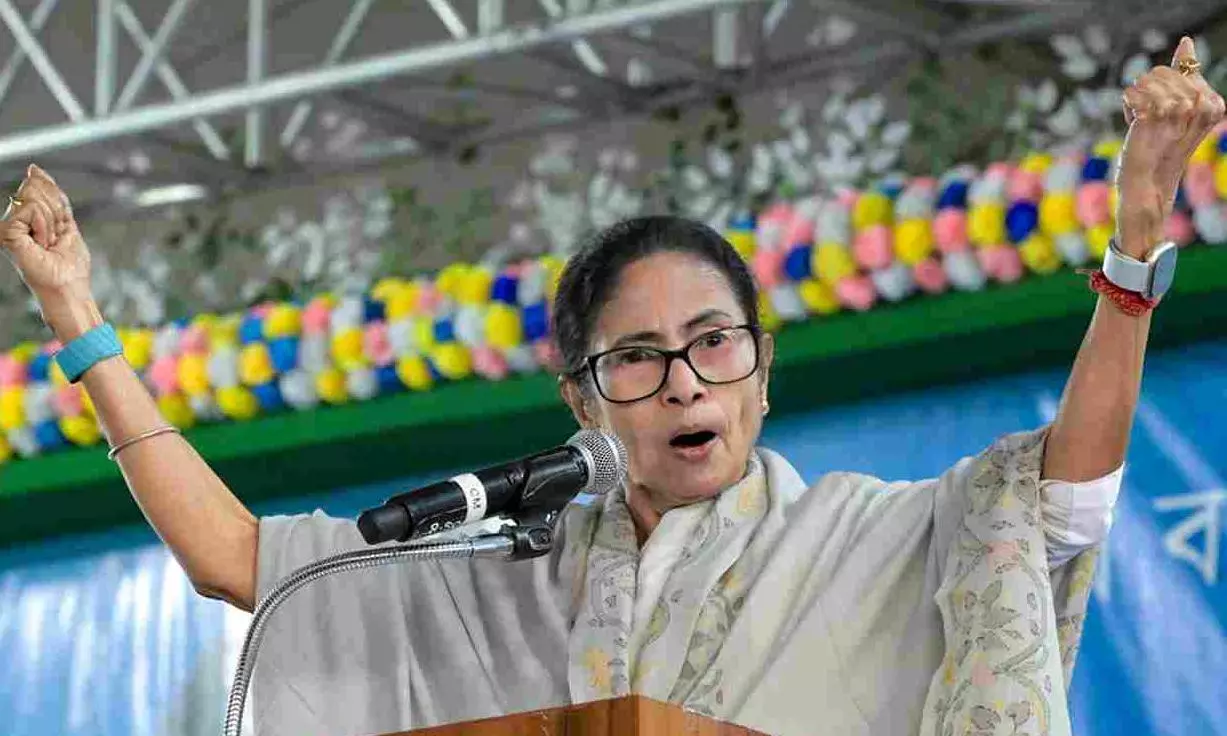
TMC under pressure as welfare politics meets voter frustration in Bengal
Despite welfare schemes securing loyalty among women and rural voters, concerns over jobs, corruption, and law and order are shaping youth sentiment ahead of polls

Moments before the Model Code of Conduct came into force for the 2026 West Bengal Assembly elections, the state government led by Mamata Banerjee announced a last-minute increase in monthly honorariums for Hindu priests and Muslim muezzins.
The move underscored the TMC’s continued reliance on welfare politics even as it confronts a far more complex electoral battle this time.
Over the past decade, the TMC has built one of India’s most extensive welfare systems, prompting critics to say “from birth to marriage to death, there is a dole for every stage of life” in Mamata Banerjee’s West Bengal.
Welfare endures, anger simmers
From maternity benefits to the Somobyathi scheme, which offers financial aid to families unable to bear funeral costs, as well as cash transfers for women, student support and subsidised services, the coverage spans different stages of life. These schemes have created a broad base of beneficiaries across rural and urban Bengal.
Also read | Bengal elections: TMC's 291-candidate list out, Mamata vs Suvendu in Bhabanipur
But as campaigning begins for the 2026 assembly election, party leaders and analysts say the political environment is more challenging than in 2021.
“Welfare is still a strong pillar, but it is not the only issue this time,” said political analyst Debasish Chakraborty. “There is visible stress among young voters, especially around jobs and recruitment, and concerns over corruption, institutional credibility and law and order are shaping voter perception, particularly in urban areas.”
For many voters, welfare support is real and helpful, but so is the frustration.
Dolly Lahiri, a 56-year-old homemaker and voter in Behala East, said, “We get money every month. It helps with household expenses, but it is not enough.” She added, “My son has no job. How long can this continue?”
That sentiment is being actively tapped by the BJP, which is trying to expand its appeal beyond its traditional Hindutva base.
BJP taps youth frustration
At a recent rally in Kolkata, Prime Minister Narendra Modi directly addressed young voters, many of whom are beneficiaries of state nascent Banglar Yuva Sathi scheme, which provides a monthly stipend of Rs 1,500 to unemployed youth.
“The youth of Bengal are being forced to migrate for work,” he said. “Instead of jobs, they have been given allowances.”
According to the state’s Migrant Workers Welfare Board (MWWB), around 22 lakh people from West Bengal work in other states.
Several attendees at the PM’s rally echoed that frustration. Gopal Das, who travelled from Raiganj to attend Modi’s Brigade rally on Saturday, said he used money received under the Yuva Sathi scheme to make the trip.
He added that he would vote for the BJP despite receiving the cash benefit, saying Rs 1,500 was not enough and that he needed a job, which he believed would only be possible with a change in government.
Tuhin Kumar Nath, a PhD scholar from Chinsurah in Hooghly district, said he appreciated the financial help but wanted stable employment. “The money helps, but it is not a future,” he said. “We are preparing for exams, but recruitment is delayed again and again.”
Anti-incumbency woes mount
Concerns over job creation, infrastructure strain, and a lack of large-scale industrial investment have led to a degree of anti-incumbency.
Despite efforts to attract investment, critics argue that West Bengal has lagged behind some other states in manufacturing growth, an issue that resonates with first-time voters entering the job market.
Beyond employment, corruption has emerged as another dominant issue, with many linking the teacher recruitment and ration scams, along with other graft allegations against leaders of the state’s ruling party, to a deeper systemic rot in the administration.
Questions over transparency have also surfaced in other sectors, including health recruitment, where candidates alleged irregularities in hiring panels.
Opposition parties have also repeatedly pointed to what they describe as a “syndicate raj” in construction and local business, where politically linked groups allegedly control contracts and extract payments.
Recruitment anomalies spark outrage
The BJP has also sharpened its attack on corruption, particularly in recruitment. Allegations of irregularities in school job appointments have become a major political issue, with court interventions adding to the controversy.
Also read | EC sacks top bureaucrats, senior cops in poll-bound Bengal; Mamata to hit the streets
“Jobs were sold, and deserving candidates were left out,” Modi said at the rally, referring to the recruitment cases. These are not merely allegations of political opponents. Even courts have flagged irregularities.
The TMC, however, has denied systemic wrongdoing, saying irregularities were limited and corrective steps have been taken.
The party’s decision to field Jyotipriya Mallick again from Habra, despite his alleged links to the ration distribution corruption case and the fact that he is currently out on bail, has further reinforced the Opposition’s narrative on accountability and governance.
The corruption will definitely be an issue, especially among educated urban voters, said Anusua Roy Choudhury, a retired professor.
Women’s safety fuels campaign
Law and order, particularly women’s safety, has emerged as another flashpoint in the campaign.
Incidents such as the 2024 unrest in Sandeshkhali, where allegations of sexual abuse and political intimidation triggered protests, and the controversy surrounding a case at RG Kar Medical College and Hospital are also being raked up again by opposition parties as key campaign issues.
“These are not isolated incidents, but a reflection of the collapse of law and order,” said Nirapada Sardar, a CPI(M) leader from Sandeshkhali, alleging that those linked to the ruling party were operating with impunity.
“These incidents show the ground reality,” Modi said, accusing the state government of failing to protect women.
Local BJP leaders have used these cases to highlight rising safety concerns, particularly in rural areas. With the slogan “Bachte chai, tai BJP chai (We want to survive, that’s why we want BJP),” the party is signalling that issues of law and order, infiltration, and demographic change are central to their campaign message this year.
The TMC has pushed back strongly, accusing the Opposition of exaggerating isolated incidents for political gain. “Crime data does not support this narrative,” state minister Becharam Manna told The Federal. “West Bengal is no less safe than other states.”
Official data from the National Crime Records Bureau has not shown a dramatic spike in overall crime, but perception remains a key battleground, especially in urban constituencies.
Identity politics shapes discourse
The BJP has also intensified its identity-based messaging, reviving its campaign around alleged illegal migration from Bangladesh and its impact on local demographics.
Party leaders have argued that Hindus feel insecure in certain areas, citing sporadic incidents of communal tension in districts such as Murshidabad and North 24 Parganas in recent years.
“Bengal is burning. The social fabric is torn. Enough is enough,” said Suvendu Adhikari, the Leader of the Opposition in the West Bengal Legislative Assembly. He has been repeatedly alleging that Hindus had been forced to flee their homes due to “religiously driven bigots” and blaming the state government’s policies for a breakdown of law and order.
Manna has dismissed these claims as divisive politics aimed at polarisation.
Still, the issue resonates in border districts. In Malda, a social activist said such narratives are shaping public discourse and influencing social dynamics.
“Earlier, people spoke about development,” said Mosarekul Anwar of the Ganga Bhangon Protirodh Nagarik Action Committee. “Now there is more talk about identity and security, especially during elections.”
Despite these challenges, the TMC’s welfare model continues to offer a significant electoral advantage. Over time, it has evolved into a form of political clientelism, where access to state support often translates into electoral loyalty, particularly among women, rural voters, and economically vulnerable groups.
BJP faces welfare challenge
At the same time, the Opposition has also struggled to present a credible alternative model of governance that matches the scale of these benefits.
While the BJP, the principal challenger, has sharpened its attack against the TMC, it has yet to clearly articulate how it would replace or improve upon the existing welfare ecosystem without alienating its beneficiaries.
Chief Minister Mamata Banerjee has repeatedly framed this contrast in political terms, accusing the Centre of failing to deliver on its commitments while projecting her government as one that fulfils its promises.
Also read | PM Modi 'guarantees' nobody can save TMC, launches Rs 18,680 crore projects in Bengal
“They make big announcements, but people do not get what is promised,” she said at a recent public meeting. “In Bengal, whatever we announce, we implement. That is our guarantee.”
The party is also hopeful that discontent around the Special Intensive Revision (SIR) of electoral rolls could help it win back a section of voters from the BJP’s support base, particularly among key Scheduled Caste communities such as the Rajbanshis and the Matuas.
The BJP, however, believes the electoral arithmetic is shifting, with party leaders arguing that even a small swing in its favour could change the outcome in several constituencies.
Union Home Minister Amit Shah echoed this view at a recent meeting with party leaders and functionaries, saying the BJP had already crossed the 40 per cent vote mark in over 140 seats, pointing out that the party had improved from winning 77 assembly seats in 2021 to leading in 97 assembly segments in the 2024 Lok Sabha polls.