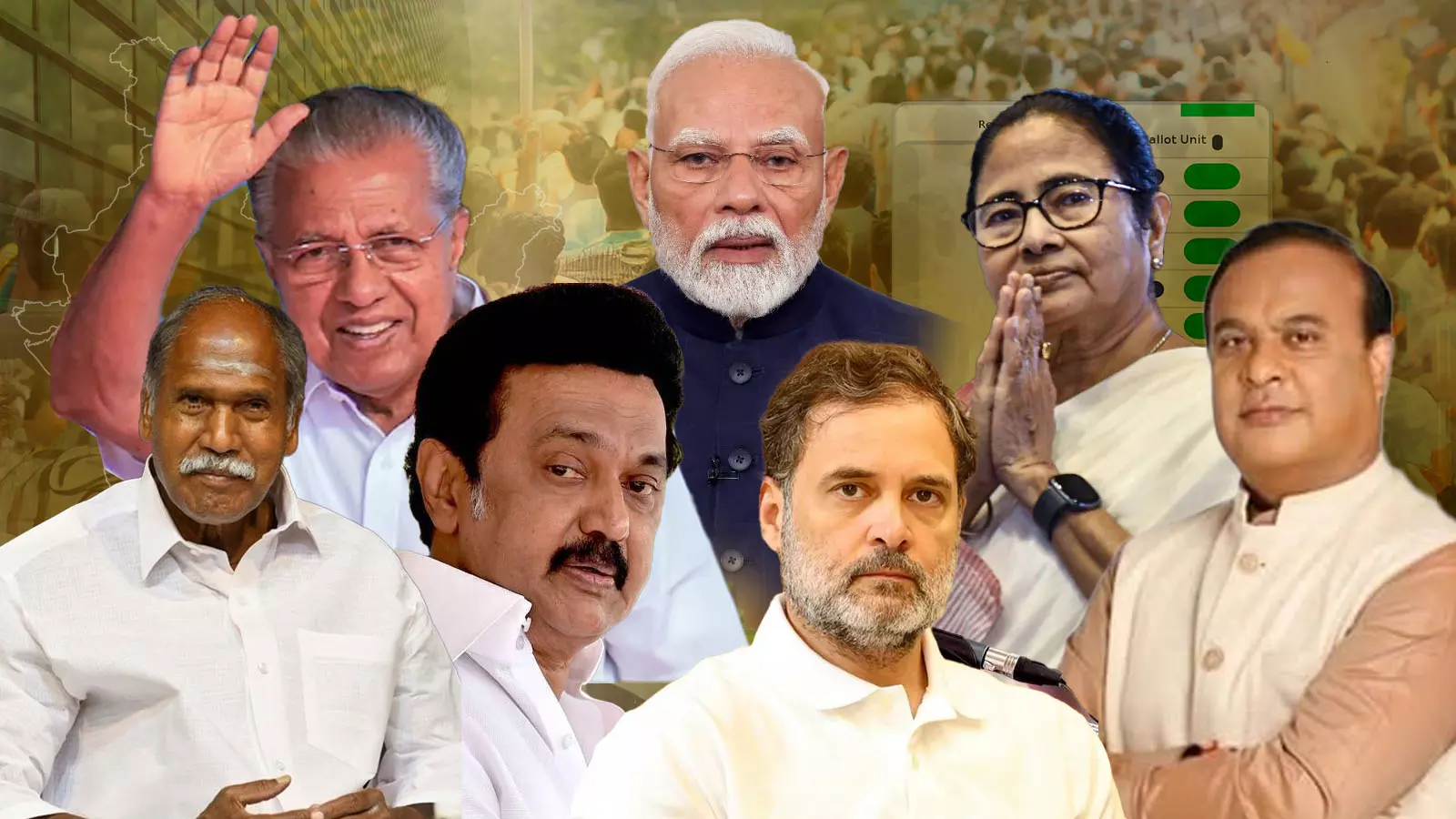
Five elections, and a moment of reckoning for Congress, BJP and EC
The elections will also be a test for regional powerhouses such as the DMK, TMC and Left to ensure that they are not thrown out of power on their home turfs

The Assembly elections scheduled for April 9 in Assam, Kerala and Puducherry, April 23 in Tamil Nadu and April 23 and April 29 in West Bengal, will not only put the Opposition Indian National Developmental Inclusive Alliance (INDIA) bloc through the wringer but also test the Bharatiya Janata Party’s (BJP) relentless expansion plans.
Also read: As Kerala goes to polls on April 9, can LDF rewrite history a second time?
On test will also be the sanctity of the electoral process and the credibility of the poll panel, arguably more than ever before, given the Opposition’s unprecedented bid to initiate impeachment proceedings against Chief Election Commissioner (CEC) Gyanesh Kumar is currently awaiting a decision by the Speaker of the Lok Sabha and Chairman of the Rajya Sabha.
Outcome of April 2026 elections
The four states and the Union Territory of Puducherry may each be markedly different from the other in their electoral landscape, but the outcome of the polls would define the contours of political discourse, both in regional and national terms, as well as the dynamics within the INDIA bloc for the foreseeable future.
The Congress, whose resurgence following the fleeting uptick of the 2024 Lok Sabha polls was brutally nipped by a series of Assembly poll debacles since, is a fringe player in the otherwise formidable Dravida Munnetra Kazhagam (DMK)-led alliance in Tamil Nadu and a footnote in the contest in Bengal.
In Kerala, though, where its principal rivals are the INDIA bloc allies from the Left, the Grand-Old Party has high hopes of staging a comeback. In Assam, the party is hoping that despite the mounting electoral and organisational upsets of the past decade, it would, at the very least, bag the consolation of holding on to its vote share with a modest improvement in its seat tally, even if defeating the Himanta Biswa Sarma-led BJP seems difficult at this moment.
Also read: Dissent brews in Congress over Assam seat-sharing even as party releases 2nd poll list
An electoral outcome that goes contrary to this expectation would further dent the Congress’s already shaky standing within the INDIA bloc, embolden critics within and outside its ranks, and chip away at the party’s bargaining power with ally Samajwadi Party for the all-important Uttar Pradesh Assembly election due in a year’s time.
Time running out for Congress
A string of defeats for the Congress in the current round of polls is also bound to hit its morale in Gujarat and Punjab, where too polls are due next year, and could push the party’s traditional voting blocs in these states further towards Arvind Kejriwal’s Aam Aadmi Party (AAP), which had successfully trounced the Congress in Punjab in 2022 and come close to displacing it as the BJP’s main rival in Gujarat later that year.
The massive victories that the BJP registered in Haryana, Maharashtra, Delhi and Bihar in the recent past have already erased from public memory the setbacks that the party suffered in the 2024 Lok Sabha polls.
With Prime Minister Narendra Modi’s Teflon image somewhat restored, the party’s electoral machinery in full throttle and its narrative of communal polarisation already at deafening levels, the saffron party is confident of scoring a third consecutive victory in Assam and hoping to rebound considerably in Bengal, even if a full-fledged victory against Banerjee’s equally combative Trinamool Congress (TMC) may look improbable right now.
BJP too has its challenges
For the saffron party, the big challenge is to somehow breach the Dravidian citadel of Tamil Nadu on the strength of an alliance that still seems so far from taking shape that its own leaders are at pains to confirm whether the party will ultimately team up with Edappadi Palaniswami’s All-India Anna Dravida Munnetra Kazhagam (AIADMK) or actor Vijay’s Tamilaga Vettri Kazhagam (TVK) or both to stop DMK chief MK Stalin’s victory lap.
Also read: Hours before MCC sets in, Mamata gives hike to priests and clerics, clears DA arrears
The other coastal state of Kerala, too, presents formidable challenges for the BJP, despite the lone Lok Sabha win the party had managed to squeeze out through actor Suresh Gopi in Thrissur in the 2024 Lok Sabha polls and the Thiruvananthapuram Municipal Corporation win of last year.
A southward expansion for the BJP is the feather that has consistently evaded Modi’s electorally versatile headgear. Any victory for the BJP, no matter how inconsequential at the level of the Assembly in these two southern states, is bound to be exaggerated to disproportionately monumental levels by the saffron ecosystem as Modi continues his electoral and political vanity projects in his third term as the prime minister.
Task cut out for DMK, TMC
The ominous task of preventing such an eventuality in the current round of polls largely lies not with the BJP’s national counterweight, the Congress, but with the regional DMK in Tamil Nadu, or the TMC in Bengal.
Modi’s personal political capital and his party’s vast electoral coffers may have helped the BJP steadily expand its vote share in Tamil Nadu, Bengal or Kerala over the past decade, but that alone is not the victory the party desires in these states. In Bengal, it desperately wants to displace Mamata, while in Tamil Nadu and Kerala, it is willing to settle for victories in a few seats that can then be attributed to the Modi magic and built upon in future polls.
Where the BJP has, however, hit a wall in each of these states, albeit with varying degrees, is in tailoring its one-size-fits-all ultra-nationalistic, Hindutva narrative with the weft and warp of Dravidian and Bangla identity politics and the syncretism of Kerala.
In the formidable socio-cultural self-awareness of voters coupled with the strength of the DMK, the TMC or even the Left and the Congress in Tamil Nadu, Bengal and Kerala, respectively, the BJP has found more than a match for its infamously Machiavellian politics rooted in 'saam, daam, dand, bhed'.
Congress in TN, Bengal
Ironic as it may seem, it is the happenings within the Opposition camp that have given the BJP some reason to cheer. In Tamil Nadu, a section of the Congress party nearly took a wrecking ball to its formidable alliance with the DMK, making a long-drawn public spectacle of a spat that wasn’t necessarily between the two parties but the result of misplaced ambitions of some Congress whippersnappers close to Lok Sabha’s Leader of Opposition Rahul Gandhi.
Also read: 10 key seats to watch in West Bengal elections 2026
As a result, the ruling alliance in the state, which should have entered the poll ring with an image of steadfast unity and purpose, appeared divided and unsure.
In Bengal, where the Congress failed to win a single seat in the 2021 polls despite entering into an alliance with the Left Front and the Indian Secular Front, the party has decided to go solo this time round. With Rahul and Priyanka Gandhi expected to campaign extensively in the party’s old strongholds of Malda, Murshidabad and other areas with a sizeable Muslim population, the Grand-Old Party is hoping that the upcoming polls will allow it to re-enter the state Assembly with at least a few MLAs.
While such an eventuality may be good news for the Congress, it is unlikely to sit well with the TMC, which wants the state’s Muslims to remain consolidated behind Mamata. Any split in the Muslim votes between the TMC, the Congress, the Left parties and the fledgling Aam Janata Unnayan Party would naturally benefit the BJP.
While this would bring cheer to the BJP, for the Congress and the wider INDIA bloc, it spells trouble. Any upsets for the TMC because of the Congress, no matter how minuscule, are bound to alienate Mamata at a time when, at the central level, the two parties have barely managed to keep a united face due to the necessity of appearing equally determined to take on their saffron rival.
In Assam, Kerala
Considering that of the five poll-bound provinces, the Congress is in a direct contest with the BJP only in Assam, where its prospects do not look bright, the Grand-Old Party is unlikely to come out looking any stronger in taking on the BJP electorally, even if it manages to trounce the ruling Left Democratic Front in Kerala.
As such, any upsets caused to the TMC in Bengal at the hands of the Congress will embolden the mercurial Mamata to, once again, question the Grand Old Party’s perceived centrality in the INDIA bloc and seek a larger say, if not a formal role, for herself within the alliance nationally.
Also read: TVK rules out alliance with NDA for Tamil Nadu elections
In addition, if the Congress, which managed to wriggle out just three additional seats from the DMK in the seat-sharing pact for Tamil Nadu (the party will contest 28 seats this time as opposed to the 25 it got from the DMK in 2021) after visibly acrimonious negotiations, drags the Stalin-led alliance down in the southern state, the dogged support Rahul has received over the years from the Tamil Nadu chief minister may begin to teeter.
Elections at a time of war, controversial trade deal
While the peculiarities of each state will, no doubt, be the driving force for the electoral outcome in the respective electoral battlegrounds, for both national parties — the BJP and the Congress — the polls will also indicate just how much their narratives around broader national issues resonate with the voters.
The elections are being held at a time when the war in West Asia and its impact on India’s energy security have found a political echo in national politics. The same holds true for the seemingly wide-ranging and adverse implications that the US-India interim trade agreement could have for Indian farmers, textile industry stakeholders and small businesses.
Also read: Has SIR controversy hijacked West Bengal’s pre-election buzz? | AI With Sanket
These may not be issues at the forefront of the campaign in the poll-bound provinces but they may, at a more personal level, affect the voting preferences of people; especially when compounded with the now perennial factors of growing unemployment as well as economic and agrarian distress or the anxiety and humiliation that hapless voters have been subjected to through the Election Commission’s Special Intensive Revision of electoral rolls.
The poll panel’s conduct is expected to come under greater scrutiny, given the increasing perception of its lack of neutrality, which forced the TMC last week to get all INDIA bloc partners on board in submitting an unprecedented notice for a motion to impeach Kumar. Whether he, as the chief arbiter of poll-related grievances, uses the upcoming polls to cleanse himself of some of the muck he has gathered over the past year of his term, of course, remains to be seen.