Bengal elections: SIR row, two-phase polling dominate debate | AI With Sanket
Experts discuss how the Special Intensive Revision, muted campaigning, a shortened poll schedule and even the West Asian crisis could shape the outcome

The Special Intensive Revision (SIR) of electoral rolls could become the most decisive factor in the upcoming West Bengal Assembly elections, with fears of voter disenfranchisement dominating political discussions. The unusually muted campaign atmosphere and the Election Commission’s (EC) decision to conduct polling in just two phases have also triggered an intense debate.
Also read: Bengal elections: Trinamool scoffs at BJP's Suvendu Adhikari over dual-seat candidacy
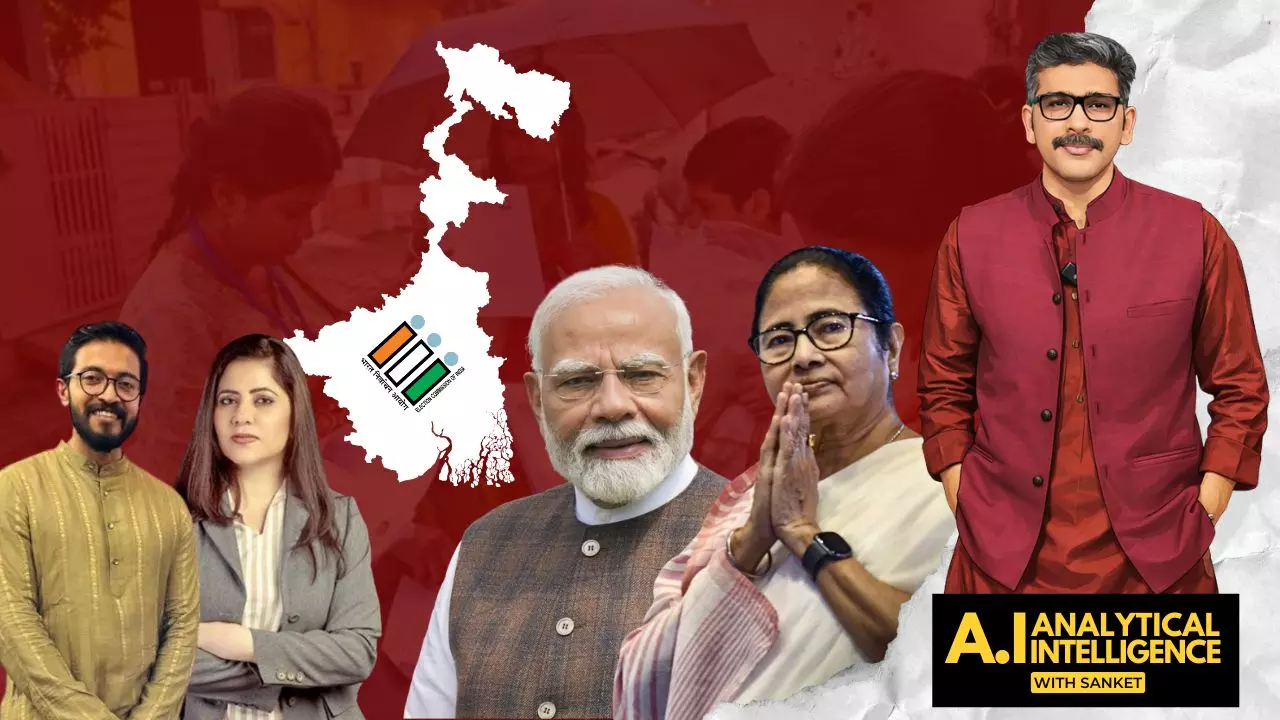
In this episode of AI With Sanket, this writer spoke with social worker and political commentator Saira Shah Halim and journalist Tamal Saha about the implications of the SIR exercise, the political strategies of the ruling Trinamool Congress (TMC) and the main Opposition Bharatiya Janata Party (BJP), and how national and global developments could influence voter sentiment in the state.
The announcement of polling dates itself came as a surprise. Bengal, which has traditionally seen elections conducted in multiple phases — sometimes stretching to seven or eight rounds — will now vote in just two phases, on April 23 and 29.
Observers and political actors alike are trying to understand whether the shortened election schedule signals a change in the security environment or a shift in political strategy by the major parties.
Fewer phases
Saha noted that Bengal has historically witnessed multi-phase elections due to concerns about violence and logistical challenges. In earlier elections, including those in 2021, the state voted in as many as eight phases.
However, the EC has now reduced the number to just two phases. According to the journalist, this shift has surprised many observers, particularly because several parties had earlier demanded more phases, citing security concerns.
He pointed out that the BJP itself had previously advocated for more phases in elections, even suggesting up to 10 phases during the 2024 Lok Sabha polls. This time, however, the same party reportedly favoured a shorter schedule.
Also read: Bengal polls: Eyeing its first Assembly seat after 2016, Left unveils 1st list of 192 names
Saha suggested that political calculations may be behind this change. In past elections, prolonged polling phases sometimes created unexpected political dynamics that benefited certain parties.
Lessons from 2021
He recalled that the 2021 Assembly elections, which took place during the COVID-19 pandemic, were conducted in eight phases despite widespread health concerns.
During that election cycle, several unexpected developments occurred between phases, including incidents that shaped voter perception and campaign narratives.
One such moment was when Chief Minister Mamata Banerjee sustained a leg injury during the campaign and continued addressing rallies from a wheelchair. According to Saha, this created a powerful political image that influenced the campaign narrative.
He also referred to the Sitalkuchi firing incident in Cooch Behar in north Bengal during polling, which became a major political flashpoint and altered the political mood in subsequent phases.
Muted campaign
Both panellists agreed that the campaign atmosphere in Bengal appears unusually subdued this time compared to past elections.
Saha said that in his experience covering elections in the state, political campaigns are usually marked by high intensity and public mobilisation. This time, however, the atmosphere appears quieter.
Also read: BJP releases first list of 144 candidates for West Bengal, pits Suvendu against Mamata
He argued that elections become “muted” not because of voters but because of the way political parties conduct their campaigns.
Saha also pointed out that even Prime Minister Narendra Modi, while addressing a rally in the state, did not directly mention Mamata, which he described as an unusual development in such a high-stakes political contest. It may be mentioned here that during the 2021 polls, a major controversy erupted over Modi's frequent use of the phrase "Didi o Didi" to taunt the chief minister at campaign rallies.
SIR concerns
The SIR of electoral rolls has emerged as a central issue in the political debate.
Halim said the exercise has raised serious concerns among voters, particularly because it was conducted within a very short timeframe.
According to her, a revision of this scale typically requires years of verification, but was attempted within months in this case.
The political commentator claimed that a significant number of voters may have been excluded from the electoral rolls during the process. She added that many of those affected belong to districts such as Malda and Murshidabad, areas with large minority populations.
Disenfranchisement fears
Halim also said several law-abiding citizens who have voted in multiple elections in the past found their names missing from the final voter lists.
She described this as a worrying development because it could prevent legitimate voters from exercising their democratic rights. She suspected that the uncertainty around voter eligibility may be one reason why the political atmosphere in the state appears subdued.
Also read: Five elections, and a moment of reckoning for Congress, BJP and EC
“If legitimate voters are left out of the electoral process, the election could become extremely messy,” Halim warned.
Political fallout
Saha suggested that the SIR exercise may have produced unintended consequences for political parties, including the BJP.
The process was initially projected as a way to identify and remove illegal migrants from electoral rolls.
However, he argued that some communities traditionally seen as supportive of the saffron party may also be affected.
He cited the example of the Matua community, a Scheduled Caste group with roots in Bangladesh that holds influence in dozens of Assembly constituencies across the state.
Citizenship issues
The journalist explained that many members of the Matua community migrated to India decades ago, often without carrying official documents from their country of origin.
As a result, some may struggle to produce documents now required during verification processes.
He pointed to complications in the implementation of the Citizenship Amendment Act (CAA), which was expected to address citizenship concerns for migrants from neighbouring countries.
According to Saha, the digital application process and documentation requirements have made it difficult for many potential applicants to complete the procedure.
Welfare politics
The panel also discussed the impact of welfare schemes announced by the Mamata government.
Halim said schemes such as Lakshmir Bhandar and other financial assistance programmes have historically helped the ruling TMC build strong support among women voters.
Also read: SIR, infiltration, women’s safety: 10 factors set to dominate Bengal polls
She noted that the government recently increased allocations and introduced new schemes just hours before the model code of conduct came into force on Sunday (March 15).
According to her, such welfare measures often influence voting behaviour, especially among economically vulnerable sections.
Anti-incumbency factor
Saha, however, argued that anti-incumbency remains a reality after three consecutive terms of the TMC's rule.
He said allegations of corruption against some leaders, including cases involving former minister Partha Chatterjee, continue to linger in public memory.
Even though the party has won several elections since those controversies surfaced, Saha believes the issue could still influence voter sentiment.
He noted that the BJP maintains a significant vote share in the state, suggesting that the political contest remains competitive.
External factors
Halim raised another dimension that could shape the election: global geopolitical developments.
She referred to tensions in West Asia and concerns about rising fuel prices and supply disruptions.
According to her, economic hardships such as LPG (liquefied petroleum gas) shortages and rising daily expenses could become key issues for voters. If everyday economic concerns intensify, she said, they may outweigh campaign promises or welfare schemes.
Uncertain outcome
Both panellists agreed that the upcoming election presents an unusually complex political landscape.
The SIR exercise, welfare politics, anti-incumbency, and global economic pressures could all interact in unpredictable ways.
While the TMC hopes welfare programmes will strengthen its support base, the BJP may attempt to capitalise on dissatisfaction and governance issues.
Ultimately, the decisive factor may be whether voters feel empowered to participate — or whether concerns over disenfranchisement dominate the political conversation.
The content above has been transcribed from video using a fine-tuned AI model. To ensure accuracy, quality, and editorial integrity, we employ a Human-In-The-Loop (HITL) process. While AI assists in creating the initial draft, our experienced editorial team carefully reviews, edits, and refines the content before publication. At The Federal, we combine the efficiency of AI with the expertise of human editors to deliver reliable and insightful journalism.