Delhi roars, Lucknow whispers: Opposition’s SIR paradox in Uttar Pradesh
Nearly 2 crore voters struck off rolls and Assembly polls months away, yet fear of crackdowns, divided Opposition keep state’s anger from becoming a movement

As protests over the Special Intensive Revision (SIR) of electoral rolls flare up in the national capital, Uttar Pradesh, India's demographic and political heavyweight, should be a political tinderbox, especially as the state his headed for high-stakes Assembly elections in just a couple of months. But the response has been surprisingly tepid.
Nearly two crore people were deleted from the state’s final electoral rolls published in April this year. Simmering anger over examination paper leaks, mounting unemployment and inflation burning pockets of the people further made the political landscape of the state sit on a volatile powder keg, waiting to be ignited into a full-fledged grassroots mobilisation.
Enough ammo, but response muted
Yet, the state comes across as a striking paradox. Despite palpable voter anger, its political expression has remained conspicuously muted, marked by hesitation rather than outrage.
Speaking to The Federal, political analysts, civil society organisations and civil rights activists argue that the elections offer the Opposition a window to turn fears of voter disenfranchisement into a full-blown political movement. So far, however, Opposition parties have fallen short of galvanising this simmering discontent into a political force.
Also read: SIR explained: From voter deletions to Form 6, what has changed?
“Uttar Pradesh is a state of fragmented mutinies, simmering discontent and growing fear of disenfranchisement. The ground is already prepared, and civil society is ready to walk shoulder to shoulder with the opposition. It is disheartening to see the opposition let this opportunity slip,” Seema Azad, president of the People’s Union for Civil Liberties (PUCL), told The Federal.
“Ideally, opposition parties should boycott the elections and stand with people demanding that the SIR be scrapped,” she added.
Why no street protests over SIR in UP?
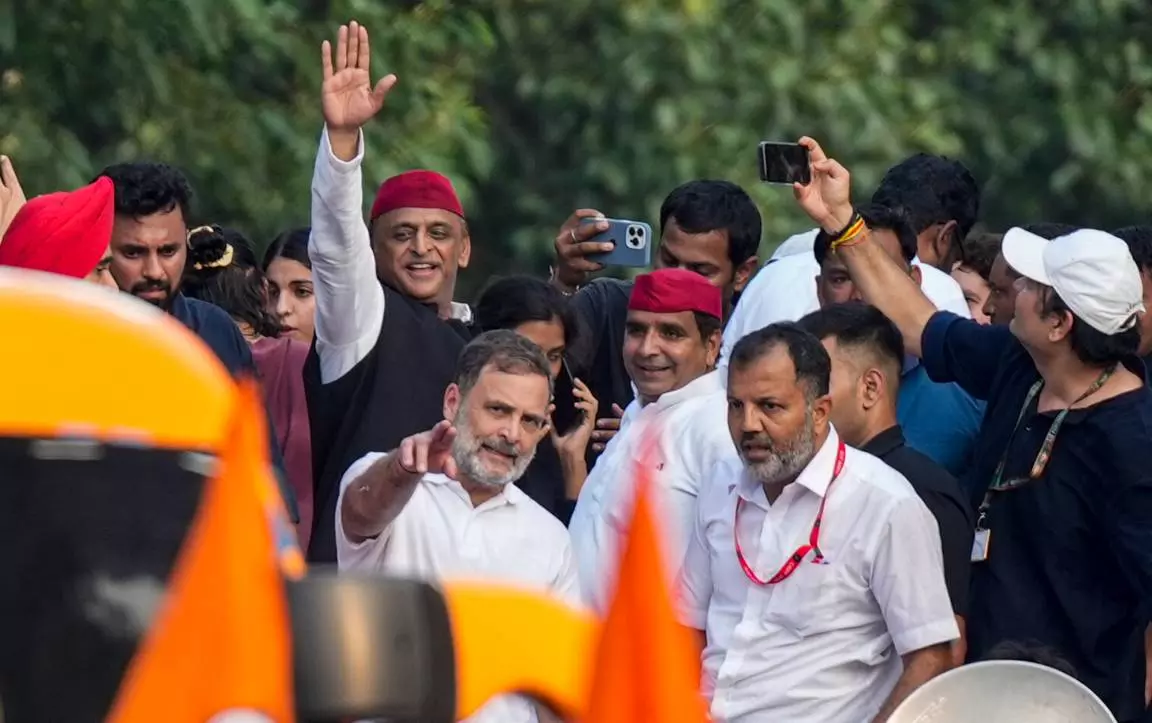
The contrast with Delhi is telling. The national capital has emerged as the principal stage for the anti-SIR agitation, with Congress leader Rahul Gandhi and other INDIA Bloc leaders bringing the issue into the national spotlight. Left-wing and student organisations have helped drive the mobilisation. Even Samajwadi Party (SP) chief Akhilesh Yadav took to the streets in New Delhi, joining the INDIA Bloc’s protest against SIR.
In Uttar Pradesh, however, where the SP is the principal challenger to the ruling BJP, the party has yet to launch the kind of full-scale street mobilisation one might expect with Assembly elections approaching. The BJP, meanwhile, is already working relentlessly to secure a third consecutive term.
Also read: What Rahul Gandhi's SIR petition in SC asks, and why sceptics doubt it
“It seems like SIR is not even an issue for them. Otherwise, we don’t see a reason why the Opposition would not use this golden window to present itself as an alternative to the voters who’d stand up for their rights. What’s the point of getting photos clicked in Delhi but not chalking out any dedicated party action here in their karmabhoomi (workplace),” argued CPI(ML) Liberation's Lucknow district secretary Ramesh Singh Sengar.
Scattered stirs, lack of Opposition unity
This is not to suggest that anger over SIR has gone unanswered. Protests have erupted in pockets across the state. In the first week of October, the SP organised its Loktantra Bachao Saptah (Save Democracy Week) and Vote Bachao, Desh Bachao (Save Your Vote, Save the Country) campaigns. The Congress, meanwhile, observed a “Black Day” over the alleged mistreatment of its senior leaders during a protest in New Delhi.
In Prayagraj and Varanasi, district-level leaders and civil society groups have also taken up the issue.
“We have been protesting against SIR since December last year. Our leader, Akhilesh Yadav ji, is also joining the INDIA Bloc’s protests in Delhi, while we are holding protests and marches across Uttar Pradesh,” SP state spokesperson Abhishek Bajpai told The Federal.
The Congress, too, maintains that it has consistently raised the issue in Uttar Pradesh. These demonstrations, however, have remained scattered and failed to turn into a statewide movement due to a lack of coordination and sustained political push.
Also read: SIR voter deletions: Can INDIA Bloc turn discontent into a movement?
Despite their alliance at the national level, the SP and Congress are yet to take to the streets together with a coordinated strategy to turn SIR into a potent political weapon against the BJP.
‘Opposition happy with tokenism, photo-ops’
Political observers see a deeper contradiction in the Opposition’s approach. They say that while the senior leaders have joined protests in Delhi and raised their voices on national platforms, the same urgency has not translated into a sustained campaign in their own political backyard even as the state edges closer to the polls.
“With the state heading towards a high-stakes election, the Opposition’s response has largely been tokenism and photo-ops rather than the spirited grassroots mobilisation that the issue demands,” asserted Lucknow-based firebrand veteran Narmada Bachao Andolan frontline activist Arundhati Dhuru.
Discontent waiting to be weaponised
In the absence of concerted opposition efforts, civil society and civil rights activists have continued to protest, despite their limited organisational strength and capacity to mobilise people at scale.
Left parties and student unions have tried to replicate Delhi’s agitation in Uttar Pradesh, hoping political leaders would join them. But they lament that their ability to mobilise large crowds has been marred by their threadbare strength and resources in the state.
Also read: 'More than a Gen Z uprising': Why the SIR protests matter beyond age and politics
Sengar argues that the state is teeming with discontent and anxiety over voter disenfranchisement. Yet, in the absence of political will, the anger remains an undercurrent the Opposition has ‘woefully’ failed to tap.
“Delhi’s protest also started like this. Left parties and student unions got the masses on the ground, and then political leaders joined and pumped in their organisational strength. In Uttar Pradesh, the Left has become almost non-existent, especially in central and eastern Uttar Pradesh. Student unions are also too weak to summon youth at scale. Still, we are fighting,” Sengar pointed out.
‘Stronger parties must take the lead’
On Monday, Sengar and a delegation marched in Lucknow and submitted a memorandum to the President of India demanding the resignation of Chief Election Commissioner Gyanesh Kumar and the scrapping of SIR.
Lending weight to Sengar’s argument, national president of Lucknow-based All India People’s Front SR Darapuri lamented about the lack of support from the Opposition parties and forewarned that it may cost them dearly.
“We are too small a party, and yet we are holding protests. Parties like the SP, whose cadre can flood the streets, just don’t seem serious about this grave issue. All that is needed is a strong political will to stitch these sporadic protests into a massive movement. If not now, then when?” Darapuri asked.
Fear of crackdowns
There is another reason Uttar Pradesh’s streets remain quieter than its political temperature might suggest. Nearly a decade of Yogi Adityanath’s government has been marked by a hard line towards dissent, with arrests, property attachments and bulldozer demolitions reinforcing the risks of taking to the streets.
The anti-CAA and NRC protests of December 2019 remain the most consequential example. Uttar Pradesh witnessed one of the country’s harshest crackdowns. The state government reported 22 deaths during the protests, while hundreds were arrested and thousands placed under preventive detention. Authorities also initiated recovery proceedings against people accused of damaging public property.
Watch | SC’s SIR scrutiny: 'Strong court can make big difference'
In Lucknow, 28 people were ordered to pay more than Rs 64 lakh in compensation for alleged damage. The administration displayed the names, photographs and addresses of those accused, a move the Allahabad High Court subsequently held violated their privacy rights.
“The consequences extended beyond those directly implicated in the protests. For many ordinary citizens, the episode offered a stark warning about the personal and financial risks of taking to the streets,” Darapuri observed.
“Besides, the government here resorts to house arrest, which is illegal. We have written to the governor complaining about it and how it practically makes dissent impossible, but to no avail,” he added.
Why Opposition unity can strengthen protests
Some civil society groups are consequently keeping their work deliberately low-profile. Activists say they are working on the ground, documenting cases of alleged voter deletions and helping people get their names back on the rolls. Much of this work, however, is being done quietly, away from the public eye, for fear of drawing the administration’s attention and inviting a crackdown.
“We have resorted to door-to-door campaigns and fact-finding missions. We are recording the impact of SIR and will then take it up at scale. But we are deliberately avoiding the spotlight right now. Otherwise, all this could be stopped through the kind of crackdowns the state has seen over the past 10 years,” noted Lucknow-based civil rights activist Deepak Kabir.
Also read: Foreign hand in anti-SIR protests? Prove it, or drop it, Mr Nabin
This climate of fear, political activists underscore, can only be transcended when the Opposition puts up a united front and lends its organisational might. If dissent carries such risks, opposition parties must do more to protect complainants, build local networks and sustain mobilisation beyond sporadic demonstrations, they contest.
“Uttar Pradesh is not short of potential flashpoints. What it lacks, for now, is a political force capable of bringing them together. Without that convergence, the state’s simmering discontent may remain a collection of fragmented mutinies rather than the mass movement the opposition hopes to harness,” Sengar maintained.