The Opposition's action plan comes after months of delay as concerns grow over the impact of electoral roll revisions on voters
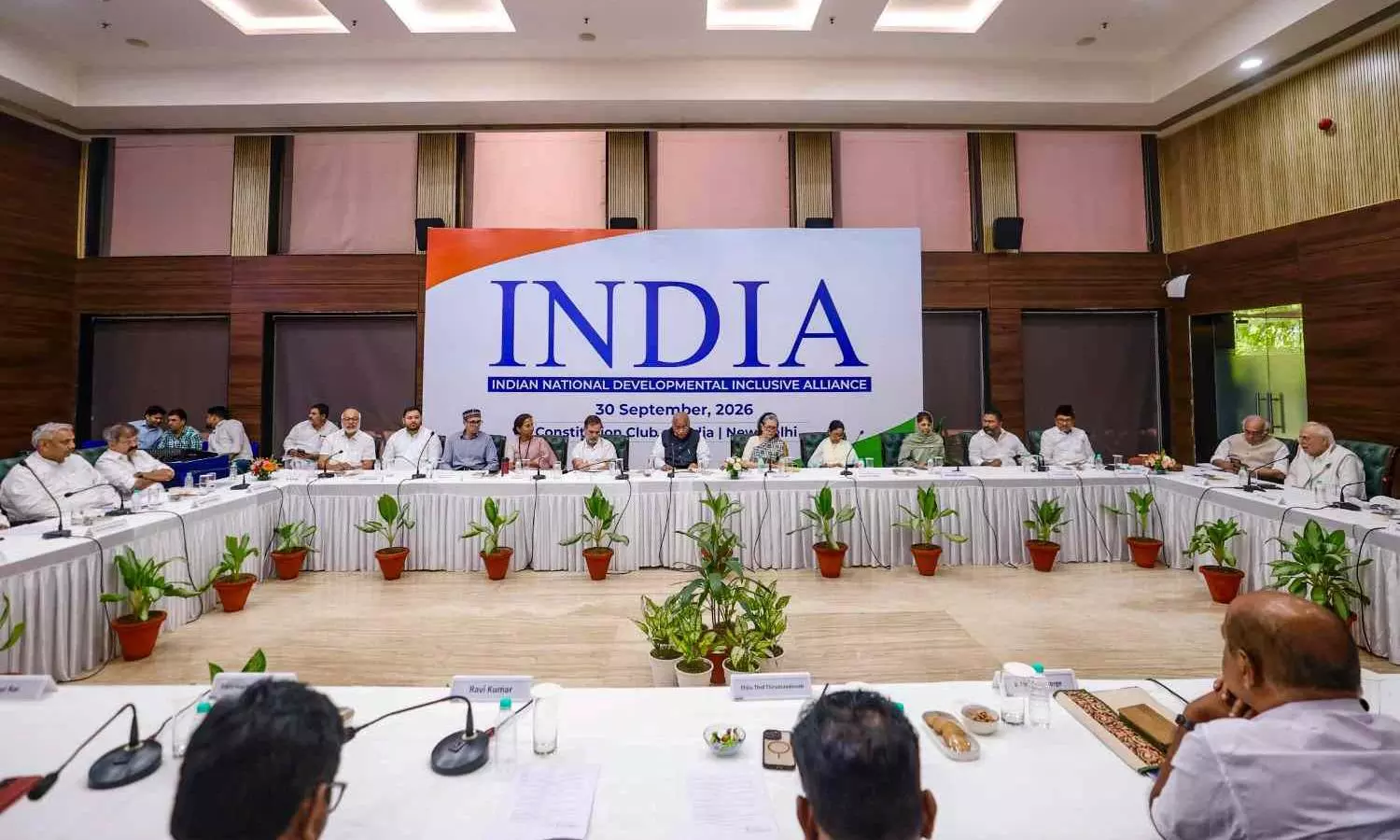
Better late than never, the plan of action unanimously adopted by the somewhat shrunken INDIA Bloc at a meeting of 19 regional and national parties, with a deadline for the first phase of agitation to “Save Democracy” from what they describe as the destruction wrought by the Election Commission and its chief, Gyanesh Kumar, through the Special Intensive Revision (SIR) of electoral rolls, is sensible because it is focused.
Also read | Why EC's reconciliation statement reads more like a confession
The excesses of the SIR process are a gift that the Election Commission has handed to the incoherent and indecisive Opposition. The delay in responding until the total number of deletions through the SIR process exceeded 13 crore voters reflects poorly on the INDIA Bloc leadership, specifically the Congress, as the most experienced and oldest political party on the one hand, and the regional parties that witnessed what was going on, albeit separately, in the states and did not raise the alarm loudly or urgently enough, on the other.
The data driving deletions
It would have been a political blunder if the collective INDIA Bloc had charged down the rabbit hole of demanding either the resignation or impeachment of Gyanesh Kumar, or trying to nail his depredations on India’s voters. That rabbit hole was designed to divert attention from the ravages of the SIR process, which not only threatens to disenfranchise over 13 crore voters but has also successfully destabilised the 97.97 crore voters who were on the electoral rolls for the 2024 Lok Sabha election.
The plan creates both expectations and momentum, making up for what it lacks as a bunker-buster bomb that could potentially destabilise its principal enemy and, therefore, target the ruling BJP-led National Democratic Alliance (NDA), specifically Prime Minister Narendra Modi. The unanimous conclusion of the INDIA Bloc is that Chief Election Commissioner Gyanesh Kumar and the triumvirate of the ECI, sharing collective responsibility, were in fact puppets controlled by those who appointed them.
The machine-generated deletions based on dirty data that produced “logical discrepancies”, through software that also blocked the authority of human intervention to make corrections, namely the Electoral Registration Officers, are one of the elephants in the SIR room that had not been clearly identified by the political Opposition till now. By naming it, the INDIA bloc has challenged the SIR process in a way that uncovers the magnitude of the problem that machine-generated data created for crores of voters.
The human cost of SIR
Since machines and software need to be operationalised by humans taking decisions, the totality of the Election Commission’s inefficiencies is exposed on the one hand and the consequences for voters, on the other. It drove the 97.97 crore voters who exercised their franchise to scramble to prove their eligibility to make choices and decisions on who will represent them.
Also read | How 'combative' INDIA bloc plans to turn EC row into a mass movement
Never before have voters been asked to prove their citizenship with documents that the Election Commission has randomly disregarded on the grounds that they are suspect, from passports and Aadhaar cards to Voter Electronic Photo Identity Cards, ration cards, job cards, property documents, birth certificates, marriage certificates and more. It was as though the triumvirate of Election Commissioners and their minions did not know the realities of India, where documentation is lousy and proof of identity based on such documentation is missing.
Never before have voters been asked to prove their citizenship with documents that the Election Commission has randomly disregarded on the grounds that they are suspect.
The SIR as a mechanism has multigenerational consequences. A voter whose parents were not listed in 2002 can be stripped of the right to vote. If a voter is disenfranchised now, the next generation would also be disenfranchised by becoming “unmapped” if the system established by SIR persists. Not being SIR-verified in states like West Bengal has meant that lakhs of beneficiaries under government social welfare schemes are being denied access, adversely affecting their financial condition.
SIR’s purpose under scrutiny
If the Election Commission had been more aware of the pitfalls of its decisions and wary of the consequences, then probably 13 crore-plus voters would not be threatened with disenfranchisement. It is, therefore, entirely legitimate to question the purpose, the intention and the mechanism that was used for the SIR process. It is another matter that deletions clearly targeted women and Muslim voters, not just in West Bengal, where data was painstakingly ploughed and sifted to reveal shocking numbers of deletions in Muslim-majority districts and specific constituencies, but also in New Delhi, where in the Jhuggi Jhopri (JJ) colony in Bela Estate within the Chandni Chowk constituency, 727 voters out of 728 were deleted from the electoral rolls.
The political battle led by the INDIA bloc is a start on consolidating the discontent that had simmered before the 2024 Lok Sabha elections, in which the BJP failed to win a majority.
The purpose, intention and mechanism of the SIR process were clearly articulated and defended by India’s Home Minister Amit Shah on December 10, 2025, on the floor of Parliament. He said it was to DETECT, DELETE and DEPORT ineligible voters. By adding DEPORT to the process of detecting and deleting ineligible voters, it turned the SIR exercise into a drill to uncover non-citizens, which in the prevailing political narrative is the same as “ghuspaithiyas” or illegal immigrants masquerading as legitimate citizens with documents forged or faked with support from the political Opposition eager to add to vote banks.
A broader battle over SIR
Non-citizens were also persons that the BJP, as a matter of policy, had identified as eligible to acquire citizenship if they were Hindus fleeing religious persecution from the South Asian neighbourhood. Clearly, the SIR process and the applications for enrolment under the Citizenship Amendment Act did not dovetail as smoothly as they ought to have. The consequence is that thousands of Hindu Bengalis, be they Matuas, a Scheduled Caste sect, Rajbangshis, or people who had functioned as the BJP’s vote bank in earlier elections in West Bengal, found themselves scratched off the electoral rolls and vulnerable to deportation.
Also read | ECI’s internal dissent: What does the law say, and what happens next? | Capital Beat
The political battle led by the INDIA Bloc, limited as it is now to mass mobilisation against the ruling ecosystem, rather than just the BJP or even Modi, is a start on consolidating the build-up of discontent that had simmered before the 2024 Lok Sabha elections, in which the BJP failed to win a majority in the Lok Sabha. The action plan, if it works, and if the bloc, as usual, does not fritter away its unity or its purpose, will succeed in ploughing up the ground.
An issue that has affected 97.97 crore voters and made them feel vulnerable or harassed is a windfall; it has affected both the political top brass and the “JJ Colony” residents, uniting them through a common grievance and making it easier for the political Opposition to mobilise the seething discontent.
(The Federal seeks to present views and opinions from all sides of the spectrum. The information, ideas or opinions in the articles are of the author and do not necessarily reflect the views of The Federal.)