What Rahul Gandhi's SIR petition in SC asks, and why sceptics doubt it
The Chief Justice promised an early hearing. The harder question is what it can deliver.

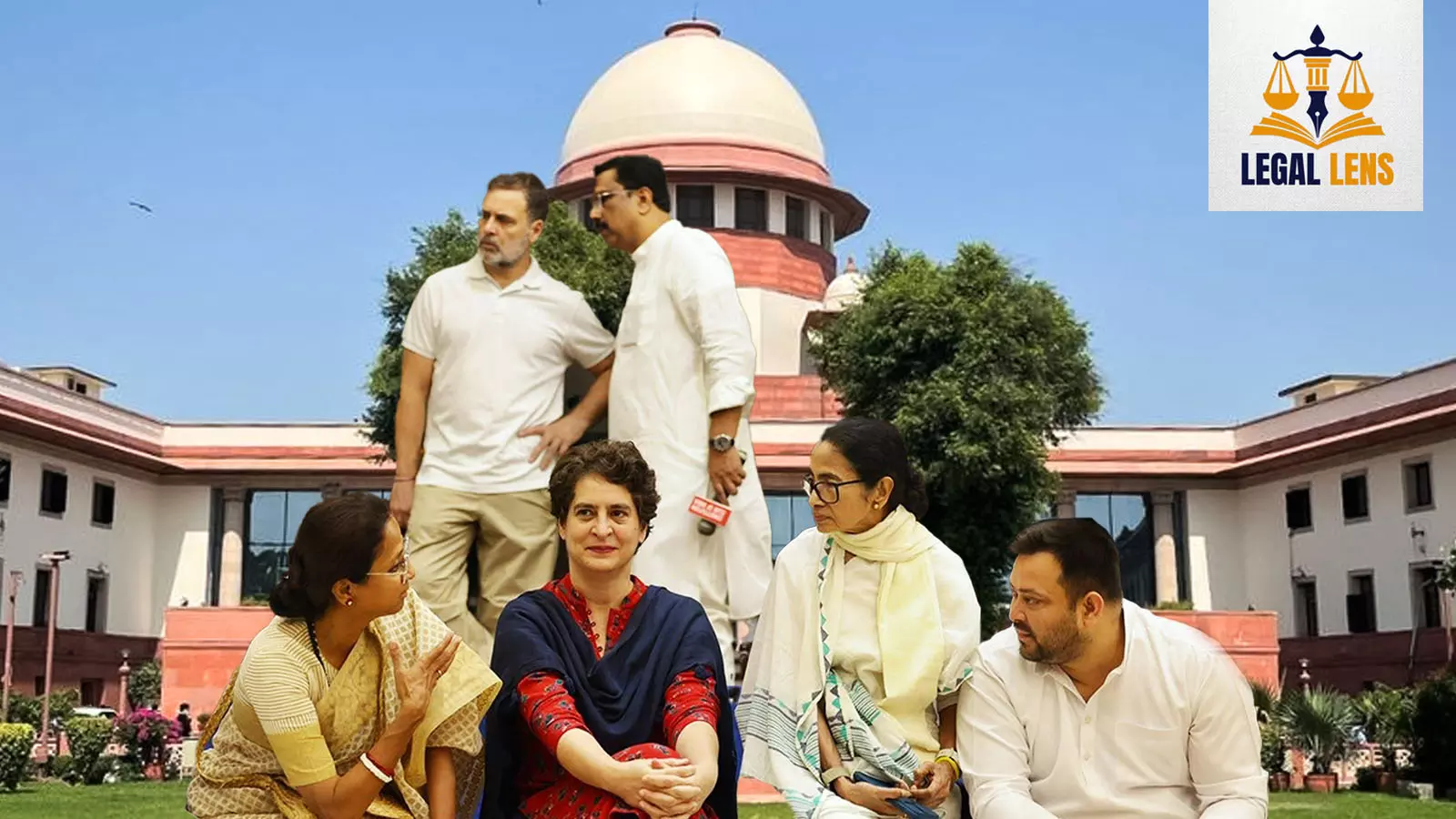
The INDIA bloc has turned to the Supreme Court over alleged irregularities in voter-roll revision, but the court has already upheld the SIR and is examining related petitions.
The Leader of the Opposition in the Lok Sabha, Rahul Gandhi, and ten other INDIA bloc leaders moved the Supreme Court on October 12. Their petition is directed against the Election Commission of India. It follows the course that Chief Justice of India (CJI) Surya Kant advised a day earlier. In a letter declining to meet Rahul Gandhi and Congress president Mallikarjun Kharge, he had asked them to seek a judicial remedy instead. Whether that course can deliver what the Opposition wants is far from certain.
The case is registered as Rahul Gandhi v Election Commission of India. The petitioners are Rahul Gandhi, Mallikarjun Kharge, Saugata Roy, Akhilesh Yadav, Tejashwi Prasad Yadav, Sanjay Raut, M A Baby, D Raja, Mahua Majhi, Supriya Sule and E T Mohammed Basheer. The respondents are the Commission, Chief Election Commissioner Gyanesh Kumar, and Election Commissioners Sukhbir Singh Sandhu and Vivek Joshi.
What the petition seeks
The central charge is that the Chief Election Commissioner alone exercised the Commission's collective powers during the Special Intensive Revision (SIR) of electoral rolls. It relies on an investigation published by The Indian Express on September 23. That report said the two Election Commissioners had recorded objections on at least 14 occasions over ten months.
Also read: SIR, CEC row: Rahul, other Opposition leaders file petition in SC
The petition's synopsis records the Commission's answer as well. The Commission has said the reports present only one part of the picture and that its decisions were unanimous. The petition says it does not seek to prejudge these positions and that only the Commission's records can settle them.
The legal foundation is Article 324 of the Constitution, which vests the superintendence of elections in the Commission. In T N Seshan v Union of India (1995), a Constitution Bench held that the Chief Election Commissioner enjoys no superior status over the other commissioners. Section 18 of the 2023 law on election commissioners gives that principle statutory form. It requires the Commission's business to be transacted unanimously as far as possible, and otherwise by majority.
Initiation of SIR
A second charge concerns the origin of the nationwide SIR. The synopsis cites a Right to Information application of July 28, 2025, seeking the files on which the exercise was decided. The Commission's information officer supplied only the published order of June 24, 2025. The appellate authority then recorded that the Commission had, until then, taken no decision to initiate a nationwide SIR in 2025.
The petition calls this irreconcilable with the June 24 order itself, and with a press note of September 26 this year claiming unanimous approval. It therefore asks for the complete file recording that decision, "if such a file exists".
Question over the revision exercise
Three further grievances follow from the way the revision was carried out. The online Form 6, used for new registrations, was modified in July without amending the Registration of Electors Rules, 1960. The Commission's ECINET and ERONET databases, the petition says, have had no independent audit. Eligible voters reportedly could not be restored because the software lacked a rollback facility. Deletions, it adds, have taken place without the notice and hearing required by Lal Babu Hussein v Electoral Registration Officer, a 1995 ruling.
Also read: EC dissent | Kapil Sibal on what SC must do: ‘Hope those shoulders are broad enough…’
On scale, the synopsis refers to a pending petition alleging that about 13 crore names were removed across the country. It also records the Commission's reply that the figure covers electors marked absent, shifted, dead or duplicate at the draft stage. On the Commission's account, the figure does not represent final deletions.
What it asks the Court to do
The prayers fall into four groups, of which the first seeks disclosure. The Commission should place on record the files, agendas, minutes, notings and objections on each disputed decision. It should also produce the database access logs and the file on the June 24, 2025 decision.
The second group seeks scrutiny and consequences. The Court should examine whether the disputed decisions complied with Article 324, Section 18 and T N Seshan, and quash any taken without lawful authority. Action should follow against those responsible, including under Section 32 of the Representation of the People Act, 1950. That section punishes breach of official duty in preparing rolls.
The third group seeks safeguards, beginning with a direction that every future SIR decision be taken and minuted under Section 18. The online Form 6 should conform to the Rules, and the names of deleted electors should be published booth-wise with reasons. A working mechanism should restore eligible electors, and no elector should be deleted without notice and hearing.
The fourth group is institutional, seeking a committee headed by a retired Supreme Court judge and assisted by technical experts. The committee would audit the deletions and the databases, and review the protocols and technical design of electronic voting machines. As interim relief, the petition seeks suspension of the SIR across all States.
What the petition leaves out is as instructive. The memorandum that the bloc gave President Droupadi Murmu on October 9 carried four demands. They were the Chief Election Commissioner's resignation, a rollback of the SIR, a return to paper ballots, and the reversal of recent Assembly elections. None of these appears among the prayers, although the interim prayer does seek to suspend the revision.
Why sceptics doubt the outcome
The first difficulty is the Court's own judgment. On May 27, a bench led by the CJI upheld the SIR in Association for Democratic Reforms v Election Commission of India. The petition acknowledges this and says it "does not seek to reopen the question of the validity of the SIR as such". Its concern, it says, is whether the safeguards the Court recognised were followed.
That disclaimer sits uneasily with the interim prayer to suspend the SIR in every State. A bench that found the exercise valid may hesitate to halt it on allegations about how it was conducted. On October 5, a bench led by the CJI declined to suspend the Chief Election Commissioner in a connected case. "Who will conduct the elections?" it asked.
Also read: SC questions Form 6 revision, orders EC to produce records on CEC’s decisions
The second difficulty is overlap, because on October 5 the Court issued notice in two earlier petitions founded on the same newspaper investigation. The CJI said then that if the law on collective decisions had been violated, "we will undo" it. The Opposition's petition may therefore add political weight and a wider set of prayers to questions the Court is already examining.
The third difficulty is time, which the petition itself illustrates by pleading urgency over Punjab, where the final roll was due on October 12. That roll was published the same day, with 2.01 crore electors, 13.60 lakh fewer than before the revision. The ground of urgency was thus overtaken on the day the petition was filed.
Bihar offers the nearest precedent, since the challenge there was filed in July 2025 and the State voted that November with the case pending. Judgment came in May 2026, six months after the election. A committee of the kind now sought, with an audit of databases across States, could take as long.
The fourth difficulty concerns voting machines, on which the Court ruled in April 2024. It then rejected pleas for a return to paper ballots and for full verification of paper trail slips. A fresh review of machine protocols by a court-appointed committee would require the Court to revisit ground it has treated as settled.
The street and the court
These doubts point to a larger choice of forum. On one argument, a Court that upheld the Commission's powers in a long judgment is poorly placed to cure disenfranchisement. Sustained and peaceful protest, on this argument, is the surer way to press the Commission to stop the SIR.
If the Court calls for the Commission's files and minutes, the record will show whether the disputed decisions were collective. The bench has already said what would follow if they were not. Justice Joymalya Bagchi remarked on October 5 that the Court would injunct such decisions as beyond the Commission's powers.
Disclosure of that kind would matter outside the courtroom as well. It could confirm the Opposition's charge or the Commission's denial, and either result would shape the argument on the street.
The immediate legal importance of the case lies in its demands for verifiable records. The Commission may be able to demonstrate that its decisions were collective and its safeguards effective; the records may instead disclose departures requiring correction. The scope of any judicial remedy will depend on that examination, and on the difference between proving a procedural violation and establishing grounds to halt the revision throughout India.