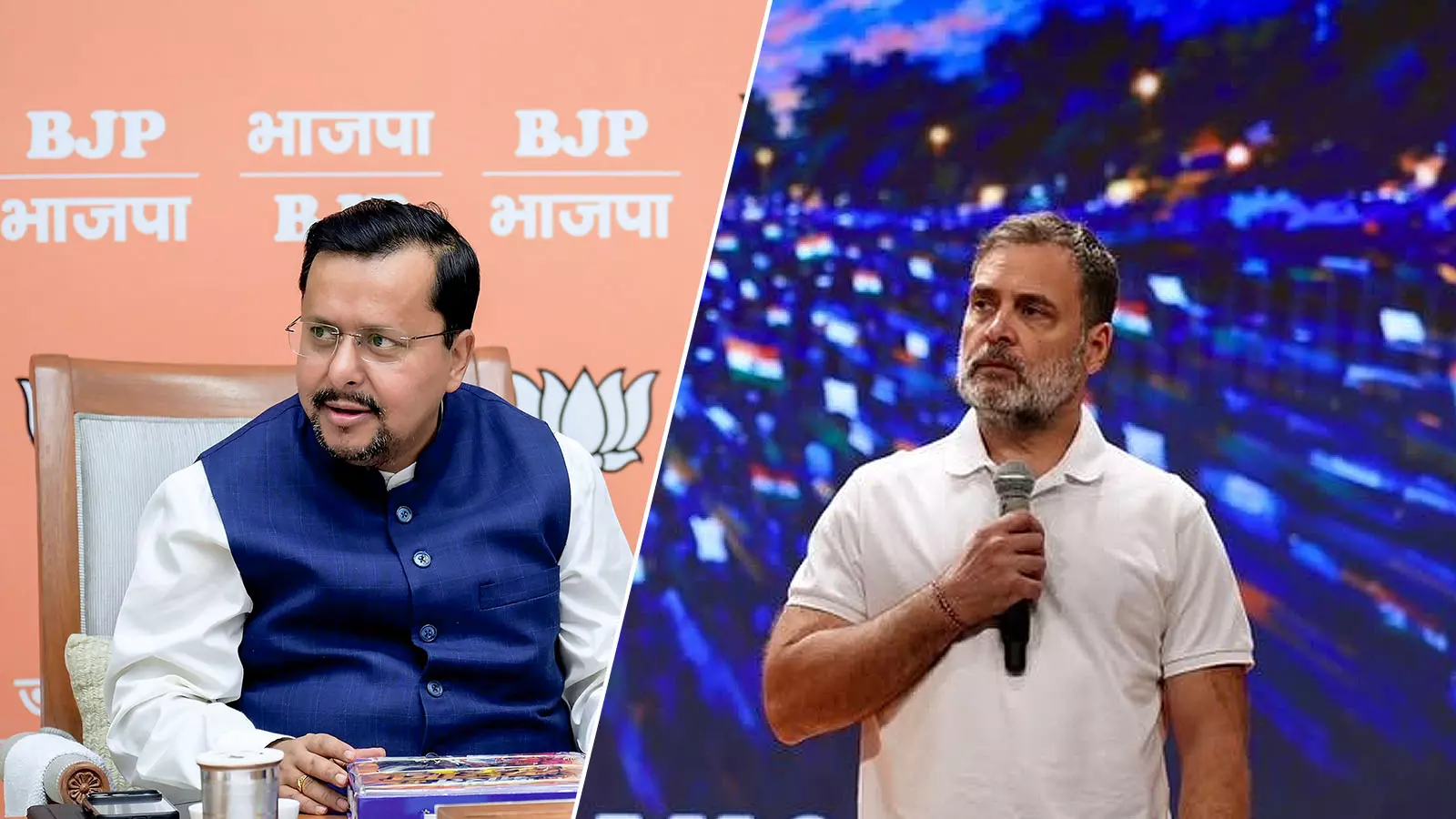
Accusing Opposition of acting at behest of unnamed 'powers' is a serious charge of treachery; BJP president must back it with solid evidence or concede it's jumla
The BJP on October 10 released the “Salient Points of Bharatiya Janata Party National President Shri Nitin Nabin’s Media Byte”.
One of the points: “Frustrated by being repeatedly rejected by the public in our democracy, the Opposition is now hatching a deep conspiracy to spread instability and anarchy in Bharat at the behest of foreign powers."
The words used in this charge against the Opposition make it very serious, especially because they have been used by the president of the ruling party. If the Opposition is acting at the “behest” of foreign powers, they are guilty of traitorous conduct towards the nation.
The choice of the word “behest” is significant. The word behest connotes that the Opposition is acting under the orders, command or direction of unnamed other states.
Also read: ‘Italian National Congress’: BJP backs Nitin Nabin’s ‘foreign mindset’ jibe at Congress
Taken in the context in which it has been used, it means that the Opposition is not acting autonomously. The use of the plural — “powers” — fortifies the view that, according to Nabin, there is not one, but at least two, if not more, foreign powers commanding, ordering or directing the opposition’s policies and actions in its protests against the Special Intensive Revision (SIR).
States or entities
It is noteworthy that Nabin has not just claimed that the Opposition is acting at the behest of random foreign individuals or groups or entities, but of “powers”. This connotes that they are either acting on the orders of foreign states or of entities or groups controlled by these states.
Nitin Nabin needs to be examined because he should have the evidence to show who these foreign powers are.
The BJP president’s charge demands that the relevant security agencies should investigate the Opposition as well as Nabin to identify the foreign powers who are interfering in India’s internal affairs either through their official agencies or elements controlled by them.
Nabin needs to be examined because he should have the evidence to show who these foreign powers are. He has not named them publicly, but in view of the seriousness of his charge and the important position he holds in India’s public life, he should be willing to identify them to the investigation agencies. If Nabin is unwilling to do so, then his charge would be exposed as just a political jumla.
Cold War interference
Throughout the period of the Cold War, the US’ Central Intelligence Agency (CIA) was active in India, as was its Soviet counterpart, KGB. There is authoritative literature based on declassified US records that indicates that the CIA was involved in seeking to influence politicians, academia and the media. Its Soviet counterpart was doing the same.
There were occasions when the CIA’s interference figured in Parliament. In the wake of an expose in 1967 in a US magazine of CIA’s activities worldwide, including in India there was an uproar in Parliament.
Also read: BJP, Congress clash over Sonia Gandhi’s alleged Vande Mataram objection
In his scholarly paper “Quiet Americans in India: The Politics of Intelligence in Cold War South Asia” which is based on declassified US official documents Paul M McGarr notes, “On 23 March, [1967] India’s Foreign Minister, MC Chagla, bowed to mounting pressure for government action and announced that a ‘thorough’ official inquiry would be conducted to ascertain whether the CIA had interfered in Indian politics.
Nabin’s accusation draws in unspecified countries. That has not happened at such senior political levels for many years, and cannot be ignored.
“We cannot permit foreigners or foreign governments to dictate to us what sort of a government we should have or what sort of people should be elected,” Chagla asserted. "We will unearth any activity that is objectionable, that is against the national interests.” He goes on to record, “...the results of the enquiry into CIA ‘interference’ in India’s general election, which MC Chagla had promised the country’s exercised parliamentarians, became available in June. In the report delivered to Chagla by the IB, both the CIA and the KGB were implicated in funding the election campaigns of their preferred candidates.”
A changed India
Much has changed in India since the end of the Cold War. India has progressed much, and it is now the world’s fifth-largest economy. The self-confidence of its political classes has risen greatly.
Political parties cannot now risk getting funding from foreign sources. It would immensely damage their political future. However, all countries play the game of nations, which not only involves espionage but also building influence in different sections of an important country’s society and polity.
Also read: ‘Swatantra Bhardwaj is the hammer, the hand wielding it is RSS-BJP’ | Capital Beat
Indeed, this ruthless game also involves seeking to influence elections in other states despite the obligation of all states not to interfere in the internal affairs of other countries. In this context, the accusation made by the Democratic Party of the US of Russian interference in the 2016 US Presidential elections to damage the prospects of its nominee Hillary Clinton is a significant manifestation that even the world's most powerful state can be targeted.
The Soros 'hand'
India’s ruling dispensations have periodically made claims of ‘foreign hands’ interfering in India. However, these are now few and far between.
The BJP has, on several occasions, accused the Congress of complicity with the US entrepreneur George Soros. The Congress has naturally denied these charges.
What is new in Nabin’s accusation is that unspecified countries have been drawn in. That has not happened at such senior political levels for many years. That is why it cannot be ignored.
Besides, the accusation is not that foreign countries are seeking to influence India's internal processes but that the Opposition has been under their direction.
Evidence and accountability
Such unspecified charges can lead to grave apprehensions in the public mind about the autonomy of the Indian political system. This should not be allowed to persist. This is particularly because India is undergoing a period of great ideological and political contestation when the old norms seem no longer relevant.
Hence, it would be good if accusations are made, they should be backed by evidence and thereafter taken to their logical conclusion. Certainly, there is no place for jumlas. This applies to all sections of the political class.
All of them must act with a great sense of responsibility because the external environment has also become very challenging.
(The Federal seeks to present views and opinions from all sides of the spectrum. The information, ideas or opinions in the articles are of the author and do not necessarily reflect the views of The Federal.)