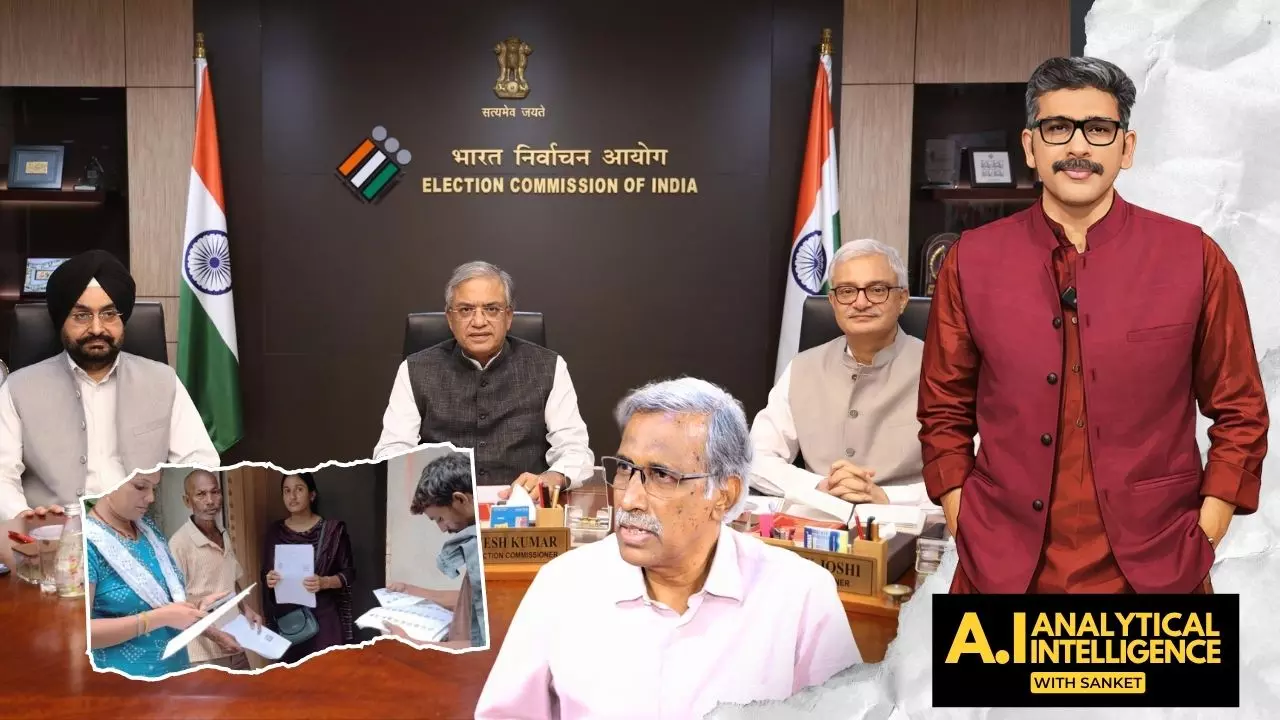
"The objective of Form 6 is very simple, in just four words: inclusion of new voters."
SIR explained: From voter deletions to Form 6, what has changed?
The Federal's Editor-in-Chief S Srinivasan explains changes to Forms 6, 7 and 8, document requirements, unresolved questions over voters excluded in Bihar, Bengal

The Election Commission’s changes to Forms 6, 7 and 8 for the ongoing and future Special Intensive Revision (SIR) exercises have raised questions about voter inclusion, deletion and the remedies available to those excluded in earlier revisions. The Indian Express has reported that Election Commissioners Sukhbir Singh Sandhu and Vivek Joshi recorded objections to several decisions concerning SIR, including changes to Form 6 and voter deletions.
“None of these changes are being introduced retrospectively for where something wrong has already happened — that is Bihar and more recently Bengal,” says S Srinivasan, Editor-in-Chief of The Federal. In this interview, Srinivasan discusses the EC’s explanations, the changes to the forms and the unresolved questions surrounding the SIR process.
Edited excerpts:
How do you see the SIR exercise from the perspective of citizens and their fundamental rights?
It affects all of us because this is an exercise being carried out on a large scale, and all citizens are affected by it.
Now, let’s go through the basic hurdles which we have to pass. In the past, when such SIRs were conducted, many people didn’t even know that an SIR had passed their way. It was so simple and perhaps so devoid of cumbersome procedures.
Also read | EC’s SIR relief bypasses 22 lakh Bengal voters trapped in tribunal backlog
Possibly, it happened because the onus of getting the electoral roll amended was more with the ECI and less with the people. The mandate of the ECI was that no citizen is left behind. That was the slogan, and it was therefore the ECI which went door to door. In fact, one Election Commissioner even said that they used to go under the bridges to find out if any citizen was left out.
From there, the onus is now shifted to each voter, and that’s the essential difference.
We should look at the changes that have happened after the September 26 press note. If you go through the forms one by one, there are basically three forms — Form 6, Form 7 and Form 8. I think we can carry on the discussion from there.
What is the issue with Form 6 and the way it has been changed for SIR?
Form 6 is for first-time voters, the Gen Z voter. The tweak or change introduced was objected to by the other two Election Commissioners, who said it was not in accordance with the law.
The objective of Form 6 is very simple, in just four words: inclusion of new voters. That’s all. So, how do you include a new voter?
Form 6 can be amended. It is not as if it cannot be, but it should go through the government. It is the prerogative of the government to change Form 6. It does not need to go to Parliament; an executive decision on this is valid. But the objection was that even that was not done in this case and therefore one of the Election Commissioners, I think Mr Sandhu, termed it illegal.
The Election Commission, in its September 26, 2026 press note, said Form 6 for SIR had been upheld by the Supreme Court. But the Live Law report says something else.
Now, what does Form 6 contain? The new Form 6 has three declarations. The first asks whether any parent was enrolled in the previous SIR, in 2002. If not, the next asks whether any grandparent was enrolled. The third asks you to fill in the other details.
For a Gen Z or a new voter, the real question is: If my parents' names were not in the previous SIR, what do I do? That was a big question and a doubt that was also raised.
The previous Form 6, issued for the Bihar elections, was essentially a declaration that I am above 18, an ordinary resident at the address given and a citizen of India. It then sought details of date and place of birth, depending on when and where the person was born, including whether the person was born in India before July 1, 1987, between July 1, 1987 and December 2, 2004, or after December 2, 2004. For those born outside India, it sought proof of birth registration issued by an Indian mission abroad or details of citizenship acquired by registration, naturalisation and so on.
What are the questions surrounding Form 7 and voter deletions?
Form 7 basically says objection to inclusion or deletion of an existing voter. This right is given to a person. If there are any objections to someone who is already included in the voter list, or if his or her name has to be deleted, somebody can fill Form 7.
In this case, Form 7 raises a big question. If you see the mass deletions that have happened in West Bengal, one of the points the Indian Express story highlighted was: who ordered these deletions? Perhaps the order also came from the EC.
In the Indian Express report, the two Election Commissioners said in a note that the court-appointed tribunal had actually said that 16.10 lakh voters and their names must be put back into the voter list.
Also read | Kharge demands CEC Gyanesh Kumar’s removal over SIR, seeks PM Modi’s resignation
Somebody, in a representation from the Election Commission, said that the EC had appealed against this decision to put the names back on the roll. To which the two Election Commissioners said: Who has ordered this? We haven’t.
So that’s a question which still remains unanswered.
What does Form 8 change for voters who need to correct their details?
Form 8 is for correcting an existing voter entry. This is where it gets even more interesting.
Suppose the name is misspelt, or there is a logical discrepancy between the previous SIR, that is 2002, and the current one. This can be a nightmare because names are written differently across various documents. Passports, PAN cards and other documents can follow different naming protocols, while some states use abbreviations for parents’ names.
There are a number of questions on which various documents in India need to be sorted out. Form 8 offers that opportunity for correction of an existing voter-list entry.
What happens to voters already excluded in Bihar and West Bengal, where the rolls have been finalised?
The all-important question is one which only the court can direct now because, constitutionally, your voter lists for Bihar and Bengal are out, right? And elections have been held.
So, in that case, to reverse the voter lists and take them back is not a constitutionally valid decision, at least for these institutions to take.
What should happen in the case of those who have been excluded in the past? It’s just a principle of natural justice. This is an answer one can expect only and only from the court. And it will be interesting to see what the courts direct the Election Commission when this matter comes up for hearing.
What is the larger picture emerging from the SIR exercises in Bihar, West Bengal and Delhi?
Overall, if we look at the whole picture, Bihar SIR happened and there was a lot of confusion over the documents. Eleven documents were allowed and then, after a court hearing, Aadhaar was added because the penetration of other documents, especially something like a passport, is very, very low. That was a trouble which most voters in Bihar went through.
Then you had West Bengal, where you saw the element or the new term “logical discrepancy” coming in and knocking out a lot of people. And then there is a tribunal which, according to some estimates, may take 12 years for the whole process to complete. So that's another big area: how are they going to deal with it?
After that, you have seen what has happened in Delhi. If you look at the progression from Bihar to Bengal, the process of electoral inclusion was being made step by step tougher. By the time it came to Delhi, it had become tougher.
That was happening in Delhi also for all the colonies that were demolished. The EROs suggested that if your name had been deleted because your address no longer existed, because your building had been demolished, you apply as a fresh voter.
Also read | Maharashtra CEO seeks four ECINet changes during SIR notice phase, writes to poll body
And that is the confusion. If I am already a voter and I have been deleted, essentially, and my identity removed, you are asking me to lie on oath that I am a first-time voter, whereas clearly these people are not. Form 6 is for new voters, for inclusion of new voters. So, they will have to fill that form to get back into the electoral list. That's what has happened.
They will have to go through this process again because perhaps something which is may be a glitch — it simply doesn't have the provision. The software perhaps doesn't have the provision. I think that is another issue which will keep coming.
But this Express report and, following that, the EC’s own examination of the whole process has brought some relief. At least that process is now halted or held back, where joining an electoral roll or being part of the voter list was getting tougher and tougher with each measure.
I think that has now got a halt. That’s a big development.