Why Article 17 matters in the Sabarimala reference
Legal Lens | The framers of the Constitution refused to define untouchability. The Kerala shrine case tests how far that Constitutional silence travels

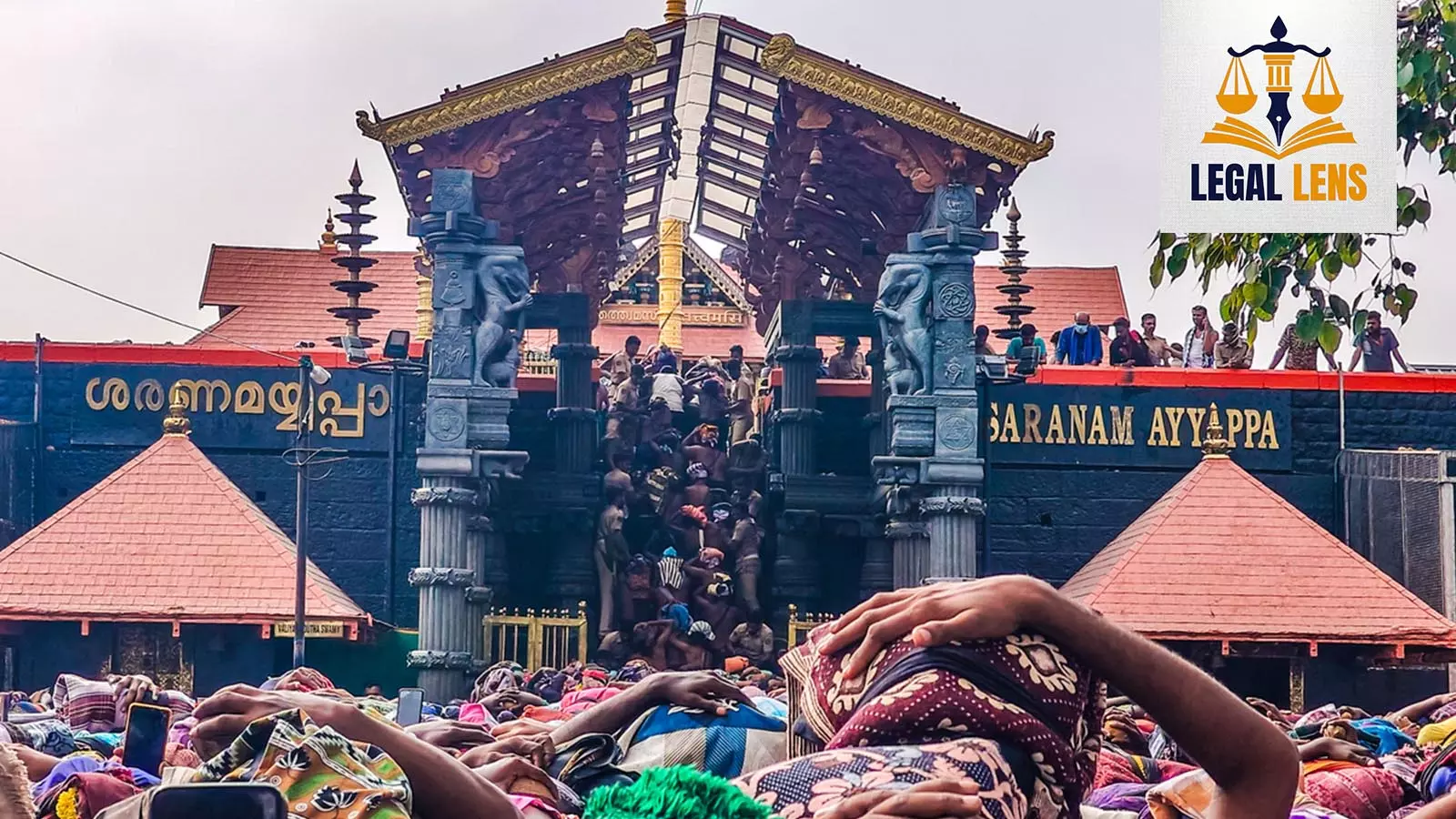
A nine-judge panel of the Supreme Court has initiated the concluding hearing on petitions concerning discrimination against women at places of worship, including Kerala's Sabarimala Temple. Photo: iStock
Article 17 of the Indian Constitution sits in two short sentences. It abolishes “untouchability”. It forbids the practice in any form. It then makes the enforcement of any disability arising out of untouchability an offence punishable in accordance with law.
The word untouchability appears in inverted commas, untranslated and undefined. The omission was the central design choice of the Article. And it is the choice on which the present Sabarimala reference will turn.
Also read: Telangana Speaker’s actions test anti-defection law’s evidentiary limits
Justice B V Nagarathna intervened during the arguments on Tuesday (April 7), when the nine-judge bench of the Supreme Court began hearing the long-pending reference. There could not, she said, as a woman, be a three-day untouchability every month that vanished on the fourth day. The remark was made in response to the Solicitor General Tushar Mehta’s objection to the reliance on Article 17 by those opposed to the bar on the entry of women of menstruating age to the shrine in Kerala.
History of Article 17
Draft Article 11, as the provision was then numbered, came up for consideration on November 29, 1948, before the Constituent Assembly. Several members of the assembly asked for a definition. Naziruddin Ahmad moved an amendment to substitute the clause with one limiting the prohibition to discrimination on account of religion or caste. His objection was lawyerly.
An undefined term, he warned, was open to misinterpretation. Professor K T Shah agreed that the silence would breed future uncertainty and proposed a different word in its place. The Drafting Committee turned both proposals down. The word entered the Constitution unaltered. The inverted commas remained.
The reason for the silence was a positive constitutional strategy. Untouchability, in the framers’ view, was not a single practice that could be captured by enumeration. It was a family of social disabilities held together by an underlying logic of purity and pollution.
Also read: FCRA amendment gives Centre sweeping powers over NGOs, with no oversight built in
To list its instances was to invite arguments about whether new instances qualified. To define it by reference to caste alone would surrender the new provision’s moral reach.
The Government of India Act 1935 had taken that path with its enumerated list of “untouchables”. The framers of the Constitution chose otherwise. They left the word open and trusted the courts to read it in the light of its purpose.
The first court to take up the invitation read it cautiously. In Devarajiah v. B. Padmanna case (1957), the Mysore High Court considered the Untouchability (Offences) Act 1955. The case concerned a Jain pamphleteer accused of inciting religious exclusion. The court declined to apply the Act to that situation. Its reasoning, however, is more nuanced than its later citations suggest.
The judgment noted that the word in Article 17 is enclosed in inverted commas. That, it said, signalled the framers had in mind the practice as it had developed historically in India. It added that the omission of any definition appeared deliberate.
Also read: From 2G to coal, why India’s biggest ‘scams’ keep ending in acquittals
The intention was to leave no room for the practice to continue in any shape or form. Devarajiah is often cited for the proposition that Article 17 reaches only caste-based untouchability. Read carefully, it does something more open-textured. The historical reference fixes the species of the wrong. The phrase in any form refuses to fix its outer limits.
A second strand opened in 1982. In People’s Union for Democratic Rights v. Union of India case, better known as the Asiad Workers case, the court took a step that mattered for what would follow. Justice P N Bhagwati held that Article 17, along with Articles 23 and 24, binds private individuals as well as the state. The implication for temple administrations was direct.
A denomination cannot claim immunity from Article 17 on the ground that it is private. If the practice is untouchability in the constitutional sense, the prohibition runs against everyone.
A third strand had to wait another decade. The Supreme Court did not have a substantive Article 17 case before it for the first 42 years of the Constitution.
When one finally arrived, the case was State of Karnataka v. Appa Balu Ingale (1992). The bench upheld convictions against upper-caste men who had stopped Dalits at gunpoint from drawing water from a borewell. Justice Kuldip Singh, writing for the court, applied the Protection of Civil Rights Act with rigour.
Justice K Ramaswamy, in a long concurring opinion, went further. He read Article 17 as a response not to a single historical wrong but to a structural one.
Also read: Development to Sabarimala row: What will decide Kerala elections? | Capital Beat
Untouchability, he wrote, was “an indirect form of slavery and only an extension of caste system”. Caste and untouchability stood together and would fall together. Courts interpreting the provision, he urged, must keep its constitutional purpose constantly in view and read it in that light.
A fourth strand came in Safai Karamchari Andolan v. Union of India (2014). The Supreme Court there connected Article 17 directly to manual scavenging. The occupation, the bench said, was an entrenched practice rooted in the same purity-pollution logic that the provision was written to abolish. The judgment did not invent a new meaning of untouchability. It identified an old one and gave it a contemporary referent.
Former Chief Justice D Y Chandrachud picked up this inheritance in his concurring opinion in Indian Young Lawyers Association v. State of Kerala (2018). His reading, often described as expansive, is in fact careful. He returned to the Constituent Assembly Debates and read in their silence a deliberate refusal to confine the article to caste alone. He returned to the text and pointed to the words in any form.
He returned to the line of authority running through Devarajiah, PUDR, Appa Balu Ingale and Safai Karamchari Andolan, and identified the common thread. The article’s animating principle, he held, is a refusal to let social hierarchies built on notions of purity survive constitutional scrutiny. Caste was the clearest form. It was not the only form.
Also read: Sabarimala case: Can Constitution override religious customs? 9 judges to decide
On that reading, the question in Sabarimala was not whether menstruating women were treated as untouchable for the days they menstruate. It was whether the temple’s bar rested on the kind of purity logic that Article 17 forbids. That bar applies to every woman aged 10 to 50. It does not pause to ask whether the individual woman menstruates, is pregnant, has reached menopause early, or is incapable of menstruation altogether.
The temple does not test menstruation at the gate. It draws a 40-year cordon around female biology. The age band of 10 to 50 is not chosen at random. It brackets the years in which a woman is presumed capable of menstruating. Strip away that presumption and the rule loses its basis. The age criterion is menstruation in respectable disguise.
Two further features of the 2018 opinion are worth recovering. First, Justice Chandrachud did not rest the case on Article 17 alone. The guarantee against social exclusion is also carried by Article 15(2) and Article 21. The first forbids the discriminatory denial of access to public spaces. The second protects dignity. The other three majority judges did not address Article 17 at all.
Justice Indu Malhotra dissented and read it narrowly as caste-only. The ratio of the case on Article 17 is therefore unsettled. It is one of the live questions before the present nine-judge bench.
Second, Justice Chandrachud anticipated the very objection now being pressed by the solicitor general. The objection runs: extending Article 17 to gender dilutes its specific reparative purpose. The reply is that the provision is reparative, but not exclusively or finally so. Caste is its most virulent Indian form. It is not its whole class. To restrict the article to caste is to confuse the clearest case with the institution itself. The Constituent Assembly chose silence to leave that distinction open. The courts, on this reading, must keep it open.
The Centre’s argument has two parts. The temple’s bar, it says, is age-based and not menstruation-based. To call it untouchability stretches the Constitution beyond its intended scope. The Centre is at least consistent on the first half of that claim.
Also read: Sabarimala hearing: Untouchability comparison sparks sharpest debate
The submission that the bar has nothing to do with menstruation, however, is harder to defend than it sounds. If the rule is age-based and only age-based, the choice of this particular age band asks for an explanation. The honest answer points back to menstruation, and from menstruation to purity. Article 17 is not a calendar. It does not ask whether a woman is excluded for three days or three weeks. It asks whether she is excluded on grounds the Constitution refuses to honour.
That is the question the framers left open in 1948. It is the question Devarajiah, PUDR, Appa Balu Ingale and Safai Karamchari Andolan have, in their different ways, been pressing forward for 75 years. It is the question Justice Chandrachud answered, on the strength of that inheritance, in 2018. The present nine-judge bench has the choice of keeping the answer open by reading the article in any form. That is the question on which the reference will turn.