Telangana Speaker’s actions test anti-defection law’s evidentiary limits
Legal Lens | Speaker’s clean chit to BRS MLAs exposes loopholes, raising key questions on proof, conduct, and the future of the Tenth Schedule in courts

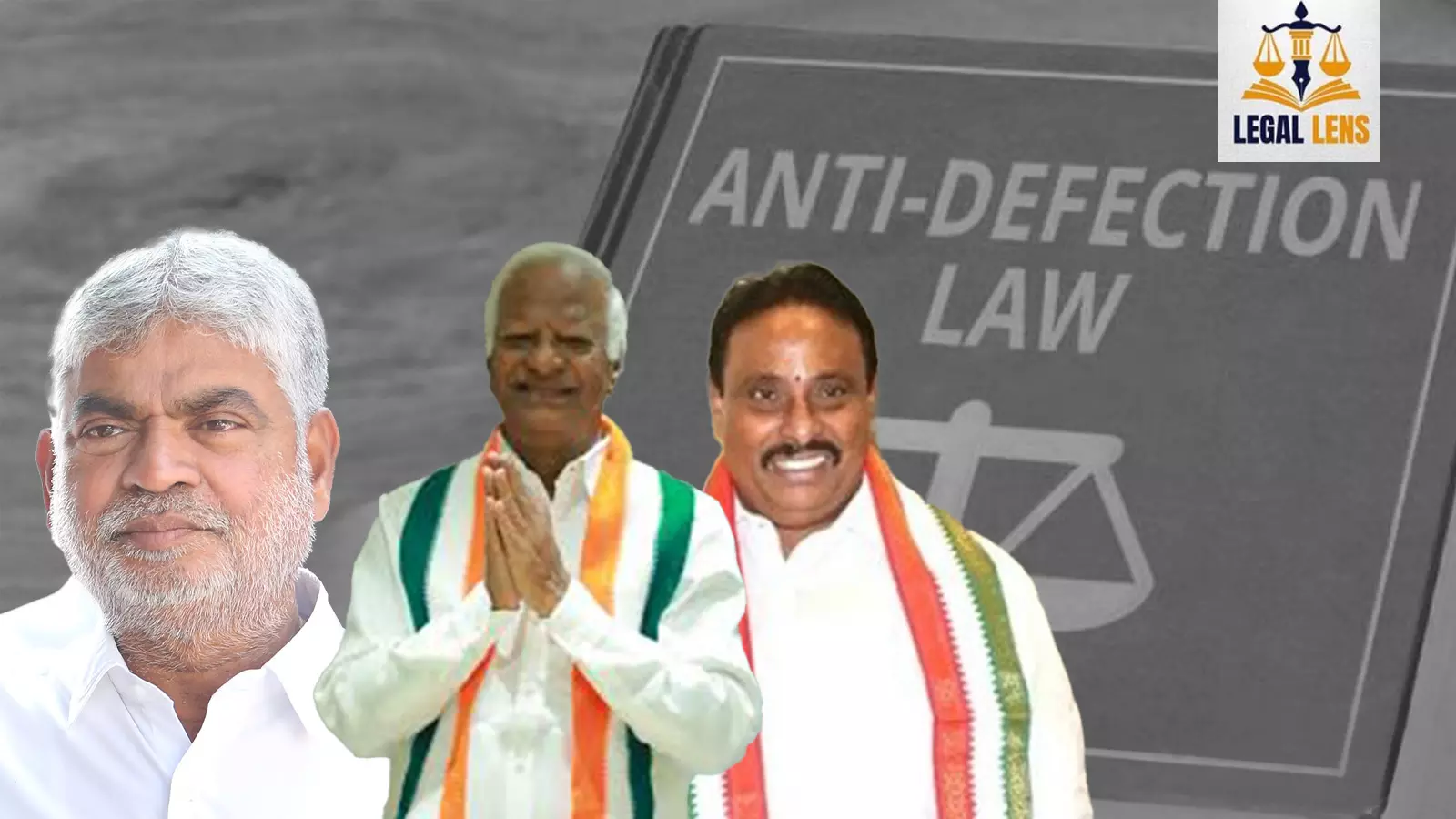
The Tenth Schedule of the Constitution, known as the Anti-Defection Law, was designed in 1985 to cure the chronic political instability caused since the days of the "Aaya Ram, Gaya Ram" politics of the 1960s. Yet, decades later, the practical application of the law remains entangled in partisan interpretations and procedural loopholes.
The recent 55-page order by Telangana Assembly Speaker Gaddam Prasad Kumar, dismissing disqualification petitions against 10 Bharat Rashtra Samithi (BRS) MLAs, serves as a textbook example of how the burden of proof can be weaponised to neutralise the anti-defection mandate.
Also read: SC directs Telangana speaker to decide BRS MLAs disqualification in 3 months
Following a strict directive from the Supreme Court, the Speaker’s office was compelled to physically deliver the final orders to the BRS petitioners who sought the disqualification of the turncoats under the Tenth Schedule. The core reasoning utilised by the Speaker to grant a ‘clean chit’ to prominent legislators, including Danam Nagender and Kadiyam Srihari, rests heavily on the assertion that there was "no conclusive documentary or legally sustainable evidence" of defection.
Case timeline
The Supreme Court’s directive came through the case of Padi Kaushik Reddy v. State of Telangana, in which the apex court, in July 2025, directed the Speaker to conclude proceedings expeditiously within three months. After prolonged non-compliance, contempt notices were issued in November 2025; a final three-week extension was grudgingly granted in February 2026.
The story so far
♦ 10 Telangana BRS defect to Congress
♦ Assembly Speaker dismisses disqualification petitions citing lack of conclusive proof
♦ MLAs’ public alignment with Congress deemed insufficient evidence of defection
♦ Contesting on rival ticket not treated as disqualification
♦ Supreme Court timelines are met only after repeated delays
♦ BRS faulted for not enforcing internal party discipline
The defections themselves dated to March 2024, when Khairatabad MLA Danam Nagender became the first of the 10 to cross over, followed by nine others in two distinct waves — three in March–April 2024, and six more between June and July 2024.
Those departures reduced the BRS's strength in the 119-member Telangana Assembly from 39 to 29, while swelling the Congress tally from 64 to 74.
Staggered dismissals
The Speaker's dismissals were themselves staggered across months — five orders in December 2025, two in January 2026, one in February 2026. The final verdicts on Nagender and Srihari followed on March 11, 2026 — nearly two weeks beyond the Supreme Court's three-week deadline.
The timing was, in its way, characteristic: the orders arrived a day before the matter was due back before the court.
Also read: 'Mockery of Tenth Schedule': SC on Telangana CM statement over by-polls
This conclusion sets the stage for a fierce legal battle in the Telangana High Court, raising fundamental questions about evidentiary standards, the definition of "voluntary giving up of membership," and the procedural responsibilities of political parties.
The anatomy of a "lack of evidence"
The Speaker's verdict operates on a highly restrictive interpretation of evidence. According to the leaked contours of the order, media reports, newspaper clippings, and television footage showing BRS MLAs flanking the Chief Minister were dismissed as mere hearsay, incapable of standing alone without independent corroboration.
Furthermore, the visual evidence of MLAs donning Congress scarves was countered by the defence that the garments were merely "tricoloured cloth" devoid of an explicit, registered party symbol. In a political culture where public optics are the primary currency of allegiance, reducing an induction ceremony to a debate over textile branding is a stark departure from the spirit of the Tenth Schedule.
The Speaker also accepted the MLAs' defence that their interactions with the ruling party leadership were strictly administrative, aimed at securing "constituency development funds." This creates a convenient, legally insulated corridor for legislators to operate effectively as members of the ruling party while technically sitting on the opposition benches.
The Ghost of Ravi S. Naik
The BRS’s impending challenge in the High Court will undoubtedly lean heavily on established Supreme Court jurisprudence. The most glaring contradiction to the Speaker’s logic is the Supreme Court’s landmark 1994 judgment in Ravi S. Naik v. Union of India.
The apex court explicitly clarified that "voluntarily giving up membership" under Paragraph 2(1)(a) of the Tenth Schedule does not require a formal letter of resignation. An inference can - and should - be drawn from the conduct of the member.
Also read: Calcutta HC disqualifies TMC leader Mukul Roy under anti-defection law
The case of Danam Nagender stretches the Speaker’s "lack of evidence" doctrine to its absolute limit. Nagender, a sitting BRS MLA, contested the 2024 Lok Sabha elections on a Congress ticket from Secunderabad.
The Speaker's suggestion that contesting a parliamentary election for a rival party does not automatically trigger the Anti-Defection Law at the state level is a novel, if not entirely perverse, legal theory. The BRS’s parallel move to seek clarification from the Election Commission on this specific anomaly highlights the unprecedented nature of the Speaker’s stance.
Defection in other ways
Kadiyam Srihari’s case, decided on the same day, extends the evidentiary logic further still. Unlike Nagender, Srihari did not himself contest the Lok Sabha elections; he instead openly campaigned for his daughter, who stood as the Congress candidate from Warangal in the 2024 parliamentary polls.
The public character of that conduct, stumping for the rival party’s candidate, his own kin, was no less demonstrative of political allegiance than Nagender’s candidature, yet it too failed to cross the Speaker’s restrictive threshold of admissible proof.
Taken together, the two cases map the outer limits of what the Speaker was willing to recognise as actionable defection under the Tenth Schedule.
BRS’s conduct as petitioner
However, to view this purely as a partisan failure of the Speaker's office ignores the procedural questions that the verdict itself raises about the BRS's own conduct as petitioner. The Speaker's order pointedly noted that the party had not initiated any formal disciplinary action against the defecting MLAs — no show-cause notices, no expulsions, and crucially, no deployment of a whip on the Assembly floor that could have forced a legally actionable violation on the record.
The BRS will contest this characterisation when it moves the High Court, and with some justification: the record shows it filed disqualification petitions within a day of the first defection, submitted affidavits and supporting evidence in September 2024, and eventually drove the matter to the Supreme Court on contempt.
Also read: Political defections: A tool to gain strength, weaken opposition
But the Speaker's observation is not without legal force. A quasi-judicial authority presiding over the drastic step of unseating an elected representative is entitled to ask why a party that commands the full repertoire of internal disciplinary mechanisms chose to deploy none of them.
Evidentiary vacuum
By leaving the MLAs officially on their membership rolls while expecting the tribunal to draw adverse inferences from public conduct alone, the BRS created the evidentiary vacuum that the Speaker then exploited. Whether that vacuum was a genuine oversight or a calculated political decision — preserving the option of a reconciliation that never materialised — is a question the party has yet to answer convincingly.
The irony is compounded by the BRS's own history. During K Chandrashekar Rao's decade in power, the party engineered defections on a scale that makes its present grievance difficult to advance with a straight face.
In the first term alone (2014-18), it absorbed an estimated 47 representatives across the three houses — 25 MLAs, four MPs and 18 MLCs — drawn primarily from Congress and the Telugu Desam Party, including a 2016 merger of over a dozen TDP legislators that effectively wiped that party off the Telangana Assembly map.
Kadiyam Srihari, one of the very MLAs now cleared by the Speaker, offered the most pointed rejoinder to his former party when he noted publicly that 36 opposition MLAs had crossed over to the BRS between 2014 and 2023 without being asked to resign their seats, two of them receiving cabinet berths for their trouble.
The party that spent a decade perfecting the architecture of floor-crossing now finds itself on the receiving end, and conspicuously without the internal disciplinary rigour that effective prosecution of defection cases demands.
The road ahead
As the battle shifts to the Telangana High Court, the judiciary will be forced to balance two competing principles.
On the one hand, allowing the Speaker's order to stand unchecked would essentially render the Tenth Schedule toothless, reducing defection to a matter of simply avoiding written resignations while openly campaigning for rivals.
On the other hand, the court must respect the procedural autonomy of the Speaker as a tribunal under Kihoto Hollohan, intervening only if the order is demonstrably perverse or violates natural justice.
Also read: Sengottaiyan resigns as MLA to avoid defection law, eyes TVK
The Telangana defection saga is no longer just about the political survival of 10 MLAs. It has evolved into a vital constitutional stress test. It will determine whether the Anti-Defection Law can adapt to the modern realities of "soft defection"—where scarves are just cloth, campaign rallies are just constituency development, and floor crossing is conducted entirely in the court of public opinion.