



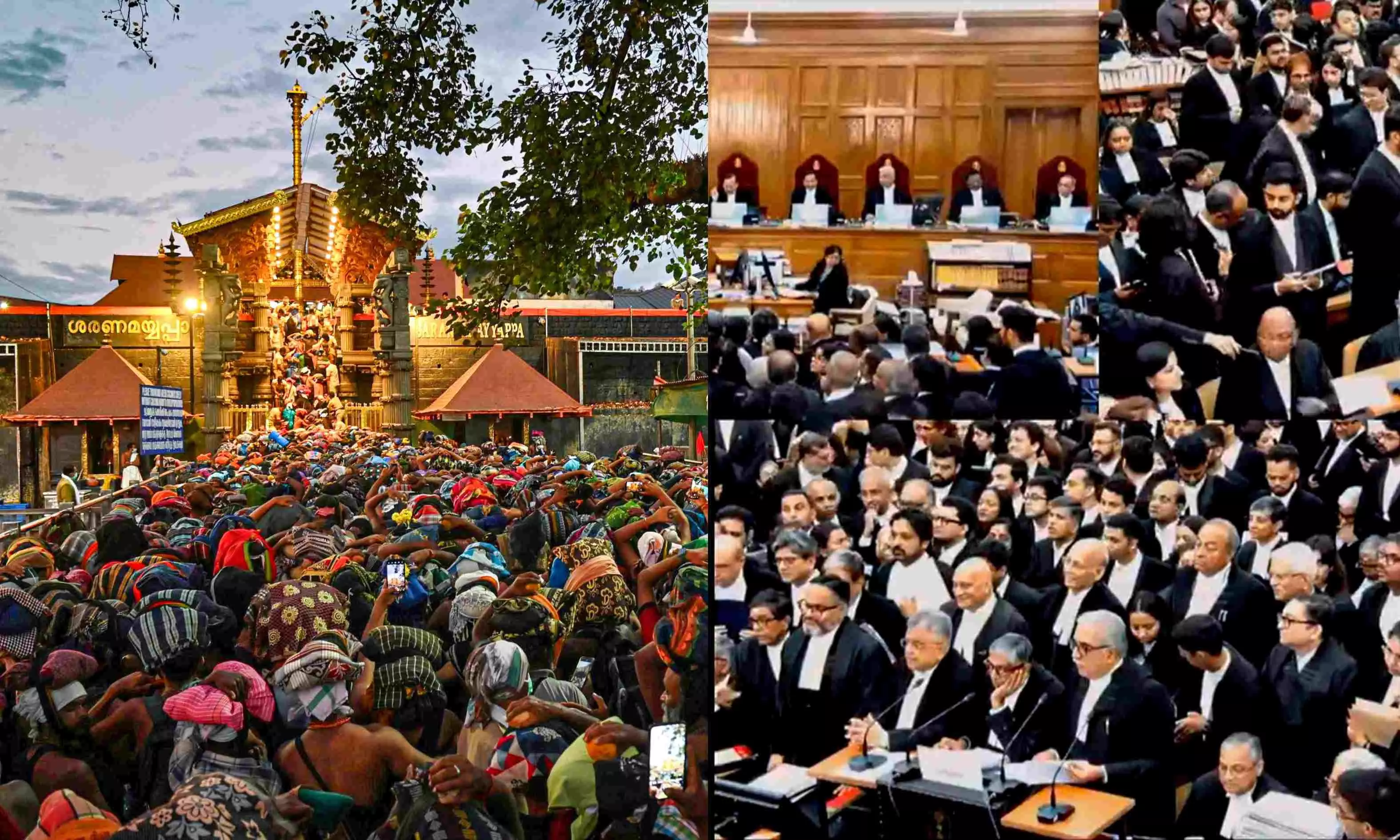
A nine-judge constitution bench heard review pleas in a case related to the entry of women in the Sabarimala Temple. Photo: PTI
Sabarimala hearing: Untouchability comparison sparks sharpest debate
Day one of the nine-judge hearing saw sharp exchanges on who gets to decide what a religion holds sacred

A pointed exchange on whether women’s exclusion from the Sabarimala temple can be equated with untouchability set the tone as the Supreme Court’s nine-judge Bench began hearing a batch of issues arising from the Sabarimala review. The court also repeatedly returned to a central question: how far can constitutional courts go in examining matters of faith?
What the hearing is about
A nine-judge Constitution Bench is reviewing the Supreme Court's 2018 Sabarimala judgment. That verdict allowed women of menstruating age to enter the Sabarimala temple in Kerala. The bench is not reopening that question directly. The 2018 judgment remains in force. What it is examining is bigger: how far can courts intervene in religious practices? And who decides what a religion considers essential?
Chief Justice Surya Kant is heading the nine-judge Bench, which is hearing the Sabarimala review case, along with him on the Bench are Justices B.V. Nagarathna, M.M. Sundresh, Ahsanuddin Amanullah, Aravind Kumar, A.G. Masih, R. Mahadevan, Prasanna B. Varale, and Joymalya Bagchi.
Also Read: Sabarimala case| Can Constitution override religious customs? 9 judges to decide
Arguing for the Union government, Solicitor General Tushar Mehta said the Centre is "not on any side". His core argument: courts are not equipped to define religion. Ancient texts need scholars to interpret them. Judges cannot do that job. He warned that a rigid judicial definition would "compress" the plural nature of Hinduism.
Untouchability flashpoint
The sharpest moment came over the untouchability remark in the judgment. The 2018 judgment had compared the treatment of women at Sabarimala to the practice of untouchability.
Mehta took strong exception. He said, "India, my Lords, has always not only treated ladies equally, but they have always been treated at a higher pedestal. There are several judgments of the recent past where there is a concept of ‘patriarchal society’, or there are some 'gender stereotypes', etc. They were never there. In Indian society, we worship ladies. The President of India, to the Prime Minister of India, to the judges of the Supreme Court, we bow down before our ladies deities. So let us not introduce those concepts of ‘patriarchy’ and ‘gender stereotypes'. There has never been (such notions in India),” he told the Court.
Also Read: Development to Sabarimala row | What will decide Kerala elections?
Justice B.V. Nagarathna, the only woman on the Bench, expressed reservations about invoking Article 17 in the case. She noted that the provision was framed in the context of India’s history of caste-based untouchability and questioned its relevance here.
“Article 17 in the context of Sabarimala, I don’t know how it can be argued. Speaking as a woman, there can’t be a three-day untouchability every month, and on the fourth day, there is no untouchability,” she said, reiterating that such an interpretation would be inconsistent.
Responding, Solicitor General Tushar Mehta clarified that his argument was not centred on menstruation. He maintained that the restriction at the Sabarimala temple was based on age, not on the idea of impurity linked to menstruation. “I will defend Sabarimala in my own different way; it does not mean 4 days, it means a particular age group,” he said.
Mehta further argued that the Sabarimala temple is a “sui generis” institution with a unique set of practices, noting that Lord Ayyappa temples elsewhere are open to women. He stressed that denominational customs must be respected, adding that just as visitors follow practices like covering their heads at a mazar or gurudwara, such requirements cannot automatically be framed as violations of dignity or bodily autonomy.
Courts vs Legislature: Who shapes religious law?
Another key argument of the day focused on who should shape religious law. Solicitor General Tushar Mehta drew a distinction between limited restrictions and sweeping bans, saying the Constitution requires a balanced approach.
He said if a religious denomination limits entry for a section of people in a specific institution, it should be examined in a way that protects religious diversity. But a “blanket ban” on an entire class across institutions would need a different test — one that balances civil rights with religious freedom.
Referring to Article 25, he stressed that “all persons” means “all classes and sections”, and argued that “the prohibition of a particular gender within a certain age group… cannot be termed as a discrimination”.
Mehta also maintained that courts are not the right forum to reform religion. He said the Constitution leaves “social welfare and reform” to the legislature, and any change “must emanate from within the religion or from within the society and cannot be imposed by a judicial dictum”. Legislatures, he added, are better placed to do this as they represent “the views and counter views of each citizen”.
The Bench, however, questioned how far this argument can go. Justice Sanjay Karol Bagchi asked whether beliefs about worship and salvation can be tested against equality.
In response, Mehta said religion can be regulated “only on the grounds of public order, morality, health” or if it violates fundamental rights. He also warned against courts examining core beliefs, questioning whether even the “attribute of a deity” can be reviewed, and said such matters lie within faith, not judicial scrutiny.
What comes next
Petitioners will be heard through April 9. Opposing arguments follow from April 14 to 16. Closing submissions wrap up on April 22.
A judgment is unlikely before mid-2026. But when it comes, it will go far beyond Sabarimala. It will set the terms for Muslim women's entry into mosques, Parsi women's rights at their places of worship, and female genital mutilation in the Dawoodi-Bohra community.