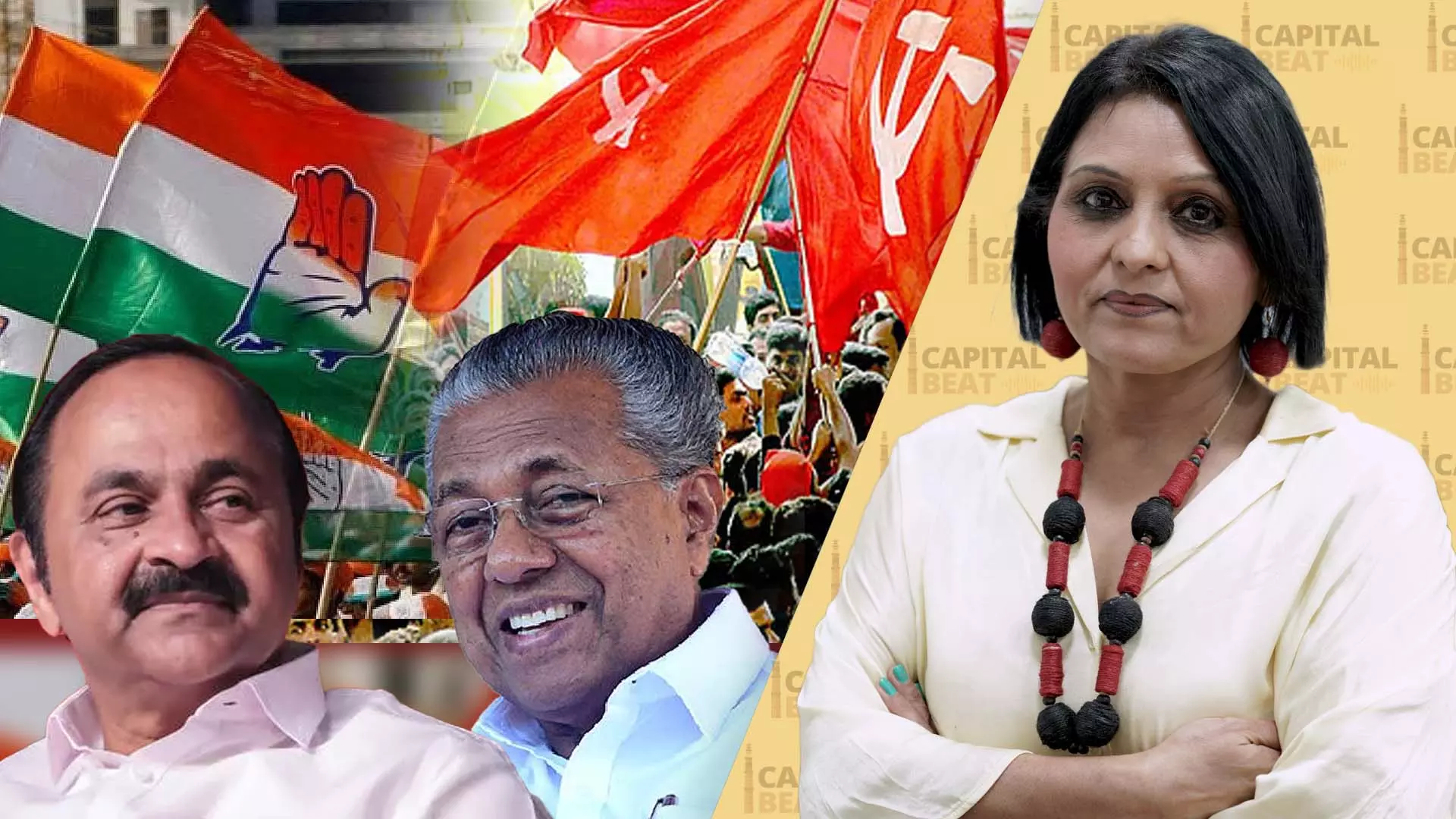
UDF VS LDF
Development to Sabarimala row: What will decide Kerala elections? | Capital Beat
Analysts decode the shifting sands of the April 9 polls as LDF battles a decade of incumbency, Congress leans on its traditional coalition, and a surging BJP eyes expansion

Assembly elections in Kerala are just a week away. The battle in the southern state is unique this time, not only because the ruling alliance Left Democratic Front (LDF) is facing a decade-heavy anti-incumbency, something which is unusual in Kerala polls, a gradually growing Bharatiya Janata Party (BJP) is also ready to make its presence felt even more firmly.
Also read: Kerala polls: Revanth Reddy takes on Pinarayi, with a Mohanlal punchline
Though political analysts believe that it is the Congress-led United Democratic Alliance (UDF) that currently holds a slight edge in the April 9 battle, they also caution that “it is still the election to lose”. The contest remains tight between the LDF, the UDF, and the BJP-led National Democratic Alliance (NDA), with multiple factors still in play. The Federal spoke with political analysts Anand Kochukody and K J Jacob on Capital Beat to decode the ground situation, key issues, and emerging trends shaping the 2026 Kerala polls.
Three-cornered fight
Kerala is witnessing a closely fought three-cornered contest. The LDF, led by the Communist Party of India (Marxist), is seeking an unprecedented third consecutive term, while the UDF is aiming for a comeback. The BJP-led NDA is also attempting to expand its footprint.
Kochukody pointed out that historically, the Congress has struggled to secure decisive Assembly victories in Kerala despite performing well in Lok Sabha elections in the state. He noted that since 2001, the Congress has not convincingly won an Assembly election, even though it managed to form the government in 2011 with a narrow margin.
He explained that the UDF’s past success depended heavily on its social coalition, particularly the support from Muslim and Christian communities, which played a crucial role in it forming governments despite the Congress getting fewer seats than the CPI(M).
Shifting votes
According to Kochukody, the political landscape began shifting after 2014 with the rise of the BJP at the national level. He observed that minority communities, especially Muslims, initially gravitated towards the LDF, viewing Chief Minister Pinarayi Vijayan as a strong leader.
Also read: 30 years on, why the arrack ban in Kerala continues to draw dissent
However, he added that the BJP initially hurt the Congress more by eating into its traditional Ezhava vote base through allies such as the Bharath Dharma Jana Sena (BDJS). But in the 2024 Lok Sabha elections, the BJP also began targeting the CPI(M)’s base, marking a shift in electoral dynamics.
He said the LDF responded by experimenting with “soft Hindutva” after realising that its earlier political messaging was yielding diminishing returns. He argued that this strategy helped the LDF regain some Hindu votes in the recent local body elections in the state.
Advantage UDF?
Despite these shifts, Kochukody maintained that the UDF currently appears to be in a stronger position. He described the election as “for the UDF to lose,” suggesting that only internal missteps could derail its chances.
Jacob broadly agreed, stating that the UDF has a “slight edge” at present. However, he cautioned that a week is a long time in politics and the situation could still change.
The senior journalist also noted that, unlike previous elections, the trend is not yet decisively in favour of any one front, making the final outcome on May 4 harder to predict.
Key issues
On the ground, several issues are shaping voter sentiment. Jacob highlighted that communal narratives, particularly around Sabarimala, have resurfaced and could influence sections of the electorate.
According to him, they may have a limited but notable impact.
The UDF has also accused the CPI(M) of adopting a soft Hindutva stance, which has also become part of the political discourse in the run-up to the elections.
Also read: Battleground Alappuzha in focus as CPI(M) braces for Sudhakaran storm
Development remains a central plank for the LDF, with Jacob emphasising that the government is relying heavily on its governance record over the past decade.
Anti-incumbency
Interestingly, Jacob pointed out that there is no strong anti-incumbency against the government itself, even though there may be dissatisfaction with Chief Minister Vijayan personally.
He argued that the LDF government has delivered significantly on development and welfare fronts, leaving little room for widespread dissatisfaction. According to him, the perception gap may be driven more by media narratives than governance failures.
Kochukody, however, contested this view, alleging that the government has relied heavily on aggressive public relations campaigns, including large spending on advertisements to boost the CM's image.
Narrative battle
The discussion also touched upon competing political narratives. The Congress has accused the CPI(M) of being indirectly aligned with the BJP, a claim amplified by its leader, Rahul Gandhi, during his campaign.
Jacob dismissed the idea of any formal understanding between the CPM and BJP but acknowledged that the CPM may have failed to effectively project its secular positioning, which could hurt its credibility among minority voters.
He suggested that policy decisions, such as aligning with certain central schemes, may have contributed to this perception, weakening the LDF’s traditional ideological stance.
Tharoor, Modi factors
Kochukody also addressed the role of key personalities. He said Congress leader Shashi Tharoor remains popular but only as a campaigner in Kerala, and is not in the race to become the state's chief minister, something he himself ruled out, saying the position should go to an elected MLA.
Also read: Kerala elections: Why MA Baby thinks Left is winning a record third term
On the BJP's side, Prime Minister Narendra Modi continues to have a certain appeal in Kerala, including among sections of Christian voters. However, Kochukody noted that the BJP lacks strong grassroots leadership across the state.
He added that despite Modi’s popularity, the saffron party's organisational limitations could restrict its electoral gains in Kerala.
Final stretch
As the campaign enters its final week, Kochukody pointed to recent controversies, including concerns around legislative measures affecting minority institutions, as factors that could further consolidate support for the Congress.
Ultimately, Kerala's election scenario remains fluid, with the next few days likely to play a deciding role in shaping the voter behaviour in one of India’s most politically dynamic states.
The content above has been transcribed from video using a fine-tuned AI model. To ensure accuracy, quality, and editorial integrity, we employ a Human-In-The-Loop (HITL) process. While AI assists in creating the initial draft, our experienced editorial team carefully reviews, edits, and refines the content before publication. At The Federal, we combine the efficiency of AI with the expertise of human editors to deliver reliable and insightful journalism.