FCRA amendment gives Centre sweeping powers over NGOs, with no oversight built in
Legal Lens | New Designated Authority can seize, transfer or sell assets built with foreign funds, with no independent review or prescribed timeline

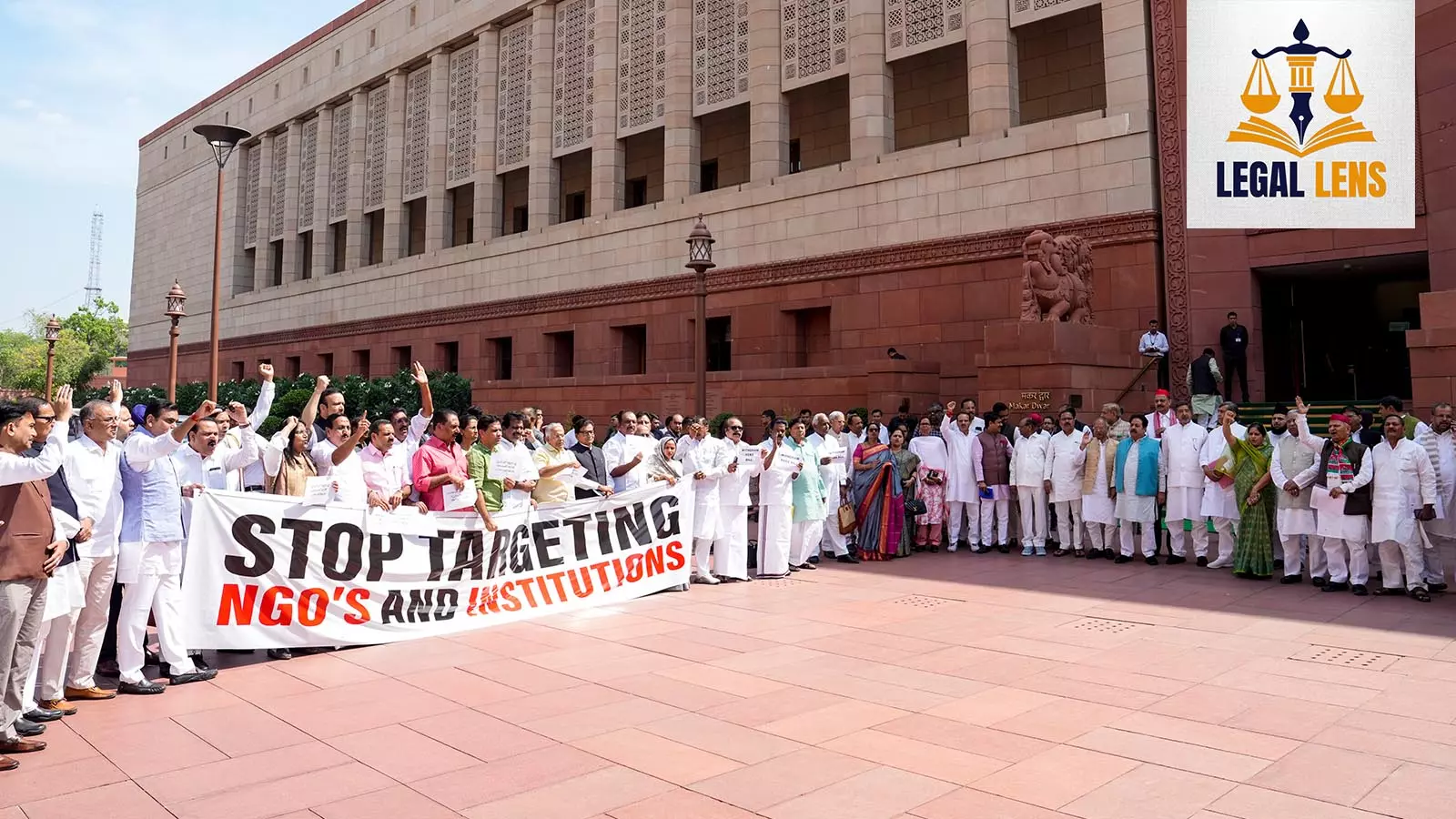
Opposition MPs Hibi Eden, Prashant Padole, Dean Kuriakose, Supriya Sule and others stage a protest during the second part of the Budget session of Parliament, in New Delhi, Wednesday, April 1, 2026. Photo: PTI
A piece of legislation introduced quietly in the Lok Sabha on March 25 has, within days, ignited one of the sharpest political exchanges of the election season.
The Foreign Contribution (Regulation) Amendment Bill, 2026, tabled by Union Minister of State for Home Nityanand Rai, changes how Indian NGOs and civil society organisations receive and spend foreign funds.
On paper, it is a regulatory tidying-up exercise. In practice, it gives the Union government sweeping new powers over the assets of thousands of organisations, including schools, hospitals and places of worship built with foreign contributions over decades.
Kerala up in arms
The political temperature has risen fastest in Kerala, where assembly elections are due on April 9. Chief Minister Pinarayi Vijayan has written to Prime Minister Narendra Modi, demanding the Bill's withdrawal.
Also read: FCRA amendment Bill: Congress claims it favours RSS; Centre says 'false'
Both the ruling Left and the Congress in the state allege it is designed to target minority institutions. Rahul Gandhi went further, claiming it would benefit the RSS while leaving charitable organisations at the mercy of the Union government. Union Minister Kiren Rijiju dismissed these claims as "completely false, fabricated and misleading."
Beneath this political exchange lies a piece of legislation whose provisions deserve scrutiny on their own terms — because the fine print is considerably more consequential than either side's talking points suggest.
Long history
The law it seeks to amend has a long history. The Foreign Contribution (Regulation) Act (FCRA), 1976, enacted during the Emergency to curb foreign political influence, was replaced entirely in 2010. Amendments followed in 2016, 2018 and, most significantly, in 2020.
The 2020 changes slashed the share of foreign funds that organisations could spend on running costs from 50 to 20 per cent. They required all contributions to be routed through a single State Bank of India account in New Delhi. And they barred organisations from passing funds on to smaller partner NGOs.
Why states are alarmed
♦ Centre gains veto over all FCRA investigations, bypassing states entirely
♦ Religious and minority institutions in non-BJP-ruled states face asset seizure risk
♦ No independent appellate body; all decisions rest with executive-appointed officer
♦ Retrospective clause threatens assets of organisations cancelled under previous governments
♦ Kerala, with elections due, sees it as targeted strike on minority-run institutions
♦ Financial Bill classification sidelines Rajya Sabha, where Opposition has more leverage
The Supreme Court upheld these restrictions in 2022, holding that receiving foreign contributions is not a fundamental right.
The cumulative effect is visible in the numbers. In 2014, over 40,000 organisations held registrations under this law. Today, roughly 15,000 do, a fall of more than 60 per cent. Nearly 22,000 had their registrations cancelled; over 15,000 saw them expire. The International Commission of Jurists concluded in 2024 that the law was unlawfully obstructing the work of NGOs and called for its repeal or revision.
In 2026, a new designated authority
The 2026 amendment arrives in this contested terrain.
The most consequential change proposed is the creation of a Designated Authority. This new body can take control of assets built using foreign funds whenever an organisation’s registration is cancelled, surrendered, or allowed to lapse.
Think of a school, hospital, or place of worship built with foreign contributions. The Authority could seize those assets, transfer them to a government department, or sell them. The proceeds would go to the central treasury.
No independent body exists to review the Authority’s decisions. The executive’s rule-making power is vast. The retrospective sweep of the provisions is unchecked.
It is fair to acknowledge what this provision addresses. The existing law already allowed the government to take over such assets upon cancellation, but created no framework for doing so.
Also read: Kerala BJP chief terms Congress' FCRA Bill claim ‘election propaganda’
The Centre for Advancement of Philanthropy describes the earlier provision as a “Sword of Damocles” hanging over NGOs for five years with no mechanism to give it effect.
All the gaps
The new body fills a genuine gap. The problem lies in how it fills that gap. It is controlled by a single executive-appointed officer. No timeline is prescribed for its decisions. No independent review mechanism exists. And where an asset is created partly from foreign and partly from domestic funds, it vests wholly in this body.
The organisation may apply for the return of the domestic portion, but must prove that it is “distinct or ascertainable”.
Registration ends automatically if an organisation fails to apply for renewal, if its application is rejected, or if its validity simply lapses. When any of these things happen, the Authority’s powers are triggered without any separate hearing.
Enormous stakes
This is what alarms Kerala’s political leadership. If a renewal application is delayed or rejected on procedural grounds, the Union government effectively gains control of the institution’s assets.
For religious institutions that have built schools, hospitals, and community centres over decades, the stakes are enormous.
A carve-out exists for places of worship. Where a permanently vested asset is a place of worship, the Authority must entrust its management to an appropriate person. It must ensure the place’s religious character is maintained. This safeguard is itself governed by rules yet to be written. The Authority retains the power to decide who that appropriate person is.
Perhaps the most striking provision is the retrospective clause. Assets that had already vested under the old, now-deleted provision will be deemed provisionally vested in the new body from the date the law commences. Organisations whose registrations were cancelled years ago will find their assets brought under the new regime without any fresh proceedings.
Two other provisions
Two other provisions are worth noting. First, no investigation under this law can begin without prior approval from the Union government. This applies even to state governments.
The Centre argues this protects organisations from politically motivated harassment. It equally gives the Centre a veto over all enforcement.
Second, the amendment requires the government to set timelines for the receipt and use of foreign funds. The timelines, however, are to be prescribed through executive rules, not defined in the statute. This is a recurring pattern: important details are left to executive discretion, outside Parliament’s oversight.
On penalties, the amendment reduces the maximum prison sentence from five to one year, a meaningful relaxation. The scope of personal liability, however, expands considerably. A broad definition of “key functionary” now covers directors, partners, trustees, office-bearers, members of governing bodies, and anyone with control over an organisation’s management.
Also read: Pinarayi Vijayan joins chorus against FCRA overhaul, urges PM to withdraw bill
All are personally answerable for violations. A due diligence defence exists but requires individuals to prove they had no knowledge and exercised all reasonable care.
Side-stepping scrutiny
The legislation was classified as a Financial Bill, a category that limits the Rajya Sabha's ability to block it. Congress MP Manish Tewari opposed its introduction, arguing that it grants sweeping powers to the executive without constitutional safeguards.
A separate anomaly is worth noting: the Bill's own financial memorandum states it involves no government expenditure. If no public money is being spent, the classification looks less like a procedural necessity. It looks more like a way of sidelining the Upper House on a matter of serious consequence.
Also read: Ladakh protests: Centre cancels Wangchuk-led SECMOL's FCRA licence
Rijiju’s assurance that the amendment does not target religious groups, and Rai’s earlier assurance that genuine institutions will remain unaffected, may be sincere.
Prioritising control
The text tells a different story, however. No statutory definition specifies what makes an institution “genuine".
No independent body exists to review the Authority’s decisions. The executive’s rule-making power is vast. The retrospective sweep of the provisions is unchecked.
India’s civil society sector delivers healthcare, provides legal aid, monitors environmental compliance, and documents human rights conditions. When the rules governing this sector prioritise control over accountability, the costs fall on the communities most dependent on its work.
The amendment could achieve its stated goals with far more targeted drafting: prescribed timelines for the Authority's decisions; an independent appellate mechanism; clear standards governing asset disposal; workable rules for separating mixed-fund assets; a sunset clause for retrospective application. Without these safeguards, what is presented as a transparency measure looks like a mechanism for slowly squeezing organisations out of existence.