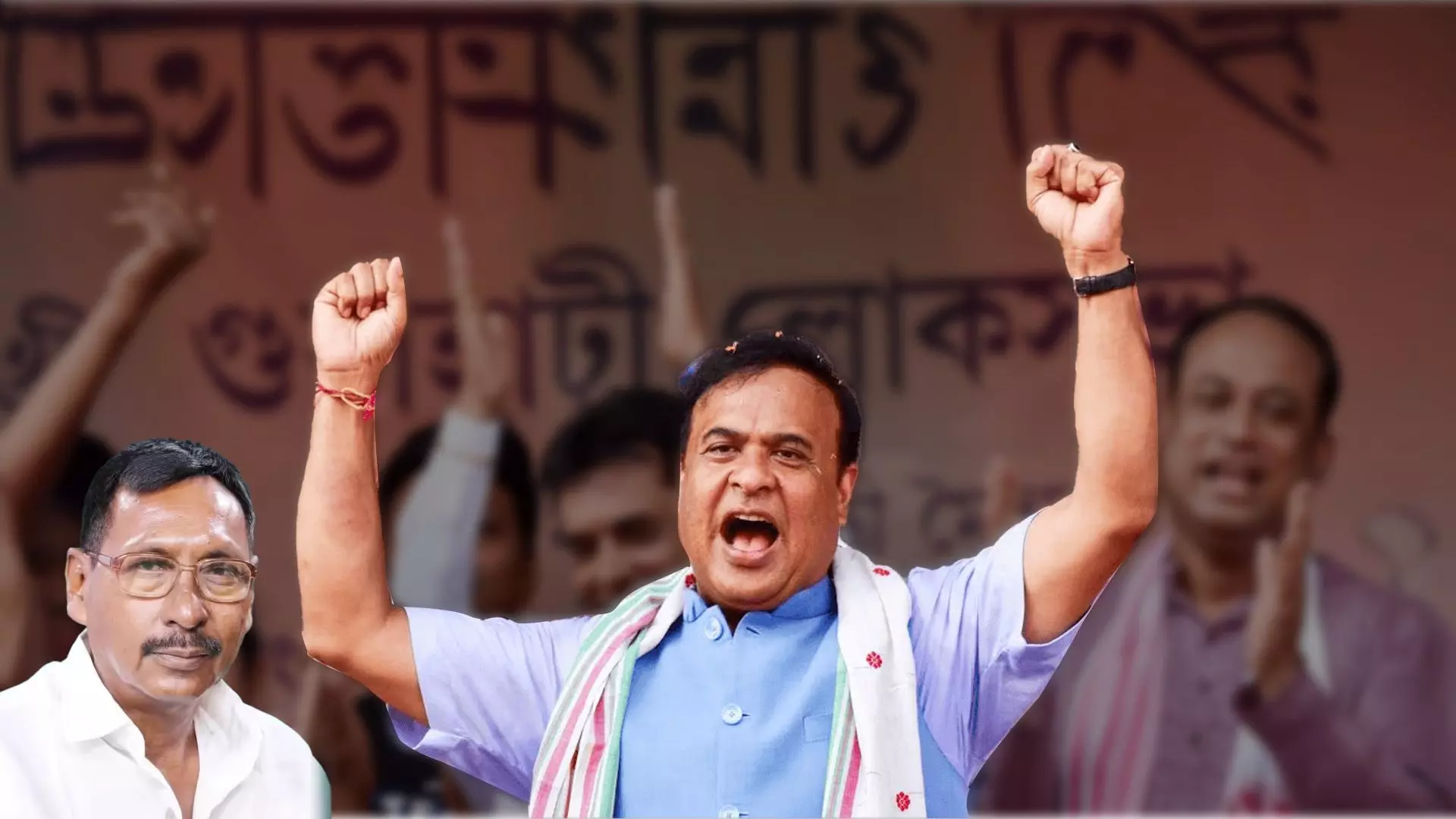
BJP is like a ‘commercial enterprise’ in Assam: Ex-BJP MP Rajen Gohain | Interview
In a scathing interview to The Federal, the former Union minister alleges erosion of ideology, rising corporate influence, and neglect of public welfare in Assam politics

At a time when the Bharatiya Janata Party (BJP) is looking to extend its stay in power in Assam, which goes to polls on April 9, a former heavyweight leader of the party from the key northeastern state has slammed it as one which no more runs like a team but as a "commercial enterprise" and that its government treats people "as customers".
Also read: Humiliated, isolated: Pradyut Bordoloi explains why he joined BJP
Rajen Gohain, a four-time BJP MP from Nagaon who also served as a Union minister, quit the party in October last year along with many other members, expressing displeasure over its working style. He subsequently joined Assam Jatiya Parishad, a regional player in the state, which is fighting this election as a member of the Congress-led Opposition alliance.
The Federal spoke with the veteran leader in the run-up to the highly charged state polls on matters related to his exit from the saffron party, the functioning of the Himanta Biswa Sarma government, and the shifting political landscape in Assam.
Here are some excerpts from the interview:
Why did you leave the BJP after such a long association? What led to this decision?
When I was in the BJP in the beginning, there was an atmosphere where the party worked as a team. Today, that concept is no longer there. Just joining the BJP today is enough—they are not concerned about ideology or teamwork anymore.
They have turned the party into something run for commercial purposes. It is being operated like a commercial institution. This has hurt not just me, but thousands of workers across the country who are unhappy.
Also read: Is BJP’s Assam churn handing Congress a lifeline before elections?
I also realised that nothing meaningful can be achieved through this party anymore, nor can it serve the people effectively. That is why I decided to move away from this ideology and join a regional party. In a national party, power remains concentrated in Delhi. Once they gain power in a state, they treat it as their own, and influential businessmen begin dictating how the state should be run. The state's chief minister is then bound to follow those directions.
Local interests are ignored. That is why I felt a regional platform would allow us to prioritise our own people and work for our region’s interests.
You said the party is being run on ‘commercial lines’ and that the state is being exploited. What do you mean by that?
The thinking of Chief Minister Himanta Biswa Sarma, who was earlier in the Congress, is that money is everything, and if you have it, you have the licence to do anything in politics.
It has influenced the party. Even central leaders may have been affected by this shift. The BJP was not like this earlier. Now, the focus is only on accumulating money, and politics is being conducted like a business.
And when leaders openly talk about earning money, buying land, building properties and hotels, the public also starts seeing it only as business, and not politics. This leads to an increasing dissatisfaction among the people.
I was never interested in money. I believe in serving people, understanding their problems, and addressing poverty. But this government does not care about that.
You also questioned the idea of a "double-engine government". Why do you think it is not beneficial?
A double-engine government does not mean development or welfare. Building flyovers every day is not development.
What matters is the economic condition of the people. Are they earning enough? Are they happy? Is their financial condition improving?
Also read: Assam elections: Can a united opposition break BJP’s streak?
Today, no one is thinking about public welfare. Every step taken by the government seems to be aimed at extracting money from people. Electricity should be subsidised, but tariffs have increased massively. Earlier, people paid Rs 700–Rs 800; now they are burdened with much higher bills.
Gas subsidies are gone. There is no relief anywhere. The government is behaving as if people are customers. Every policy is putting pressure on them.
This is not a government for the people. That is why I left—to see the day when people are free from this kind of rule.
You mentioned concerns about marginalised communities. How do you see the current situation?
I am not a supporter of the Congress, but I appreciate one thing said by its leader Rahul Gandhi—that 10 per cent of the population is ruling over the remaining 90.
OBCs, SCs, and other communities are being suppressed. Can a country function like this by ignoring such a large population? It is impossible. One day, there will be a revolt, and it will be difficult to control.
Is it worth sacrificing such a big country for a handful of people? That is the question.
There are allegations that politics in Assam is being polarised. Do you agree? Did this influence your decision?
When I joined the BJP, my intention was to protect Hindus, especially from illegal infiltrators from Bangladesh. I wanted to ensure that our identity remains intact.
Also read: From French legacy to saffron shift: Is Puducherry changing? | Talking Sense With Srini
My focus was always on stopping infiltration, not on creating division. The NRC (National Register of Citizens) was prepared under the Supreme Court's supervision. When the BJP came to power (the party formed its first government in Assam in 2016), they said it was flawed but failed to correct it properly.
Many genuine citizens were left out, while some people allegedly got in using fake documents. Why couldn’t they fix it when they had full administrative power?
In today’s digital age, controlling infiltration is not difficult. But the issue is kept alive, perhaps for political reasons.
The Hindu-Muslim divide is vitiating the country’s atmosphere. If a population control law is introduced, it could address this permanently by ensuring proportional growth across communities.
You also accused the government of ignoring indigenous communities. How?
Assam is a poor state, but it has immense potential—in agriculture, fisheries, and other areas. Yet, there is no proper development.
Resources that should benefit local people are not being utilised properly. Instead, projects are structured in a way that only big contractors can participate.
Earlier, work was divided into smaller parts, giving opportunities to many people. Now, that system is a thing of the past, and thousands have lost their livelihoods.
Also read: TN elections: Why TVK joining NDA may be suicidal | Talking Sense With Srini
The government is not thinking about public welfare. It is working for a select few—big businessmen—making the rich richer and the poor poorer.
Do you think this approach is harming the BJP itself?
Yes, it is harming the BJP as a political party as well. It is not only damaging public interest but also weakening the party from within.
The Opposition is seen as weak. How do you assess the current political landscape?
The Congress is weak and divided. Our party is also small, and so is Raijor Dal. But we have come together this time.
Earlier, we failed to form an alliance, but now we have united. This unity is creating confidence among people.
Also read: Are pro-incumbency trends changing India’s elections? | Talking Sense With Srini
The public is aware and wants a change. A strong undercurrent already existed, and now it is turning into a wave.
This time, there is no doubt—the government will change. The Congress will lead, and Gaurav Gogoi is likely to become the next chief minister.
The content above has been transcribed from video using a fine-tuned AI model. To ensure accuracy, quality, and editorial integrity, we employ a Human-In-The-Loop (HITL) process. While AI assists in creating the initial draft, our experienced editorial team carefully reviews, edits, and refines the content before publication. At The Federal, we combine the efficiency of AI with the expertise of human editors to deliver reliable and insightful journalism.