Are pro-incumbency trends changing India’s elections? | Talking Sense With Srini
Welfare schemes, leadership continuity, and coalition dynamics help incumbents retain power, challenging the long-held notion of anti-incumbency in India

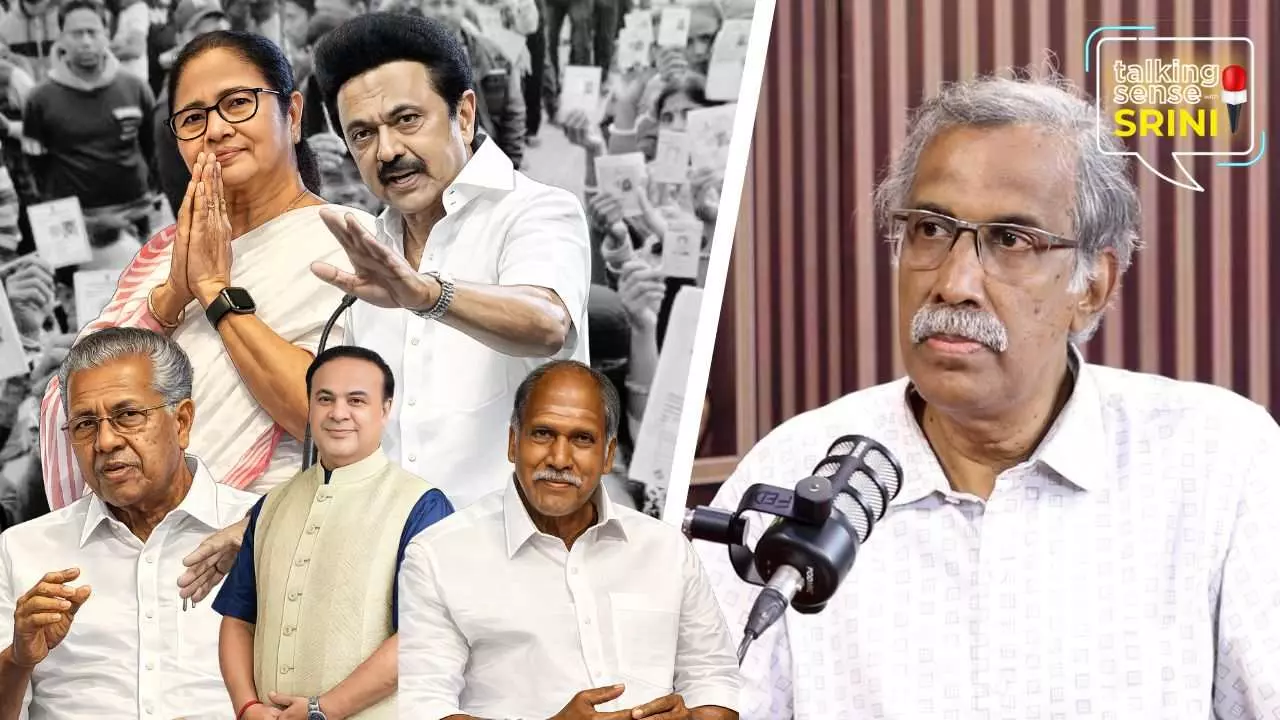
India’s voters, long seen as instinctively anti-incumbent, may be signalling a shift. In a recent episode of Talking Sense With Srini, The Federal’s Editor-in-Chief, S Srinivasan, examined what appears to be a growing pro-incumbency trend in Indian politics, set against a series of recent election outcomes.
From the BJP’s return to power in key Hindi heartland states in 2023 to its strong performance in Maharashtra and Delhi, alongside leadership continuity in states like Bihar, incumbents are no longer being routinely voted out. As five politically diverse states head into elections in 2026, the question is whether this pattern marks a durable realignment or a contingent phase shaped by weak Opposition and strong leadership.
Pro-incumbency gains traction
Srinivasan argued that the idea of “anti-incumbency” itself may have been overstated. “The electorate is not averse to repeating a government,” he said, pointing to multiple instances where voters have renewed mandates for parties in power. He credited psephologists Prannoy Roy and Dorab Sopariwala with framing the idea of “pro-incumbency,” noting that factors such as governance continuity, economic considerations and leader familiarity are increasingly shaping voter behaviour.
Also read | Congress faces Assam crisis as exodus grows, pressure mounts on Gandhi siblings
A key driver, Srinivasan said, is the absence of a credible Opposition in several states. “Where the Opposition is in disarray, the so-called ‘there is no alternative’ factor becomes significant,” he said. This dynamic has played out even in states where contests were expected to be close, with outcomes tilting decisively in favour of incumbents.
Welfare drives electoral advantage
Welfare delivery has also evolved into a central electoral tool. What was once dismissed as “freebies” has become more structured through direct benefit transfers, aided by India’s digital infrastructure. “It has become a hygiene factor,” Srinivasan said. “If you are entering an election, you must offer something.” He added that post-pandemic economic stress and the efficiency of cash transfers have made such schemes both politically viable and electorally effective.
Yet, the pro-incumbency thesis is not uniform. Regional dynamics continue to matter. In Assam, Chief Minister Himanta Biswa Sarma has leveraged both state-level governance and alignment with the federal government to consolidate support. In West Bengal, Mamata Banerjee is attempting to counter the BJP’s national campaign with a strong appeal to regional identity. Tamil Nadu presents a different challenge, where actor Vijay’s entry could split Opposition votes but faces organisational constraints. Kerala remains the most unpredictable, with its history of alternating governments and a resurgent opposition, though Chief Minister Pinarayi Vijayan could still defy precedent.
Incumbency shaped by alliances
Leadership, while central, does not amount to a presidential system, Srinivasan cautioned. “It would be tempting to call it presidential, but that would not be accurate,” he said. State politics, he argued, still hinges on coalitions and social alliances, even if chief ministers dominate the narrative. “They are the main engine, but they cannot win without bringing together broader social coalitions.”
Also read | Breaking from Jayalalithaa’s tradition, EPS camps in Delhi for seat-sharing talks
In Puducherry, a smaller but politically fluid battleground, alliance dynamics rather than ideology may determine outcomes, underlining the limits of any single explanatory framework.
Taken together, the emerging picture is one of conditional pro-incumbency, where performance, welfare delivery and leadership matter, but are filtered through local contexts. As Srinivasan puts it, “If most incumbents return to power in these five states, the theory will gain strength, but there could still be surprises.”