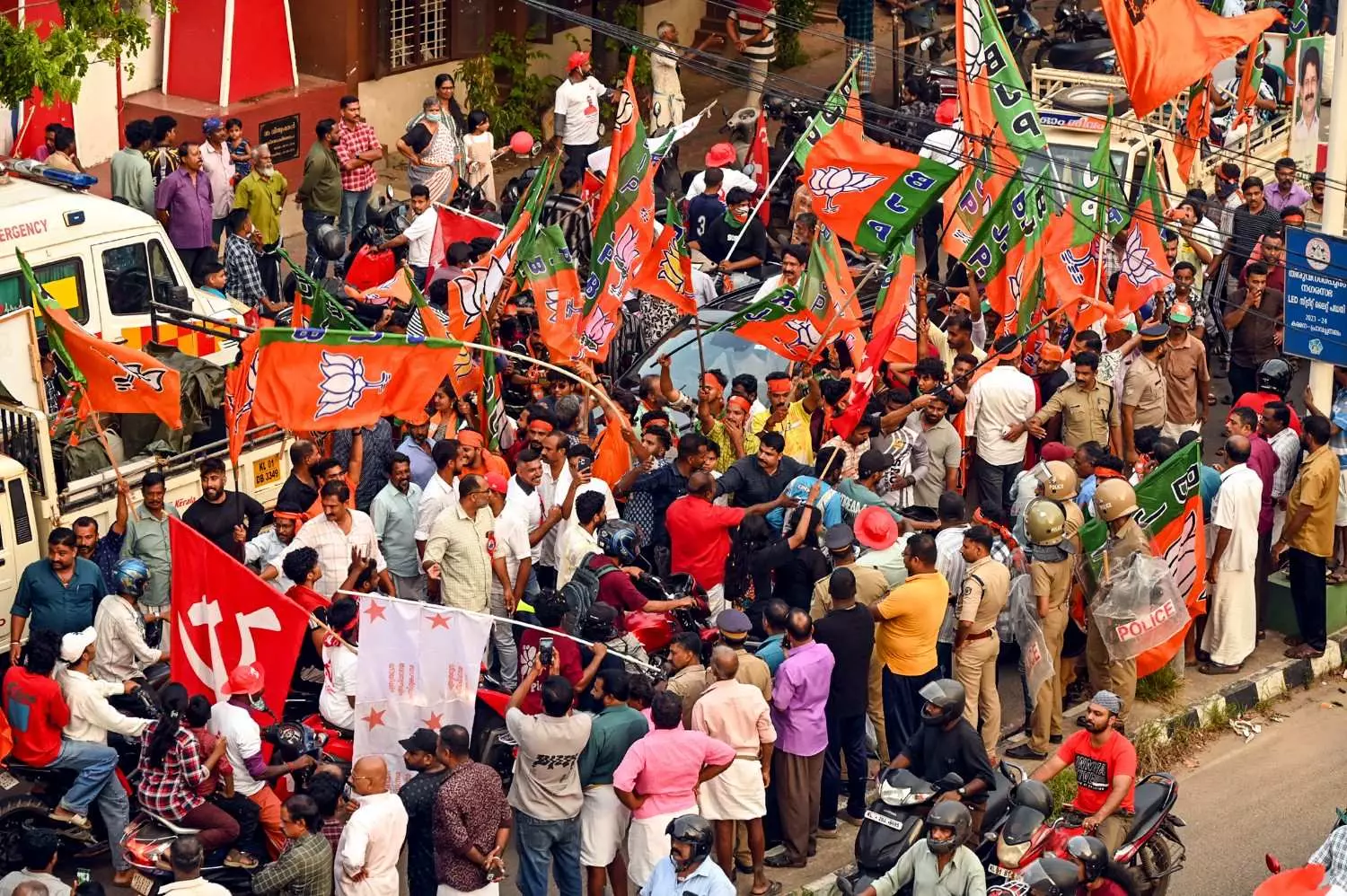
Party workers during the final day of the election campaign in Thiruvananthapuram on Sunday. Photo: PTI
Kerala’s LSG polls today: A bellwether test for the 2026 Assembly polls
Seven southern districts go to polling in the opening phase amid scandals, Sabarimala gold theft controversy and a slew of welfare measures by the Left govt

Just months before the Assembly elections, Kerala is set to hold its local self-government (LSG) polls, the first phase of which will take place on Tuesday (December 9) in seven districts. These key districts — Thiruvananthapuram, Kollam, Pathanamthitta, Alappuzha, Kottayam, Idukki and Ernakulam — have often set the tone for the state’s politics.
What PM Modi said on Vande Mataram row in Parliament
The competing political parties and alliances were making their final plays to sway the electorate, which has seen it all — controversies, welfare narratives, and high-decibel campaigns — in their favour to make a significant mark in these polls ahead of the big battle of 2026.
An intense three-way fight
This year, the battle lines are clearly drawn between the ruling Left Democratic Front (LDF), the Opposition United Democratic Front (UDF), and the National Democratic Alliance (NDA) led by the Bharatiya Janata Party (BJP), each leaning on different strategies, controversies, and promises to capture the voter’s imagination.
Also read: How Kerala’s empowerment programmes are ensuring women's participation in grassroots politics
Historically, LSG elections in Kerala have often served as a bellwether for the party likely to form the next state government. The LDF has won the local body polls in 1995, 2005, 2015, and 2020, paving the way for their victories in the subsequent Assembly elections.
Conversely, in 2000 and 2010, the LDF lagged, and the UDF went on to form the government in 2001 and 2011. This pattern underscores the predictive significance of LSG election outcomes in Kerala politics.
For the UDF, the campaign began on a high note. Riding on a strong anti-incumbency sentiment against the state’s LDF government, it was capitalising on a series of controversies, hoping to paint the ruling coalition as mired in inefficiency and scandal. Chief among these narratives has been the Sabarimala gold-theft case, which dominated headlines in the initial days of the campaign.
Also read: CPI(M) faces heat over Sabarimala gold theft case, MLA Mamkootathil row
Party strategists believed that by highlighting what they called not only a “lapse in governance” over the theft but an “organised loot of Godly property”, they could galvanise a devotee voter base.
UDF momentum hit by Mamkoothatil case
However, the initial momentum of the UDF suffered a severe jolt with the eruption of the Rahul Mamkootathil sex scandal. The case, which dominated media narratives and social media discourse, placed the UDF on the back foot.
Kerala local body and Assembly elections
LSG elections in Kerala have often served as a bellwether for the party likely to form the next state government. The LDF has won the local body polls in 1995, 2005, 2015, and 2020, paving the way for their subsequent victories in the Assembly elections.
In 2000 and 2010, the LDF lagged, and the UDF went on to form the government in 2001 and 2011. This pattern underscores the predictive significance of LSG election outcomes in Kerala politics.
What was meant to be a campaign highlighting the LDF’s lapses became overshadowed by questions over the Opposition’s moral credibility. Even though the party expelled Mamkootathil, the Palakkad MLA, from its ranks, to contain the damage, the scandal left a visible dent in its momentum.
Observers note that while the expulsion was a strategic move to salvage public trust, it did not fully neutralise the negative optics, leaving the Congress-led alliance scrambling to reframe its campaign for the LSG polls in the final days.
BJP eyes voters' polarisation
Meanwhile, the BJP continued to push its long-term strategy, heavily relying on the Sabarimala issue, to expand its influence in Kerala. With ambitions to wrest control of the Thiruvananthapuram Corporation and several panchayats and municipalities, the saffron party’s campaign has been consistent but narrow in focus.
Also read: Kerala court rejects Rahul Mamkootathil's bail plea in rape case; Congress expels MLA
By repeatedly highlighting issues related to Sabarimala, the BJP aims to polarise voters on cultural and religious lines, a strategy that has historically had mixed results among Kerala’s politically aware electorate.
While the party hopes to make inroads into urban municipalities, its influence in rural panchayats remains uncertain, especially against entrenched local networks of both the LDF and UDF.
LDF projects welfare credentials
In contrast, the LDF’s approach has been rooted in showcasing its welfare credentials. The government has leveraged a narrative built on welfare schemes, particularly the hike in pensions, development initiatives, and grassroots interventions.
Across the state, the LDF has emphasised how these schemes have impacted ordinary households, portraying the coalition as a government that delivers tangible benefits to the marginalised and working-class communities.
Also read: Dileep verdict closes a long chapter, but closure and justice elude survivor
On the ground, local candidates have focused on narratives of progress and development, contrasting them with what they describe as the Opposition’s “negative politics” and preoccupation with scandals rather than solutions.
As the first-phase voting draws near, the political field seems remarkably even. Analysts suggest that the LDF has taken an offensive stance as a strategy in recent days, aiming to consolidate its base while challenging the Opposition’s attempts to revive the Sabarimala narrative.
By highlighting the welfare and development agenda, the LDF hopes to counteract the UDF’s renewed push and ensure that local achievements dominate the discourse over controversies.
On the other hand, the UDF, having somewhat settled the Mamkootathil fiasco, is determined to rekindle the gold-theft issue, hoping to frame the election as a referendum on the LDF’s governance failures rather than personal controversies.
Also read: With LSG polls round the corner, Pinarayi gets ED notice in KIIFB Masala Bond case
The first phase of the LSG elections takes place in the seven southern districts where the Sabarimala issue could play a significant role in shaping voter sentiment. Religious and cultural narratives surrounding the pilgrimage have historically influenced political alignments in these areas, and the parties are keenly aware of their potential impact on the turnout and choices.
What could influence Phase 2
The second phase of the polls on Thursday (December 11), covering the northern districts (Thrissur, Palakkad, Malappuram, Kozhikode, Kannur, Kasaragod and Wayanad), is expected to see different dynamics. Here, minority politics could play a more decisive role, with the parties focusing on community-based issues and representation to consolidate support.
The political discourse in these areas often revolves around local development, social welfare, and community concerns, making the electoral battle in the northern districts distinct from the south.
Also read: Crisis brews in Kerala BJP with cadre suicides in Thiruvananthapuram
Political observers note that the campaign in the seven districts that go to polling in Phase 1 has been intense, with door-to-door canvassing, digital outreach, and public rallies all playing a significant role. In several municipalities and panchayats, local issues such as water supply, roads, school infrastructure, and social welfare schemes have become key determinants for voters.
While controversies dominate headlines, it is the issues related to everyday governance that often tip the scales in local elections, making the final days of campaigning crucial for all parties.
In many urban wards, the BJP’s messaging has found resonance among certain demographic groups, particularly young voters and those disillusioned with traditional political alignments.
Also read: Kerala HC gives interim protection from arrest to Rahul Mamkootathil, hearing on Dec 15
Yet, in the rural panchayats, the LDF’s long-term engagement through welfare schemes appears to have sustained a strong base, while the UDF works to consolidate anti-incumbency sentiment and reframe its narrative in the wake of Mamkootathil’s expulsion.
A strong showing by the LDF would reinforce its development-focused messaging, potentially dampening the Opposition’s moralistic critiques.
Conversely, if the UDF manages to swing a significant number of wards by reviving the gold-theft narrative and mitigating the fallout from the Mamkootathil case, it could reshape the political map ahead of subsequent phases.
For the BJP, even incremental gains in key municipalities and panchayats would signal a potential for greater influence in Kerala’s long-term political landscape.
In the final hours, the party offices are abuzz, last-minute rallies echo in town squares, and the candidates make their final appeals to residents.
Today, voters across the seven districts head to polling stations, carrying with them not just the political intention, but a judgment on a complex interplay of welfare promises, moral controversies, governance achievements, and local concerns.
The results will be announced on Saturday (December 13).