How Kerala’s empowerment programmes are ensuring women's participation in grassroots politics
Women constitute roughly 52% of candidates in this week's local self-government polls in the state. Many of the contestants have emerged from women’s empowerment programmes — such as the flagship Kudumbashree — which created training grounds in public service and neighbourhood governance.

When the earth gave way in Kerala’s Wayanad in the 2024 landslides and entire slopes disappeared under mud, rescue teams, officials and volunteers rushed in from across the district. Amid the chaos, a familiar and steady presence emerged from the community itself. One of the first people The Federal had encountered at the Meppadi health centre was Shyja Baby, moving with quiet precision...
When the earth gave way in Kerala’s Wayanad in the 2024 landslides and entire slopes disappeared under mud, rescue teams, officials and volunteers rushed in from across the district. Amid the chaos, a familiar and steady presence emerged from the community itself. One of the first people The Federal had encountered at the Meppadi health centre was Shyja Baby, moving with quiet precision through the crowd of responders and grieving families. She knew every lane, every cluster of homes and almost every face. Over those devastating days, she helped identify nearly a hundred bodies, including around ten of her own relatives.
An ASHA worker, a Kudumbashree (Kerala’s flagship poverty alleviation and women empowerment programme) activist and a member of the Meppadi panchayat (in Wayanad) during the 2015–20 term, years of grassroots work had trained Shyja in coordination, public service and community mobilisation, long before disaster struck. Her contribution was later recognised with the Kerala Sree award, a state-level civilian honour which seeks to recognise exemplary work in promoting health, education, and environmental conservation.
This year, she returns to electoral politics as the Left Democratic Front (LDF) candidate from Attamala ward (Wayanad) in the Kerala local body elections, voting for which will take place in two phases on December 9 and 11.
“This is my land and doing my part was the least I could do,” Shyja says. She recalls the 2019 Puthumala (Wayanad) landslides, when early warnings issued by local workers helped save many lives. “Only those who went back home after spending the night elsewhere were trapped when the slope collapsed,” she says. Most people had already shifted to relief camps the previous day and remained there. A few insisted on returning to their homes despite repeated warnings from the authorities and panchayat members.
“In 2024, we could not repeat that. What we managed in 2019 was possible because we had a deep connection with the people. We knew every household and every person,” she adds.
According to Shyja, this experience is now central to her campaign message, the value of community workers who remain rooted in their villages and are able to act quickly because they know the terrain and the people it holds.
Also read: Why law banning commercial surrogacy has landed women who rented their wombs in greater misery
Shyja is not an exception. Her journey is part of a larger story unfolding across the state. Women who have built their public identities through Kudumbashree, ASHA networks, and Haritha Karma Sena (Kerala’s sanitation and waste-management workforce) are stepping into the local self-government elections. A substantial share of women contesting the current local body elections have emerged through different women’s empowerment programmes introduced in the state since the 1990s, particularly after the Panchayati Raj reforms took root.
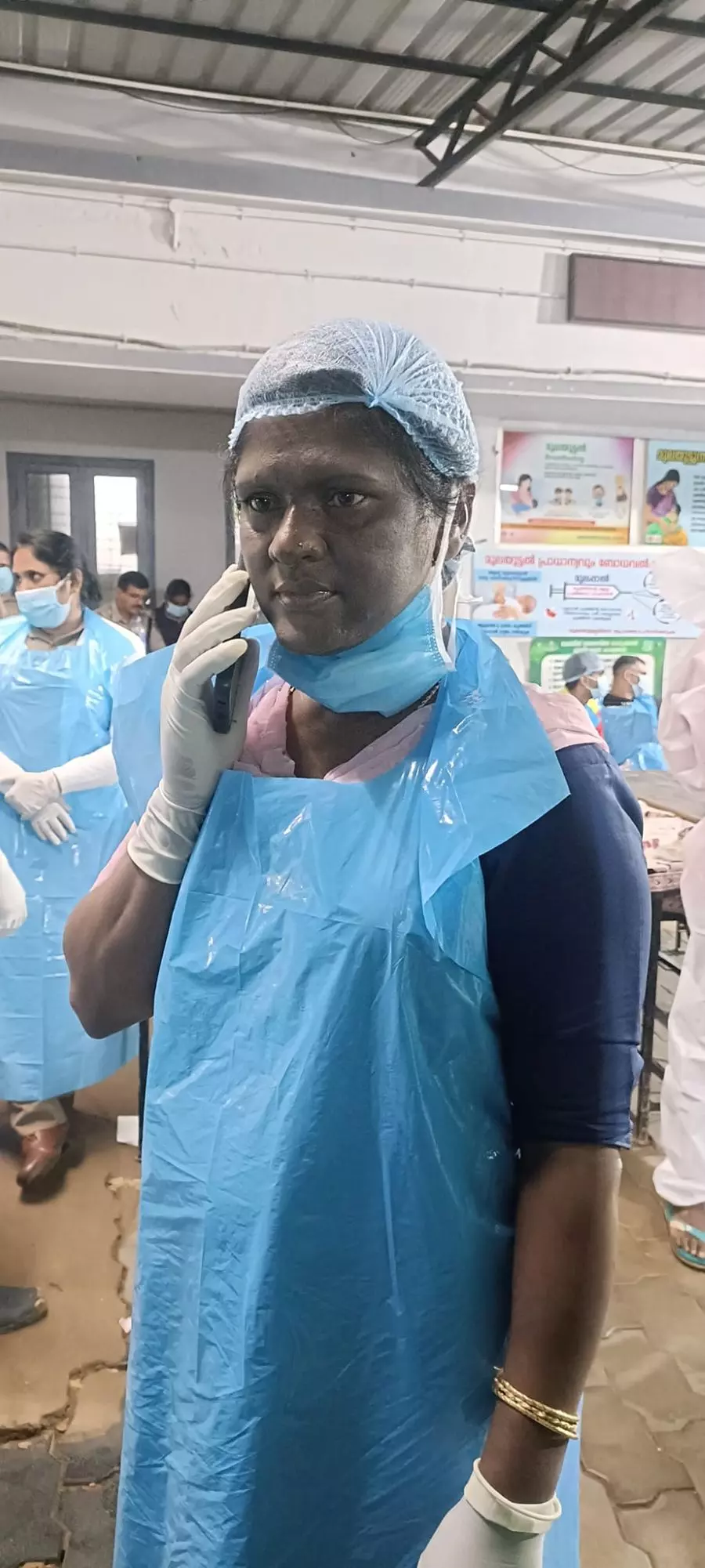
Shyja Baby, during rescue operations for the 2024 Wayanad landslide victims. Photo: By Special Arrangement
As Kerala began reserving one-third of local seats for women, along with reservations within the Scheduled Caste (SC) and Scheduled Tribes (ST) categories and later raised that quota to 50 per cent, women’s participation stopped being symbolic and gradually became structural.
Kudumbashree, officially launched by the Kerala government in May 1998, ASHA networks and later Haritha Karma Sena, introduced in 2013, created sustained training grounds in public service, finance, neighbourhood governance and collective decision-making. Over the past two decades, these women, with real administrative experience and deep social roots, have moved from community roles into elected office, forming a sizeable political constituency that knows how local institutions function from within. Their presence has steadily changed the composition of local governments, making women not just policy beneficiaries, but active makers of welfare schemes.
With women constituting roughly 52 per cent of all candidates across wards statewide, the 2025 local self-government polls may become one of the most gender-inclusive electoral contests in the state’s history.
“There has been a very visible change in the functioning of local bodies after women entered the system. They are deeply involved in day-to-day issues and focus strongly on problem-solving because they are directly connected to households and their concerns. In several places, local communities have demanded the same woman representative even when a ward shifted from women-reserved to general under rotation. As a result, many women are now contesting in general seats. This puts Kerala’s panchayat landscape well above the mandatory levels of women’s representation,” says Majida AM, former councillor of Ponnani municipality in Malappuram district.
Majida was only 33 when she entered the council. A lawyer by training, she was brought into public life at an early stage of her professional career. “Kudumbashree was still in its early stages then. Units were only beginning to form and most women were unaware of the possibilities it offered. But once this space opened up, it began to change their lives. Women started talking to each other and sharing personal experiences, which created stronger bonds than we usually saw among male councillors. Today, we see women openly discussing troubled marriages and other personal issues, and dealing with them with much more confidence,” says Majida.
Dhanya M, a 39-year-old LDF candidate for the Ponnani Municipality and a single mother to two school-going children, has re-enrolled for her BA degree. She had discontinued her studies after she got married, but is now pursuing higher education alongside her responsibilities as chairperson of the Kudumbashree community development society (CDS) and an active political worker.
Speaking about her journey to The Federal, she says, “I was just like any other homemaker in the beginning. I joined Kudumbashree as a member a decade ago and whatever I am today, the confidence to do what I do has come from there. Not only me, but many women who were not even able to speak in public have now become effective leaders through Kudumbashree. The economic independence it gave women is key for me. It has completely changed my life.”
Also read: Why Delhi moms fear their children are becoming collateral damage to the city's smog apathy
Kudumbashree, which translates to “prosperity of the family”, is built on microcredit, self-help groups and community-based institutions. It brings women together at the neighbourhood level to improve their economic security through savings networks, microcredit and small-scale enterprises. These activities are organised through locally-formed community development societies that link individual households to wider community structures. Over the years, the programme has evolved into one of the largest women-led grassroots networks in the state, supporting both rural and urban women in building livelihoods, collective strength and public leadership.
In Kudumbashree’s three-tier structure, the area development society (ADS) and CDS function as key organisational layers of the women’s network for poverty eradication. The ADS is a federation of neighbourhood groups (NHGs) at the ward level, while the CDS is the higher tier, formed by federating ADS units at the level of the local government — such as a gram panchayat or municipality. Together, they provide collective strength and serve as institutional platforms for implementing programmes aimed at women’s empowerment.
“Kudumbashree is a clear example of how women’s economic, social, and political empowerment can reshape society. Our own slogan once was ‘from the kitchen to the centre stage’ and Kudumbashree has demonstrated exactly that in practice. Today, every political party turns to Kudumbashree networks while looking for women candidates at the grassroots,” says MB Rajesh, minister for local self-government, Kerala.
He adds: “In the early years of Panchayati Raj, around 40 per cent of plan funds were allocated to women-related schemes, which later came down to about 20 per cent. As per the recommendations of the Sixth Finance Commission, this allocation had to be increased by 0.5 per cent and eventually raised to 30 per cent. Kerala has moved in that direction and the allocation in the state has now crossed 28 per cent."
From Kudumbashree alone, 16,080 women have filed nominations to contest in the local body elections this year, among them 227 CDS chairpersons, 1,985 CDS members, 1,898 ADS members and 11,838 neighbourhood-group members, plus 132 from the auxiliary groups, show state selection commission data. The participation spans the entire state. District-wise, the largest number of Kudumbashree candidates comes from Alappuzha, with 1,735, followed by Thiruvananthapuram with 1,648. At the lower end is Idukki, with 269 candidates. On top of this, hundreds of members from Haritha Karma Sena are also contesting.
According to Mini Sukumar, member of the State Planning Board, the growing number of women with experience in social work entering electoral politics is linked to a long-term shift in Kerala. “The change began during the decentralised planning phase of 1995–96, when large numbers of women started participating in public governance. Until then, feminists had repeatedly pointed out the near invisibility of women in public decision-making, despite Kerala having achieved high levels of education and health indicators for women,” she says.
Sukumar adds: “The People’s Plan Campaign deliberately brought women to the forefront by involving them in participatory planning at the local level. After that came Kudumbashree and its neighbourhood groups, which turned women from participants into organisers at the grassroots. Many later joined as ASHAs and literacy preraks [inspirations] and that created a wider movement. Over time, women found concrete forums to work in, which gave them space as organisers rather than mere spectators. What we are seeing today is the expansion of that space.”
Kerala’s People’s Plan Campaign, initiated by the Left government in 1996, was a landmark and largely indigenous experiment in grassroots democratic decentralisation. Drawing inspiration from the 73rd and 74th Constitutional Amendments and broad ideas of decentralised planning, such as the People’s Plan proposed by political activist and theorist MN Roy, it was not modelled on any single blueprint but evolved through Kerala’s own political context and social mobilisation capacities. The campaign devolved close to 40 per cent of the state’s development budget to panchayats and municipalities, introduced mass participatory planning through gram sabhas and built a strong emphasis on local resource mapping, social inclusion and community-led development. It is widely regarded as having reshaped Kerala’s local governance landscape, even as outcomes have varied across regions.
“From that period onwards, nearly 30 to 40 per cent of the state’s annual plan expenditure has been transferred directly to the panchayats. A share of these funds was channelled through the Women Component Plan [which required every local self-government to earmark 10 per cent of its development outlay exclusively for projects concerning women, ensuring that women’s needs were built into local planning processes and that development spending directly supported their economic and social empowerment]. Some projects may look unsuccessful if judged only on financial returns, but the social transformation they triggered was enormous. The key change was the space created for women to work in development planning. It may not have been a successful business model in a narrow sense, but it was a bold experiment in democratic participation,” Sukumar, a feminist academic and former head of the Women’s Studies Department at the University of Calicut, explains.
She adds: “The idea of gender budgeting also played a major role, both conceptually and in implementation. Many departmental schemes depend on women for their execution and that has been critical. It allowed women to engage directly with governance and project management and that process has produced a generation of leaders. There is often a view that women’s participation should remain outside party politics. My position is different. Politics is central to any meaningful participation, and women must take their place in the political mainstream. Local self-government institutions are a route towards that shift.”
Also read: Mumbai to small-town nets, how World Cup win is redrawing the map of women’s cricket in India
The LDF holds the upper hand among Kudumbashree members contesting this election, reflecting the historical influence and organisational strength the Left has established within the network. Observers see this as a natural outcome of the People’s Planning process, the LDF’s flagship initiative, from which Kudumbashree emerged as an offshoot.
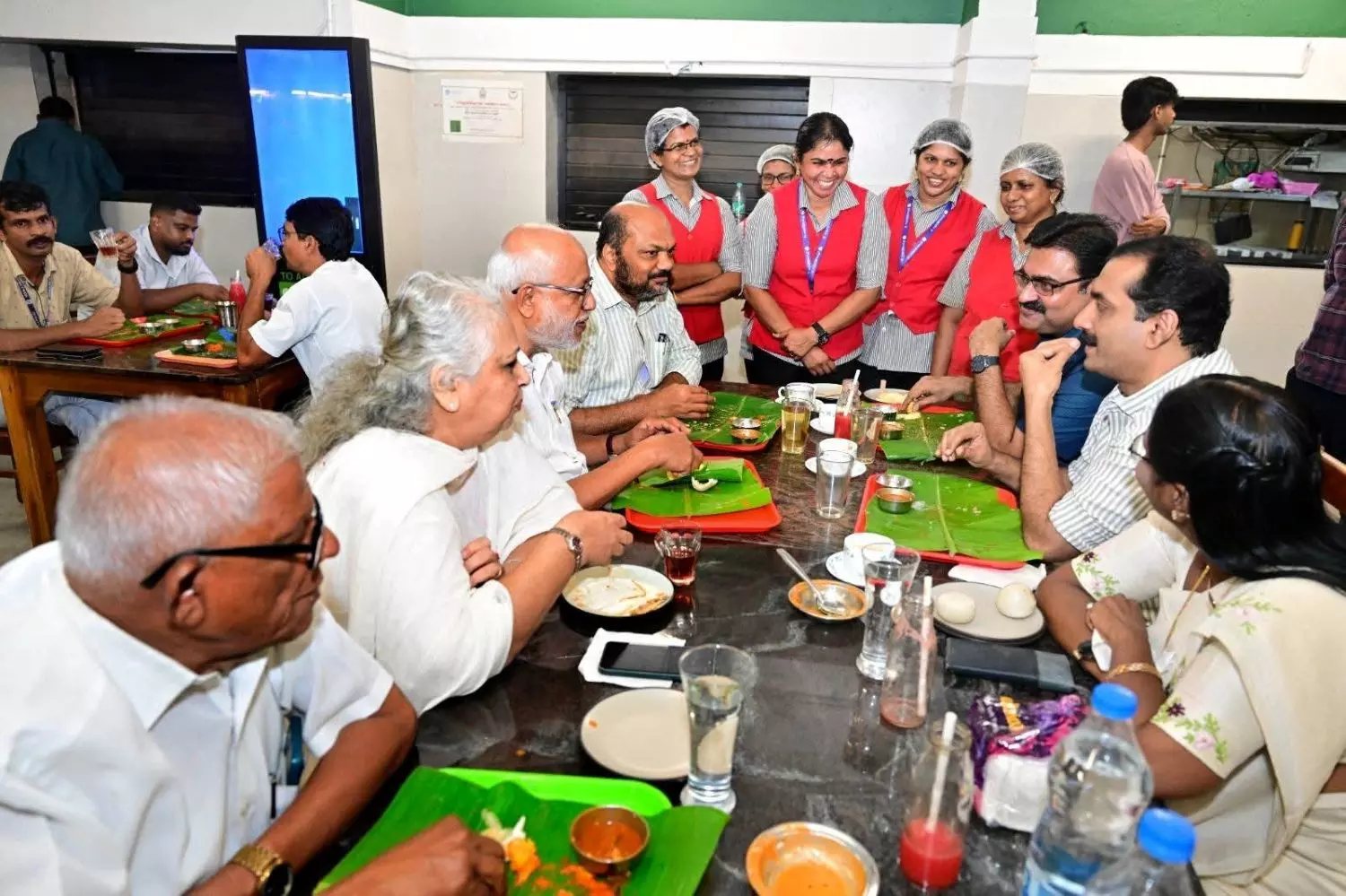
Samrudhi Project, run by Kudumbashree in Kochi Corporation. Photo: By Special Arrangement
The Congress-led United Democratic Front (UDF), on the other hand, has long been apprehensive about the Left’s organisational influence through Kudumbashree and was initially reluctant to embrace it. It even attempted to create a parallel women’s network called Janasree. The Janasree Sustainable Development Mission is a grassroots-oriented non-governmental organisation, formed with the aim of promoting social, economic and moral welfare by mobilising ordinary citizens into collective self-help groups. It was founded by the Congress leadership in 2006-07, but failed to make an impact.
The IUML was the one UDF constituent that supported Kudumbashree in its strongholds despite political differences and has achieved substantial organisational presence within the programme in proportion to its local strength.
Many of the UDF contestants in the 2025 local self-government elections are also Kudumbashree members.
Rasheeda Mohammed, an active Kudumbashree member, is contesting from Ward 6 of Vengola panchayat in Ernakulam district as a UDF candidate. Known locally for her long years of community work, she has served multiple times as an ADS member and has been closely associated with livelihood programmes and MGNREGS activities. “Kudumbasree is what gave me confidence. It taught me how to organise work and how to stand with ordinary families, whether it was a crisis or just daily needs. After so many years of that, I began to feel that I could take up a bigger role in public life,” she says.
Ganga Gopan, the Congress (UDF) candidate contesting from Punalur Municipality, runs a food-processing unit with support from Kudumbashree and the Industries Department. She has a slightly different perspective.
“Every household should have economic security. Creating employment opportunities that ensure that security is the larger purpose that motivated me to contest this election.”
Sajitha TP, a Kudumbashree member from Ernakulam, had earlier contested the local body election with Congress support in 2010 and although she lost, she had put up a strong fight. According to her, Kudumbashree should not be viewed as a CPM project, as she points out that Congress supporters are also part of it.
“In our area, the unit is mostly made up of UDF sympathisers,” she says. “There is a general perception that this is a communist initiative, but what we should do is make it a truly public platform. My experience in Kudumbashree has helped me a great deal, especially through the self-help group and the two or three women-run food production units we operate. Last time, my opponent was also a Kudumbashree member. We are friends and although she won by a narrow margin, I considered it a friendly contest.”
She explains that initiatives like Kudumbashree have been crucial in easing tensions between rival political parties at the grassroots level. By working together in neighbourhood groups, area federations, and community programmes, women have developed a strong sense of solidarity and sisterhood that often transcends political loyalties, allowing them to collaborate effectively despite differing party affiliations.
For many of these women, the move from community activism to contesting elections represents a coming-of-age for grassroots leadership. Years of social work, neighbourhood organising, sanitation and waste-management efforts, health services or micro-enterprise work have given them community visibility and credibility. Political parties seem to be recognising this shift by fielding women from these networks, not only in reserved wards, but increasingly even in general-seat contests.