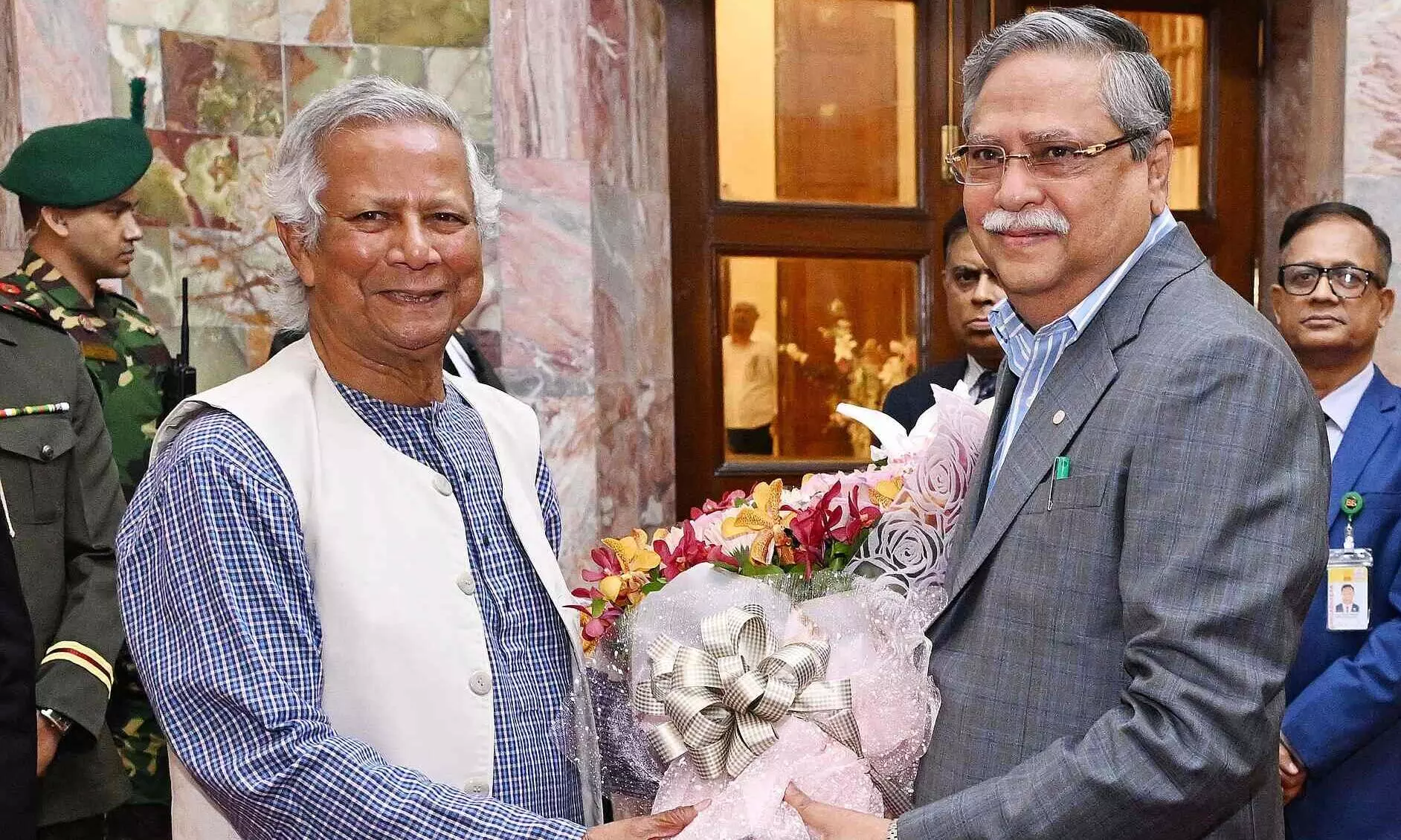
US fears extension of China-Myanmar Economic Corridor to Bangladesh will jeopardise its plans to operate in Rakhine Corridor and knows a loyalist like Md Yunus can make it stop
With Bangladesh President Shahabuddin Chuppu pressured to step down, the country’s domestic scene is clearly hotting up for a showdown. Although the president resigned citing health reasons, he was asked to step down by Prime Minister Tarique Rahman, who was under pressure from both Islamist parties and BNP hardliners to send Chuppu packing.
Was Chuppu a threat?
The pressure mounted after ousted prime minister Sheikh Hasina, cooling her heels in Delhi since August 2024, announced her intention to return to Bangladesh along with senior leaders of her Awami League party. Though she told Reuters she intends to stand trial, most in Bangladesh feel the ousted leader seeks to ignite massive street protests with her presence that could lead to a counter-revolution to bring Awami League back to power.
Also read: Hasina's home-return promise rattles Bangladesh government, Islamists
Hasina's rivals in Bangladesh feared a major role by President Chuppu in this possible change of fortunes because he could use his emergency powers in the event of chaos. That Chuppu had already said he did not have any resignation letter from Hasina was seen as evidence of the president's possible involvement in a possible conspiracy to unseat the current government.
US behind Chuppu's ouster
But top Bangladesh intelligence sources say there was something more to Chuppu's ouster. They say he was removed after rumours were spread about his telephonic discussions with Hasina in Delhi when the president was in London for medical treatment recently.
Two top Bangladesh officials told this writer on condition of anonymity that Chuppu was removed after the US mounted massive diplomatic pressure on Prime Minister Rahman to get rid of him. Hasina's planned return to Bangladesh was not the cause but the excuse to get Chuppu out, they say. The real reason: the US wants one of its loyalists, possibly Nobel laureate Muhammad Yunus, as president to push its geopolitical agenda in Bangladesh.
Chinese corridor plans worry US
When this writer confronted senior Bangladesh officials about the timing of Chuppu's ouster and the real reason, they said Rahman's recent visit to China has unnerved Washington. Not only has Rahman signed a string of deals to pave the way for Chinese companies to invest in crucial infrastructure projects like port development, but he has also agreed to Beijing's proposal to extend the China-Myanmar Economic Corridor (CMEC) to Bangladesh. While the CMEC intends to give Beijing land-to-sea access to the Bay of Bengal, its extension to Bangladesh will help China firmly consolidate its presence in the entire Indian Ocean region.
Also read: 'Chest thumping not foreign policy, New Delhi-Dhaka must return to dialogue' | Worldly-Wise
That would also negate the US’s plans to operate the 'Rakhine Corridor ' (Bangladesh to Myanmar's Rakhine State) that is crucial to supplies for rebel groups seeking to defeat the Myanmar army and undo the military-driven federal government. The military junta in Myanmar has been a close Chinese ally and is doing everything possible to implement the CMEC to ensure Beijing's presence in the Bay of Bengal. This is exactly what the US wants to stop.
US officials rush to Dhaka
Washington discouraged Rahman from getting 'too close' to Beijing prior to his visit to China. Quite obviously, it has not worked. So American pressure mounted on the BNP government, almost immediately after Rahman’s China visit, to push president Chuppu out. A top former CIA officer, Gerald Hamilton, arrived in Dhaka late in July and US ambassador to India Sergio Gor (Trump's pointsperson for South Asia) is reaching Dhaka on July 30. Bangladesh officials say these top US officials intend to strongly dissuade the Bangladeshi prime minister from pursuing the Chinese corridor extension plan and also accept Muhammad Yunus as president. If BNP accepts Yunus, he will emerge as the unanimous choice since the Islamist Opposition parties are sure to back the Nobel laureate's candidature.
Also read: Suvendu's deportation claims: Dhaka ties sink even as numbers don't add up
The US clearly cannot rely on Rahman after he went ahead with the Chinese deals -- so it wants a president who will play to its tune lock, stock and barrel.
India’s BRICS bait
What worries Washington most is Rahman’s keenness to join the BRICS. He has already been invited to the forthcoming BRICS summit due in Delhi in mid-September. The invitation has gone out from India, which might use the visit to also discuss bilateral issues at the highest level. India has been seeking to scale down border tensions and also get the ban on Awami League lifted to allow for a normal democratic atmosphere in Bangladesh.
Also read: India-Bangladesh ties under strain as pushbacks threaten reset
In view of its excellent relations with Moscow and improving relations with Beijing, Delhi might use the BRICS summit to draw Bangladesh away from the US ambit that Yunus' interim government had drawn it into. India may not like growing Chinese influence in Bangladesh and Myanmar, but it has made it clear it does not want to be part of American machinations to Balkanise Myanmar and turn Bangladesh into an anti-India hub in the East.
India has important connectivity projects in Myanmar like the Kaladan Multimodal Transport project to connect to the Northeast and the Golden Trilateral Highway for overland connectivity to Southeast Asia – so it can ill afford Myanmar falling apart.
Delhi’s subtle balancing
There seems to be growing consensus between India and China to curb American influence in Bangladesh, which could destabilise the whole region. After Trump's hugely disruptive power play in the Middle East, both Beijing and Delhi can ill afford another spell of cowboy action in South Asia.
Also read: Why unrest in Bangladesh matters to India | Talking Sense With Srini
For India, it works well to use the US to limit Chinese presence in Bangladesh and use China and BRICS to curb Uncle Sam a free run to unsettle eastern South Asia. Hope that's the kind of subtle balancing Delhi may be looking to ensure.
(The Federal seeks to present views and opinions from all sides of the spectrum. The information, ideas or opinions in the articles are of the author and do not necessarily reflect the views of The Federal)