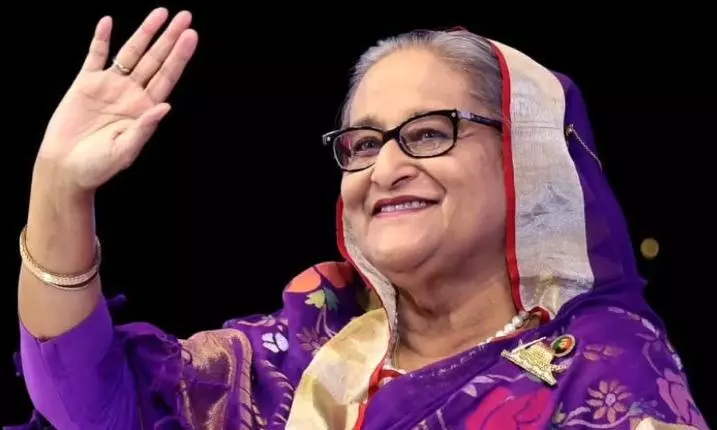
By vowing to return to Bangladesh by 2026 end, the ousted leader puts the BNP govt in a bind: jail a formidable rival and risk civil war, or leave her free and trigger an uprising
Bangladesh's ousted prime minister Sheikh Hasina has promised to return to her country in 2026 and asked the government to keep "my jail and gallows for hanging me ready".
In an exclusive interview with NDTV recently, the leader said what she has repeatedly told her supporters during frequent Telegram or WhatsApp group meetings — "Inshallah Druto Dekha hobe" (God Willing, will meet you all very soon). But unlike in the past, she gave a definite time by which she plans to return in her interview — before the current year comes to an end.
Also read: Bangladesh's Teesta River project: 'India should oppose it, seek modification'
Bangladesh's previous interim government led by Muhammad Yunus and the current elected government of Prime Minister Tarique Rahman have asked India several times to extradite Hasina — first to stand trial on charges of ordering repressive measures to control the July-August 2024 agitation that brought her government down and then to face the death sentence awarded to her by the country's International Crimes Tribunal.
The Indian response has been unambiguous — External Affairs Minister S Jaishankar made it clear that Hasina will only leave India when she wants to. But now that Hasina herself says she will return, the authorities in Dhaka appear totally puzzled.
Poll ban on Awami League
Hasina's Awami League, which spearheaded Bangladesh's independence war in 1971, was prevented from contesting elections by the Yunus regime in February this year and then formally banned by the Bangladesh Nationalist Party (BNP) government through a parliamentary legislation. Exactly like the ban imposed by the military junta in its neighbour Myanmar on Aung San Suu Kyi's National League for Democracy.
Thousands of Awami Leaguers and secular personalities supporting it have been jailed on blatantly false charges and systematically tortured. Global media outlets such as the BBC have run detailed reports on the growing spate of mob attacks, prison torture and custodial deaths in Bangladesh, with most victims connected to the League.
If the ban is not lifted, the only option for the League is to unleash a powerful street agitation. That is only possible if Hasina returns to Bangladesh. And that is precisely why her promise to return is unnerving government and Opposition alike.
Bangladesh's award-winning actress Rokeya Prachy, who was forced to flee the country after a violent attack on her in Dhaka, said that though the League has faced such repression many times before, both during the movement against Pakistan and later during Bangladesh's own spell of military rule, the present phase of repression has crossed all limits.
"What we have faced during the last two years is clearly unprecedented," Prachy , who is a leader of the League's women and labour fronts, told this writer.
Hasina's return rattles rivals
But Hasina's open challenge to arrest and hang her on arrival has clearly unnerved both the ruling BNP and the opposition coalition led by the Jamaat-e-Islami. Intelligence officials in Dhaka said the government is not really prepared to handle Hasina's arrival, which may trigger large-scale mobilisation by the League to back its demand for lifting the ban.
Also read: 'Chest thumping not foreign policy, New Delhi-Dhaka must return to dialogue' | Worldly-Wise
If she really turns up, the BNP government will be caught between a rock and a hard place. If she is jailed and then hanged, it may provoke a furious phase of public protests difficult to control, but if she is let off, the BNP will end up upsetting the Islamist Opposition, so far on friendly terms with the BNP. And if she is handed, the country may well be looking at a civil war.
During the recent Awami League Raising Day celebrations, the government deployed additional army battalions in several districts, fearing large-scale disruption by the League supporters. Hasina's promise to return home has clearly energised the beleaguered Awami rank and file. Their processions have got bigger and more aggressive, and many suspect their involvement in bomb attacks on rallies of the National Citizen Party, formed by leaders of the 2024 agitation that ousted the former prime minister.
The BNP government is trying to put up a brave face. Home Minister Salahuddin Ahmed recently thundered in the parliament that the League "has been effectively buried in Delhi".
Some shadowy American diplomats, believed to be closely involved with the 2024 regime change operation, have even come out openly against Hasina's planned return, with one even saying, "She will end up either in a Bangladesh jail or die in India".
BNP warns the media
PM Rahman's Information Adviser Zahed Ur Rahman has recently warned Bangladesh media outlets of serious consequences if they carry any statement by Hasina or stories based on her interviews in the global media.
The prime minister's press secretary has even called up TV anchors and asked them to stop shows remotely critical of the current government. "Why would that happen if Hasina is history?" asked a senior editor, but on condition of anonymity.
If the Awami League is finished, as claimed by the home minister, let the government lift the ban and face us in a fair election. They know they will lose, despite all this repression for the last two years.
The media in Bangladesh is already heavily censored, and dozens of journalists and editors, jailed by the Yunus regime on flimsy charges, continue to remain in prison because they are seen as friendly to the League. The message is clear — if you don't speak well of us, you better not publish or broadcast at all.
But in the age of rampant social media, there is a limit to how effective government censorship can be. The League's Facebook and Instagram accounts, X handles and other social media outlets are at full steam. Often, they just add to the government’s embarrassment by circulating global media reports critical of the government.
Planned anti-India hysteria
The government and the Islamist Opposition have tried to counter the League's campaign by whipping up anti-Indian hysteria on a host of issues like the pushback of illegal migrants by the Border Security Force. But that was largely defeated when India reopened its tourist visa services in Bangladesh, and lakhs lined up to submit applications.
Also read: India-Bangladesh ties under strain as pushbacks threaten reset
The League remains the country's largest political party and continues to have a formidable support base, which is why both the BNP and the opposition Islamist coalition are unwilling to lift the ban on the party.
"If the Awami League is finished, as claimed by the home minister, let the government lift the ban and face us in a fair election. They know they will lose, despite all this repression for the last two years," said senior League leader and former minister Jehangir Kabir Nanak.
If the ban is not lifted, the only option for the League is to unleash a powerful street agitation. That is only possible if Hasina returns to Bangladesh. And that is precisely why her promise to return is unnerving government and opposition alike. Especially because she has now given a definite time of return — within this year.
The League is always formidable when it comes to street protests. In 2024, its leaders made the mistake of relying on the army to handle the student-youth agitation and did not mobilise their own party activists. The army backed out after a while and left the government defenceless.
Reports have suggested that its chief, General Waker-u-Zaman, was very much part of the "meticulous design" claimed by Yunus for the success in toppling the Hasina regime. Now, with Hasina energising the Awami rank and file with her promise to return, the government has every reason to worry.
(The Federal seeks to present views and opinions from all sides of the spectrum. The information, ideas or opinions in the articles are of the author and do not necessarily reflect the views of The Federal.)