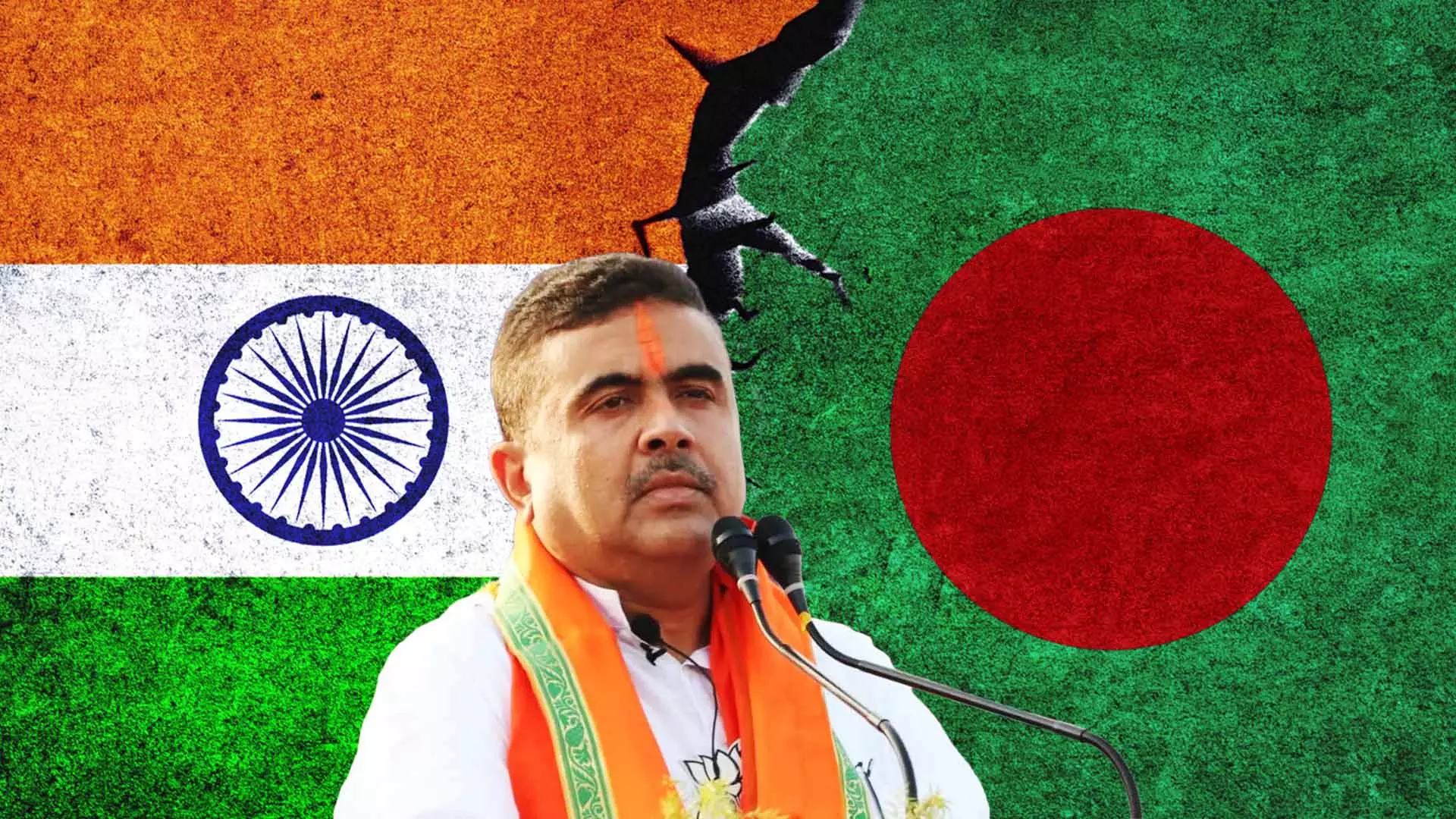
The issue is proving to be yet another classic case of the BJP government's domestic political compulsions overtaking foreign policy considerations
For decades, Indians have been told that millions of illegal Bangladeshi migrants have sneaked into the country. Tackling the menace of illegal Bangladeshi infiltration was high on the BJP's 2026 West Bengal election manifesto — a pitch that is believed to have fetched it rich electoral dividends.
With a 'double-engine' government finally established in the state, some visible action on detection and deportation of Bangladeshi illegals was expected.
Also read: India-Bangladesh ties under strain as pushbacks threaten reset
Immediately after the BJP government was installed in Bengal, the Centre started mounting pressure on Bangladesh. On May 21, External Affairs Ministry spokesperson Randhir Jaiswal told a weekly media briefing that the verification of the nationality of many alleged illegal migrants has been pending with Bangladeshi authorities for almost five years.
'They will be dealt as per law'
“We have asked the Bangladeshi side to verify their nationality. We have a pending list of 2,369 people who are required to be deported,” Jaiswal said in response to a query on Indian authorities pushing back illegal migrants from Bangladesh through land borders.
“Foreigners staying in India illegally, whether they happen to be Bangladeshi nationals or any other national, they will be dealt with as per law. We have a large number of Bangladesh nationals here who are required to be deported,” he added.
Once Bengal leaders like Jyoti Basu and Pranab Mukherjee played a quietly critical role in improving India-Bangladesh relations. That first changed with Mamata Banerjee scuttling the Teesta water-sharing accord in 2011.
“Many of them have actually completed their jail sentences, and in many cases, the nationality verification is pending since 2020. So almost five years have gone by. We would urge the Bangladeshi side [to] expedite the verification process so that people who are required to be deported can be sent back to Bangladesh,” he said.
Illegal migration from Bangladesh into the Indian border states has been an undeniable phenomenon. But when India's official spokesman talks of only a few thousand illegals waiting to be sent back, it doesn't quite match up to claims of "millions" of ghuspetiyas (illegal migrants) that leaders have thundered about in poll rallies.
The numbers mismatch
There is also quite a mismatch in pushback statistics between the claims of those pushed back into Bangladesh since the BJP assumed power in Bengal.
The Border Security Force (BSF), which has been accused of forcibly pushing back Bangladeshi illegals, says it has deported 2,390 people back to Bangladesh since March this year. Since Bangladesh has made a huge issue of the forcible pushbacks and claimed it as a violation of existing deportation procedures, the BSF has understandably sought to play it down.
Watch/Read | 'Chest thumping not foreign policy, New Delhi-Dhaka must return to dialogue'
But West Bengal's new Chief Minister, Suvendu Adhikari, has gone to town big time on the issue. On June 8, he claimed that around 4,800 people had been pushed to Bangladesh, and another 836 people were in holding centres.
Saying that border security and illegal infiltrators were some of the biggest concerns for the state government, Adhikari remarked in a BJP party meeting: "We have started the work of deporting infiltrators who do not fall under the purview of CAA. There was an MHA (Ministry of Home Affairs) directive to hand them over directly to BSF instead of sending them to jail. Here, however, the infiltrators used to be treated like sons-in-law and sent to jail. Now, holding stations have been set up in border districts.
"From there, 4,800 people have been sent across the border so far, and another 836 people are currently in the holding stations. We are making arrangements to send them over. The process will continue. This was a priority. The demography of Bengal had changed, as you all know."
Frayed tempers
Adhikari's statements came ahead of the 57th edition of the biannual director general-level border coordination conference between the BSF and the Border Guard Bangladesh (BGB), which was held in New Delhi on June 8-11.
The BGB made a huge issue of the pushbacks in this meeting. The tempers were so frayed that the two forces did not go in for the joint press conference usually held at the end of such meetings. Clearly, the gloves were off.
Then, on Tuesday (June 23), Adhikari said his government had pushed back 10,000 illegal infiltrators to Bangladesh, and another 1,800 were waiting in 12 holding centres to be sent back. "We have already sent back 10,000 illegal infiltrators and another 1,800 are waiting in 12 holding centres to be sent back. We are sending back illegal immigrants every day," the Chief Minister told the state Assembly.
Also read: From Basu’s warning to Bengal ballot: How Bangladesh turmoil fuelled BJP’s eastern rise
If Adhikari is right, that would mean the pushbacks have gathered real speed in June after the border guard meeting because the number has doubled in just two weeks.
Claims of victory
The BGB has claimed they have prevented at least 30 pushback attempts in May-June by the BSF. Bangladeshi netizens were all praise for BGB personnel for "bravely resisting" the BSF pushback efforts.
In one case, when the BSF took back a few deported people stuck in the no-man's land on 'humanitarian grounds', Bangladeshi Islamist hardliners claimed victory and thanked the BGB for 'resisting Indian aggression'. But neither the Bangladesh government nor the BGB officially contested Adhikari's pushback statistics, except that one Jamaat-e-Islami MP wrote to the Indian government to "control Suvendu Adhikari".
No independent verification has been possible on the actual number of pushbacks. The Indian government and the BSF would clearly play it down to avoid blame for violating standard operating procedures of deportation by unilaterally pushing back.
But if that is what New Delhi preferred, that stands undone by Adhikari's unabashed triumphalism on the issue, as he has presented definite statistics on the Assembly floor.
Domestic politics over foreign policy
This is yet another classic case of domestic political compulsions overtaking foreign policy considerations. All this has resulted in a sharp drop in bilateral ties with Bangladesh amid an escalating social media war involving the Hindutva brigade in Bengal and the Islamist hardliners in Bangladesh.
There was a time when Bengal leaders like Jyoti Basu and Pranab Mukherjee played a quietly critical role in improving India-Bangladesh relations. That first changed with Mamata Banerjee scuttling the Teesta water-sharing accord in 2011. Her alleged hobnobbing with Islamist radicals in Bangladesh even upset an India-friendly Sheikh Hasina and her Awami League.
Also read: Why Suvendu's BJP govt in Bengal can never truly claim Rabindranath Tagore
Adhikari's tirade against the Jamaat-e-Islami is welcomed by Awami Leaguers and anti-radicals, but his frequent boast that the Indian military "can sort out Bangladesh in a few minutes" drives up political temperatures on the other side of the border. It makes the task of India's new High Commissioner in Dhaka, Dinesh Trivedi, so much more difficult.
Need for diplomacy
With both border forces on high alert over the pushbacks and some cases of firings already reported, it will need a strong diplomatic effort to control the tensions and normalise ties. With Pakistan frequently threatening war over the Indus Waters issue, it does not help India get into a two-front confrontation.
Sabre-rattling may help win elections, but a two-front confrontation with an unresolved border dispute with China is surely not in India's interest.
When Indira Gandhi sent the Army to help liberate Bangladesh in 1971, it was precisely to avoid such a scenario.
(The Federal seeks to present views and opinions from all sides of the spectrum. The information, ideas or opinions in the articles are of the author and do not necessarily reflect the views of The Federal.)