'Chest thumping not foreign policy, New Delhi-Dhaka must return to dialogue' | Worldly-Wise
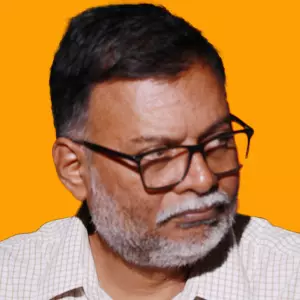
Amid strains between New Delhi, Dhaka, senior journalist Subir Bhaumik says both nations need each other and must stop allowing domestic politics, hardline rhetoric to dictate bilateral ties

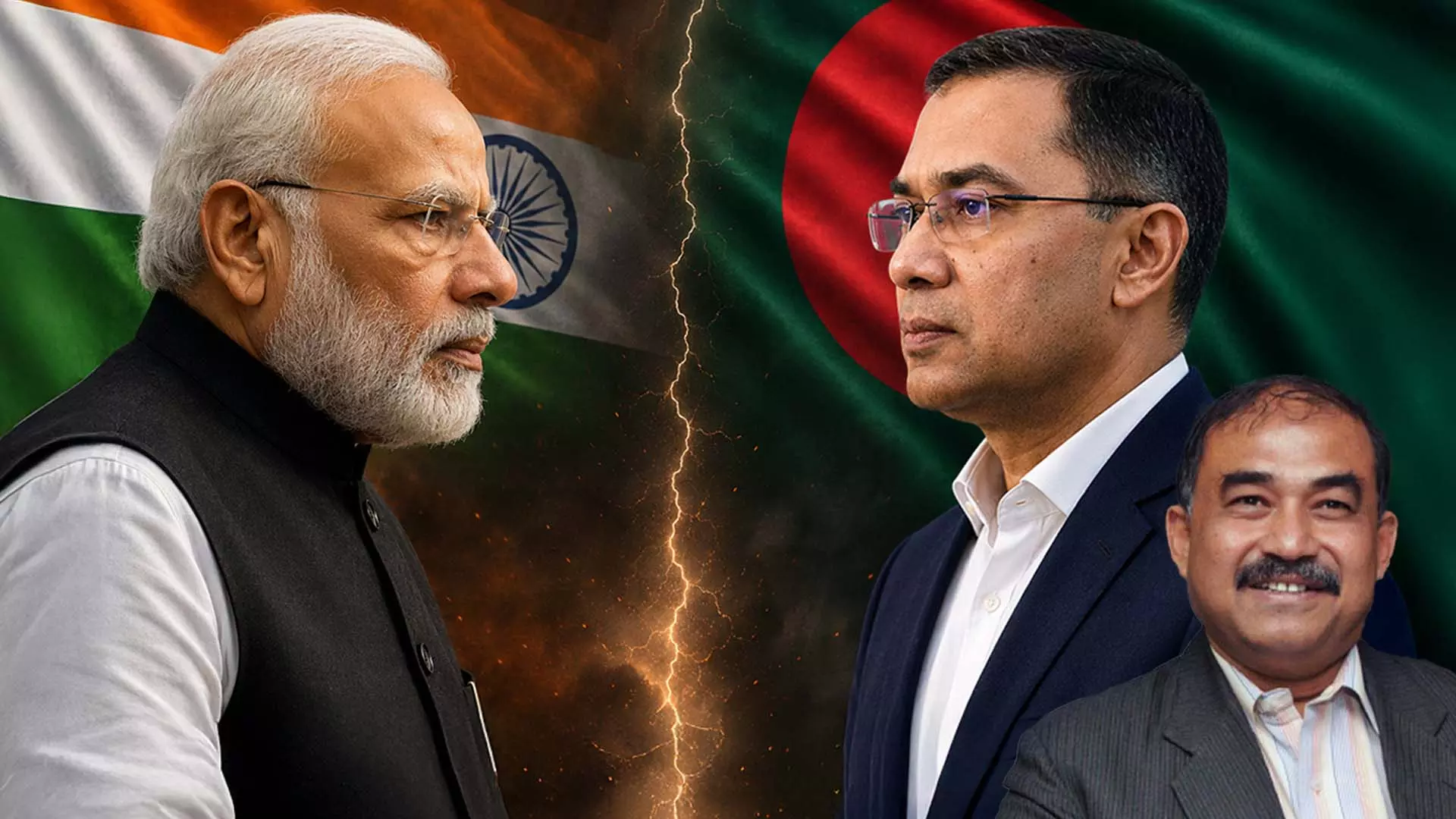
India and Bangladesh need each other, and both governments must stop allowing domestic politics and hardline rhetoric to dictate bilateral relations, says senior journalist Subir Bhaumik. As ties between New Delhi and Dhaka face fresh strains over border pushbacks, visa restrictions, strategic alignments, and the upcoming renewal of the Ganga Water Treaty, diplomacy appears to have taken a back seat.
The Federal spoke to Bhaumik, also a long-time observer of Bangladesh, Myanmar, and the Northeast, about why Bangladesh Prime Minister Tarique Rahman chose China over India for an early foreign visit, the growing tensions between the neighbours, and whether both sides can still find a way back to constructive engagement.
Does Bangladesh Prime Minister Tarique Rahman's visit to China before India reflect continuing tensions with New Delhi?
I would imagine that is the case because Prime Minister Narendra Modi extended a formal invitation to Rahman. There were talks that he would first visit Bhutan, an important neighbour for Bangladesh, as it is beginning to source some electricity from there through India, and then visit India. But things have turned out differently.
Rahman first visited Malaysia, perhaps to make it clear that he was neither visiting India nor China first. But immediately after Malaysia, he went to China.
Also read: Will Tariq Rahman’s return reshape India-Bangladesh ties after Sheikh Hasina’s exit?
Let me make one thing very clear. I do not read too much into Rahman engaging China because Sheikh Hasina, who was India's very good friend and continues to be sheltered in Delhi, also engaged strongly with China. The simple reason is that Bangladesh sees China as the biggest source of development assistance.
The Americans provide no development assistance and currently have a president who is more interested in pushing countries to buy more from the US. India has its own development needs and cannot afford extensive funding, although it has supported some projects in Bangladesh.
China remains the go-to country when Bangladesh is looking for development assistance. Hasina used to say that India was a good friend, but Bangladesh needed rapid development. Otherwise, economic crises could destabilise the country and push it towards extremism.
She linked development assistance to Bangladesh’s future political character. If Bangladesh wanted to remain a moderate Islamic country and not turn into a jihadist state like Pakistan, it needed economic development, and that required funding.
Take the Padma Bridge, one of Bangladesh’s biggest development icons, for instance. It was not built with Indian money. When the World Bank refused funding, Chinese engineering firms stepped in, while Bangladesh raised much of the financing through its own bonds.
The difference now is that Rahman is not looking at China only as a source of development assistance. His government appears interested in expanding strategic cooperation as well.
There is talk that the Bangladesh Air Force may be looking at Chinese fighter aircraft such as the J-10. That takes the relationship to an entirely different level.
Why does India seem reluctant to normalise relations with Bangladesh despite the clear benefits?
People in Delhi's foreign policy establishment may see things differently, but I would go back to history.
Why did India play such a major role in Bangladesh’s liberation? Why did Indira Gandhi send the Indian Army into Bangladesh? It was not because of sentiment. She saw a clear strategic benefit. She wanted to replace a hostile East Pakistan with a friendly Bengali nation.
Also read: India-Bangladesh ties under strain as pushbacks threaten reset
The roots of that thinking go back to former Tripura chief minister Sachindra Lal Singh, who argued that India should replace a hostile East Pakistan that had become a sanctuary and source of support for Naga and Mizo insurgents. There was a definite strategic purpose behind India's actions.
I also remember speaking to Jyoti Basu in 1997 when he was pushing for the Ganges Water Treaty and peace in the Chittagong Hill Tracts. I asked why he was so invested in those issues. He told me that if Hasina were not in power, Islamic fundamentalists would come to power there, and if that happened, hardline forces would gain strength here too. His interest was entirely political and strategic.
The problem today is that Bangladesh has become part of the political narrative during the West Bengal elections. I am surprised that even after the elections are over, the emphasis on pushbacks continues.
The Indian Ministry of External Affairs spokesperson, Randhir Jaiswal, said on May 22 that India had identified 2,390 Bangladeshis and wanted to deport them after verification. But then West Bengal BJP leader Suvendu Adhikari said 4,800 people had been pushed back. Later, he claimed the figure was 10,000.
I checked with sources in the Border Security Force and in Bangladesh’s Home Ministry. Both were citing figures close to 2,300.
So there is a major discrepancy. I do not know who is right, but there is clearly some chest-thumping involved.
The result of this is growing tensions at the border. We have seen cases where people were stranded in no man's land, with border forces on both sides refusing to accept them. Some were left without food and water for nearly 48 hours.
Also read: Women, children stranded in no-man’s land as India, Bangladesh spar over nationality
There appears to be little effort from either Delhi or Dhaka to solve the issue through diplomacy, which is really the only viable solution.
Why have visa restrictions and other barriers remained in place despite expectations of improved ties?
India had complaints during the period of Muhammad Yunus. He openly said he did not want special relations with India.
During that period, some student leaders and political groups went so far as to attack Indian diplomatic establishments. For security reasons, many Indian diplomatic personnel were withdrawn, and visa issuance declined.
The demand for Indian visas remains enormous. To handle that volume, you need adequate staff. If personnel are not safe, it becomes difficult.
After the new government under Rahman came to power, there was hope that things would return to normal.
India also signalled political intent by appointing Dinesh Trivedi as ambassador to Bangladesh. For the first time since Bangladesh’s creation, India sent a senior politician rather than a career diplomat.
Trivedi speaks fluent Bengali and understands the region well. But even when he made a friendly remark that travelling from Kolkata to Dhaka did not feel like entering a different country, hardliners immediately portrayed it as evidence of an ‘Akhand Bharat’ agenda.
Also read: New Delhi-Dhaka ties: Can India afford to lose Teesta to China?
The same pattern exists on both sides of the border. Bangladesh-bashing has increased in India, while Islamist radicals in Bangladesh react strongly to anything they perceive as Indian influence.
There are radicals and hotheads on both sides.
Much attention has been given to attacks on Hindus in Bangladesh. Those attacks are real, but I would also point out that 87 Sufi shrines have reportedly been demolished by hardline Islamist groups.
These groups consider Sufi traditions incompatible with their interpretation of Islam. Bangladesh is experiencing a rise in Islamic radicalism, and that is a serious issue.
At the same time, radical rhetoric has also intensified in India.
Both governments need to step back and ask a simple question: do India and Bangladesh need each other? My answer is yes.
Is Tarique Rahman's decision not to seek Sheikh Hasina's repatriation a sign of reconciliation?
I think the Rahman government has accepted that Hasina had a special relationship with India and is currently in Delhi. What they seem to want is an assurance that she and her supporters will not create major problems for Bangladesh from the Indian territory.
The Awami League remains a powerful political force with considerable street mobilisation capacity. India, meanwhile, continues to talk about restoring inclusive democracy in Bangladesh. That raises an important question. How can a country claim to be a democracy if its leading political party is banned?
Also read: Bangladesh summons Indian envoy over detention of PM's adviser at Delhi airport
Can India ban the Congress and still claim to be a democracy?
We saw something similar in Myanmar when the military authorities banned Aung San Suu Kyi's National League for Democracy. Pakistan has also kept Imran Khan in jail for years without meaningful legal progress. Bangladesh cannot fully claim to be an inclusive democracy if the Awami League remains excluded. At the same time, practical diplomacy is needed.
India is also concerned about growing military and political contacts between Bangladesh and Pakistan. Senior figures linked to Lashkar-e-Taiba have reportedly visited Bangladesh, and India sees this as a security concern. Pakistan Army chief Asim Munir has even spoken about striking India from the east. Naturally, India interprets such statements seriously. India's primary expectation is that Bangladeshi territory should not be used for activities hostile to India.
Could the Ganga Water Treaty become leverage for India?
That brings us back to the fundamental point: both countries need each other.
India needs Bangladesh for peace and stability in the Northeast. Many insurgencies declined significantly because Sheikh Hasina cooperated with India and handed over insurgent leaders.
Also read: Yunus sparks fresh row with map showing India’s North East as part of Bangladesh
At the same time, Bangladesh depends on India for water, electricity, and connectivity.
There are people in Bangladesh who say they do not need India because they have China or America. But for water, Bangladesh needs India. For electricity, Bangladesh also needs India.
When electricity imports were interrupted even briefly, industries in Bangladesh faced serious difficulties. Bangladesh's economy remains heavily dependent on sectors such as ready-made garments. Reliable power is crucial. That is why I would appeal to leaders on both sides: sit down, talk, and resolve your problems. Give diplomacy a chance. Foreign policy is not about chest-thumping, slogans, or projecting a muscular image. It is a serious business. India and Bangladesh need each other, and it is time both countries returned to diplomacy and meaningful dialogue.
The content above has been transcribed from video using a fine-tuned AI model. To ensure accuracy, quality, and editorial integrity, we employ a Human-In-The-Loop (HITL) process. While AI assists in creating the initial draft, our experienced editorial team carefully reviews, edits, and refines the content before publication. At The Federal, we combine the efficiency of AI with the expertise of human editors to deliver reliable and insightful journalism.