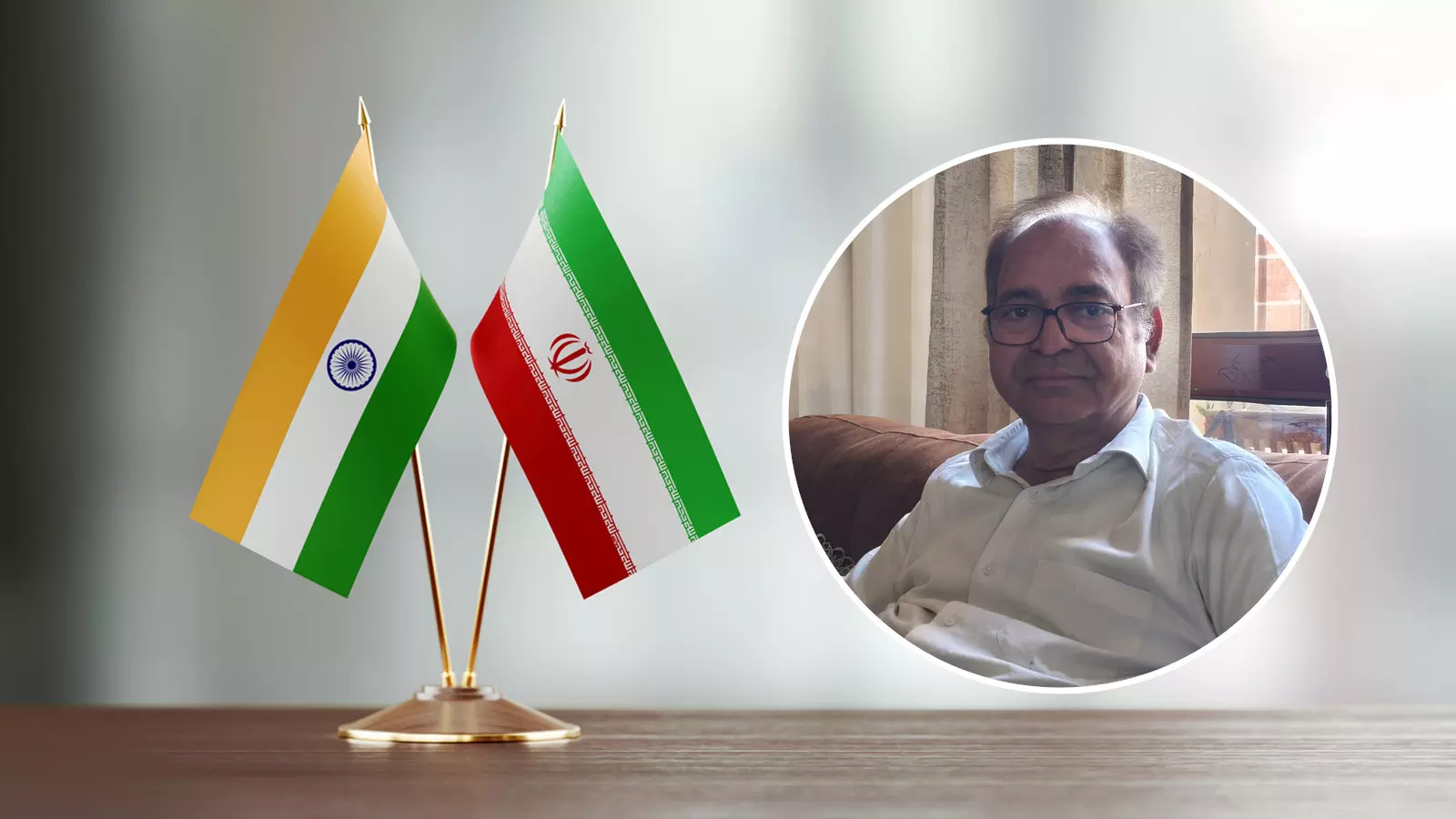
Jawaharlal Nehru University Professor Syed Akhtar Hussain (inset) has criticised the Indian government's response to the attacks on Iran by Israel and the US.
'India's silence over attacks on Iran not pragmatism, but cowardice' | Interview
JNU Professor Syed Akhtar Hussain critiques New Delhi’s 'belated' diplomacy vis-a-vis Tehran amid the ongoing war, saying Iran deserved better from India

As the conflict in West Asia intensifies, questions are being raised about India’s response to it and what it means for its long-standing ties with Iran, the attack on which by Israel and the US triggered the war. The Federal spoke with Syed Akhtar Hussain, professor at the Centre of Persian and Central Asian Studies, Jawaharlal Nehru University, to understand deep civilisational links between the two countries, their recent diplomatic choices, and how their ties are stacked up against the prevailing reality.
Here are excerpts from the interview:
What has been the history of India-Iran relations?
The present scenario does not match the continuum of the India-Iran relationship. Iran happened to be our next-door neighbour before the creation of Afghanistan way back in 1747 and before the creation of Pakistan 200 years later, in 1947. We, therefore, shared common frontiers with Iran long ago, and even during the colonial period, although the relationship started much, much earlier, to be more precise, way back in 570 AD, when we had the Gupta rule in India and the Sassanid rule in Iran, before Islam.
Also read: India's oil reserves: How long can the country sustain a supply shock?
To give an example of the links the two countries once enjoyed, the ancient book of Panchatantra was taken to Iran and translated into the Pahlavi language.
Thereafter, we find Islam entering India from Iran. So many Sufi elements and much of the Iranian psyche have come into India through the Islamic transmission, and it has left a profound impact on this country.
Iran's language, Persian, was made into an official language in India by Raja Todar Mal in 1581. In fact, it was used as an administrative language even during the time of Sikandar Lodi, who ruled before the Mughals. Indians started learning the Persian language in the 15th century, as one could witness the increasing number of grammar books and dictionaries being written in India. The language was spoken in this country till the mid-1830s, when it was removed by Lord Macaulay through his Minute on Indian Education.
The two countries and their peoples share so much of a common heritage as they have lived in a neighbourly relation for such a long time. Indian languages incorporate varying degrees of Persian vocabulary, which can range from 15 to 70 or even 80 per cent.
Even in terms of syntax, the Bengali language, for instance, lacks a specific term for “to drink”. They eat water, just like the Iranians, who also do not drink water but eat it. Also, the Persian language does not have gender, nor does Bengali.
Also read: Iran war tests India’s strategic autonomy as it walks a diplomatic tightrope
Coming to the current times, India was among the first set of nations to recognise the Islamic Republic of Iran, after it was established. Morarji Desai was the prime minister of India then.
India has always enjoyed a very good relationship with Iran. The latter, even under embargo, sold oil to India at a very nominal price through a barter system or exchange of goods.
When did the continuum break?
When US President Donald Trump and Israeli Prime Minister Benjamin Netanyahu launched all of a sudden their sinister mission to invade Iran. The bombings started within 48 hours of Prime Minister Narendra Modi’s visit to Israel.
When Iran’s supreme leader was assassinated during the US-Israeli attacks, India maintained a tacit silence. It did not say a word to condole. It was a few days later that we could see our foreign secretary (Vikram Misri) visiting the Iranian embassy to sign the condolence book.
A school was bombed in Iran during the war, killing 165 young girls. Yet, we did not observe any expression of grief from the representative of the Government of India. These things are quite irksome.
Now, this has never been the practice in our ministerial or bureaucratic setup. Either the prime minister, the head of state or the foreign minister pays a visit, because the secretary is not competent enough to fulfil that protocol. The secretary is a servant of the Indian government; he is not the government.
So, it was just a face-saving exercise, I would say. We could also see that India is remaining silent and indifferent to the hardships and sufferings of the people of Iran.
A school was bombed in Iran during the war, killing 165 young girls. Yet, we did not observe any expression of grief from the representative of the Government of India. These things are quite irksome.
Also read: ‘Severe setback to India’: Congress on reports of Pakistan mediation in West Asia
In times of a global conflict, India’s traditional non-alignment stance and speaking truth to power were not visible.
The situation could also be divided into two phases: the pre-Hormuz and the post-Hormuz.
Can you elaborate?
In the pre-Hormuz scenario, we could see the Indian leadership saving face. Then in the post-Hormuz scenario, one could see Indian vessels being disallowed to pass through the Strait of Hormuz.
When ships carrying gas and oil to India were blocked and denied free passage, New Delhi found itself on the wrong side. The Indian government eventually took pragmatic steps, but only after realising it quite late.
It was then that the relationship between India and Iran started changing, and dialogues began. On March 21, when Eid and Nowruz coincided, we could see PM Modi exchanging greetings with the Iranian President, Masoud Pezeshkian.
It's a shift; it's taking a side. India became more concerned with the dismantling or bombardment of American bases in the Gulf. It was speaking about those attacks.
This once again illustrates that if it had been a customary practice, why didn’t the Indian prime minister greet the Iranian president last year on Nowruz? Or the year before? The Persian New Year is celebrated in Iran on March 21 every year. India should have established the groundwork for this formal greeting much earlier, at least when Modi assumed office.
Again, it was a kind of face-saving gesture because India found that, like Netanyahu and Trump, it was caught in the vortex.
Therefore, upon examining all these factors, it becomes evident that we have not responded to Iran in the way we should have.
Iran has always been a very faithful and friendly ally of India since time immemorial. But when its sovereignty was in question, we could see that our leadership miserably failed to reciprocate.
You say that India did not respond the way it ought to have. How do you think it should have responded?
At least, there could have been a timely condolence for Khamenei's death. When Iran was invaded by Israel and America, India should have given a statement that it is an unwanted war and that Iran is on the defensive. It should also have said that this is an imperialist design of Israel and America, and that it is a blatant interference in that country’s internal affairs, and that the very idea of regime change was unlawful and did not enjoy any legitimacy.
At the same time, India supported a UN Security Council resolution condemning Iran’s attack on the Gulf countries. Would you still see this as indifference, or is this taking a side?
Also read: Genuine goodwill or tactical pause? Reading Trump’s 5-day Iran break | Capital Beat
It's a shift; it's taking a side. India became more concerned with the dismantling or bombardment of American bases in the Gulf. It was speaking about those attacks. Whereas in this invasion, Iran was not waging a war but reacting to America and Israel in self defence.
What would you say to people who are saying that silence or maintaining neutrality is pragmatic?
This is not pragmatism. As someone said, this is cowardice, not pragmatism. It shows a lack of strength or conviction. This invasion has also exploded the myth of Israel and America: that they are not as powerful as the world had been contemplating or visualising.
Do you think that this is just a shift in India's attitude towards Iran during this war, or can you trace it further back?
I think so. Perhaps the government is facing fluctuations in matters of foreign ties. There are hiccups, but there are also certain principles, and one should not deviate from them. Our stated position, for example, is that India stands by the oppressed. When people in Gaza, Palestine, and other places were oppressed by the Israeli authorities, our previous dispensations always stood for the people in Palestine and against the aggression on Gaza. But in the current setup, we fail to see such type of support for the oppressed.
What do you make of PM Modi’s statement in Parliament? When he spoke of the war, the most he said was India is “deeply concerned…”
These are vague statements. If you say we are deeply concerned, you should also call a spade a spade, because the prime minister is above petty considerations. He is the PM of the entire country, not of a particular party. Serving in that post, he represents India globally.
Whether it was Jawaharlal Nehru, Mrs Indira Gandhi, Manmohan Singh, or whoever else we have seen as the prime minister, we have seen an appeal which is global and impartial and not partisan towards any power. India always spoke truth to power and did not align itself with any power in an act of aggrandisement.
What do you have to say about reports suggesting that Pakistan is pitching itself as a mediator in the war?
That is something in the offing. We have no clear idea about it because no official government statement has been made. Many opposition parties are also raising their concern about how Pakistan could play the role of a mediator in the present crisis in Iran. If any mediation were to take place, the initiative should have been taken by India in South Asia, because Pakistan is not a fit country to mediate.
Also read: Close friends to bitter foes, US-Iran story of a busted partnership
Do you think one reason why India did not condemn the supreme leader's killing at that point and stayed silent was that there could be a belief that the regime would change?
Yes, that perhaps might have been in the back of the mind, but the government should have realised the Indian psyche. People condemned the death of the spiritual leader irrespective of caste, creed, and colour. So did different political parties. They all went to sign the book of condolence at the Iranian embassy in Delhi. At least India should have taken cognisance of this mood.
But even Iran has not said anything about India's lack of support...
Iran will never say anything because they have a civilisational etiquette. Their civilisational etiquette would never allow them to say so, but they must have felt it.
What do you mean by civilisational etiquette in this context?
When you live in Iran, you can see how they handle something even if that is not palatable to them, in a very polite and subtle manner, and in a very cultured and sophisticated language. But, at the same time, they are highly offensive and reactive towards their enemies, and thus, you can see that they have been chanting slogans of “death to America” and “death to Israel” for decades.
Also read: Trump dials PM Modi, West Asia conflict, Strait of Hormuz issue discussed
So, you’re saying that despite our silence, we are not seen as an enemy…
No, not at all. I am quite sure that the people of Iran would never disown us. The Iranian government would never disown India because of the historical embedding. India’s stance will make India-Iran economic relations more transactional and more expensive for us, but the threads of friendship are woven very strongly.
Our relationship is based more on civilisational and cultural lines rather than economic ones. Economics change a lot, and even politics change a lot. They are not permanent and constant, but what is constant is the people-to-people relationship, the historical past in which we have lived, and the concern that we have had for one another. So I think, on those lines, the India-Iran relationship will always flourish.