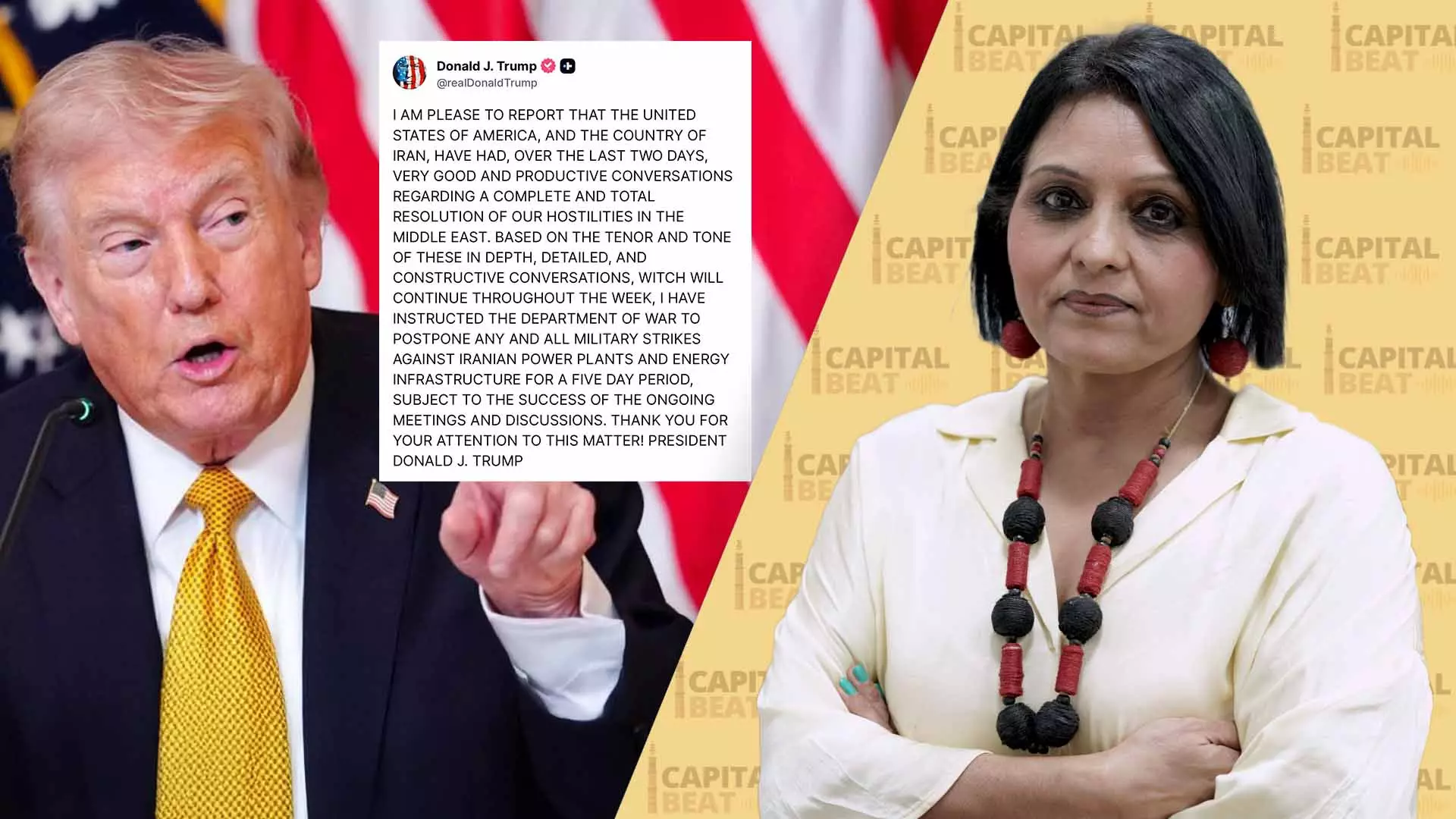
Donald Trump's Social Media post
Genuine goodwill or tactical pause? Reading Trump’s 5-day Iran break | Capital Beat
Analysts debate whether the five-day strike suspension announced by the US president is a cynical 'regrouping' manoeuvre in a war with no clear endgame

In a dramatic turn on the escalating conflict in West Asia, US President Donald Trump on Monday (March 23) announced a five-day pause on planned strikes against Iran’s energy infrastructure, citing “productive conversations” with Tehran.
Also read: A deadline over Hormuz, Iran’s ominous threats, and a U-turn by Trump
The Federal took an opportunity in between the oscillating moments (Trump's announcement came in the middle of the discussion) to speak with journalist Smita Sharma and foreign affairs experts Prof Aftab Kamal Pasha and K S Dakshina Murthy in this episode of Capital Beat to understand where the situation might be heading.
According to them, the development could either signal the first step toward de-escalation—or a tactical pause ahead of a larger escalation.
War context
The discussion began with reports of widespread blackouts across Tehran following heavy airstrikes, raising fears of a worsening humanitarian crisis as the war entered its fourth week.
Over 2,000 people have been killed so far, mostly in Iran and Lebanon, with infrastructure damage intensifying civilian risks. The global economic impact has also widened, even as the US attempted to stabilise markets.
Also read: Is Trump serious about winding down Iran ops? Mixed signals raise concerns | Capital Beat
The situation escalated further after Iran warned it could mine communication routes in the Persian Gulf if its territory was attacked, raising alarm over global oil and shipping disruptions.
Breaking shift
The conversation took a sharp turn when Trump’s latest social media post was read out live. In it, he claimed that the US and Iran had engaged in “very good and productive conversations” over the past two days.
He announced that all planned strikes on Iranian power plants and energy infrastructure would be postponed for five days, subject to the outcome of ongoing discussions.
Also read: Iran media mocks Trump after 48-hour ultimatum melts into 5-day nap
This marked a significant shift from his earlier ultimatum, threatening strikes within 48 hours if Iran did not comply with the American demand of reopening the key Strait of Hormuz. The deadline was set to expire on Monday night.
Do Trump's words carry weight?
Sharma cautioned against taking the announcement at face value, pointing to the fluid and often contradictory nature of information emerging from the conflict zones.
She noted that misinformation and propaganda were rampant, making independent verification difficult. “The visuals are not looking good,” she said, referring to reported strikes on civilian infrastructure, including schools and energy facilities.
Sharma argued that Trump’s strategy appeared to involve raising stakes before negotiations but questioned whether the cost calculations had been fully assessed.
Iran’s stance
According to her, Iran has consistently maintained that any attack on its civilian infrastructure would invite a strong response. She cited retaliatory strikes targeting energy facilities and strategic sites across the region.
She also pointed out that Iran had made it clear from the beginning that it would “raise the cost of this war”, particularly for the US and its allies.
Also read: Current West Asia conflict lacks a roadmap, says geopolitical expert: 'A pointless war'
This raises doubts about whether Tehran would trust a sudden pause announcement, especially without concrete guarantees.
Tactical pause?
Pasha dismissed Trump’s announcement as a possible tactical move rather than a genuine peace effort.
He argued that the US could be attempting to prevent retaliatory strikes from Iran, particularly on nuclear or energy infrastructure in the region. Tehran has carried out a series of lethal retaliations against both the US and Israel recently after they started joint operations against it on February 28, pounding Iranian cities and key infrastructure, including nuclear and energy.
Pasha claimed that Iran had laid down conditions for talks, including compensation and withdrawal of American forces, and with no willingness to stop the war outright.
Trust deficit
Pasha also questioned the credibility of Trump’s claims about “productive talks,” suggesting that Iran was unlikely to fall into what he described as a “trap”.
He warned that the five-day pause could be used to regroup militarily, rather than as a genuine step toward de-escalation.
According to him, Iran currently holds a strategic advantage, with continued missile strikes and regional pressure on US allies.
Silver lining?
Offering a more optimistic view, Dakshina Murthy said the announcement could still be seen as a “silver lining”.
He noted that the clarity of a defined five-day pause and mention of backchannel talks suggested some level of seriousness.
Also read: How Iran has cemented its place in the world of science and technology
However, he stressed that the real test would be whether there is any reduction in hostilities over the coming days.
Two possibilities
Dakshina Murthy outlined two possible interpretations: one, that genuine negotiations are underway; and two, that the pause is a strategic move to buy time for further escalation.
He pointed out that the war has so far lacked a clear objective, making it easier for any side to claim victory.
The absence of a defined endgame, he said, complicates both military and diplomatic calculations.
Regional pressure
The panellists agreed that pressure from Gulf countries and global stakeholders may have played a role in pushing the US toward a pause.
Escalation, particularly attacks on energy infrastructure, had begun affecting the broader region, raising stakes for global markets and security.
This external pressure may have contributed to the sudden shift in tone from Washington.
Uncertain future
Despite the temporary pause, however, the experts warned that the war is far from over.
Sharma noted that even if hostilities reduce in the short term, the conflict could evolve into a prolonged, simmering crisis similar to past regional wars.
Also read: Israel, Iran's tit-for-tat war puts global security on the edge
The panel agreed that the next five days would be critical.
While Trump’s announcement offers a momentary breather, deep scepticism remains about its intent and sustainability.
For now, the world watches closely as diplomacy, military strategy, and political calculations collide in one of the most volatile conflicts in recent times.
The content above has been transcribed from video using a fine-tuned AI model. To ensure accuracy, quality, and editorial integrity, we employ a Human-In-The-Loop (HITL) process. While AI assists in creating the initial draft, our experienced editorial team carefully reviews, edits, and refines the content before publication. At The Federal, we combine the efficiency of AI with the expertise of human editors to deliver reliable and insightful journalism.