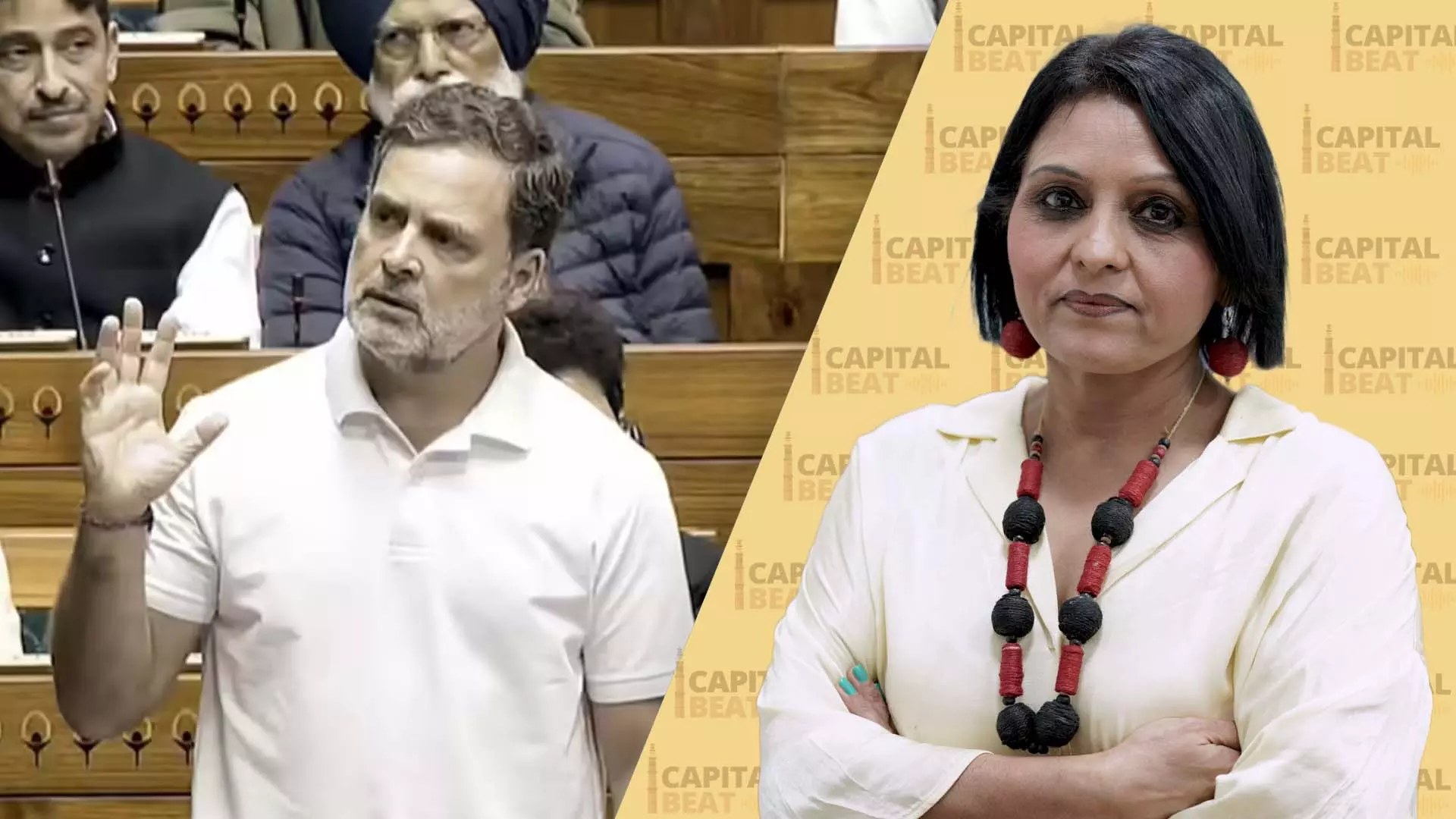
Rahul Gandhi speech sparks expungement row
Rahul's speech: Brutal truth or 'bundle of lies'?
The LoP alleges energy and data sovereignty compromised under new pact while treasury benches seek expunction of his remarks on Epstein and Adani

In this episode of Capital Beat, senior journalist Vivek Deshpande, and Congress spokesperson Anuma Acharya, discussed a speech made by the Leader of Opposition in the Lok Sabha, Rahul Gandhi, in the Lower House alleging the India-US interim trade deal amounted to a “wholesale surrender”, and that the Narendra Modi government sought seek expunction of portions of his remarks from parliamentary records.
The episode tracked Rahul's statements on energy security, agriculture, and data, alongside the parliamentary objections raised after he linked the trade deal to the Jeffrey Epstein files and referenced an issue allegedly involving industrialist Gautam Adani, prompting protests from treasury benches and objections from the Chair, Jagdambika Pal, who presided over the House in place of the Speaker, Om Birla.
Also read: Opposition submits notice seeking Birla's removal as LS Speaker, what next?
The discussion also addressed the demand by ministers that the Congress leader “authenticate” his claims by tabling documents in the House, and the political backdrop of the Opposition considering a no-confidence or removal motion against Birla.
Rahul slams US deal: 'Disgraceful'
The programme opened with excerpts from Rahul’s Budget-debate remarks.
“Our energy security has been handed over to the US under the trade deal. This is a wholesale surrender,” he said in the Lok Sabha, alongside a warning on agriculture: “You have opened the door to mechanised American farms. You have opened the door to crush our poor farmers. It is disgraceful.”
The LoP also asserted that “no Indian prime minister” would have agreed to such an arrangement and alleged that Prime Minister Narendra Modi had “surrendered the future of 1.5 billion Indians” to protect what he termed the BJP’s “financial architecture,” with the reference to Adani, which was interrupted by the Chair.
Also read: No-confidence motion against Speaker Birla: Will INDIA bloc unite? | Capital Beat
A revised fact sheet released by the White House on Monday (February 9), described in the episode as an interim agreement announcement, was cited in the context of the deal’s evolving public description, including a reference to pulses being removed, while “full details” were described as yet to emerge.
'US must engage with India as an equal'
The episode highlighted Rahul’s focus on data as a negotiating lever. He said, “Indian data is the most important asset and key to protecting the dollar,” adding that if the US sought access, it “must engage with India as an equal”, while India would “protect its energy security and safeguard its own farmers.”
He also linked the Budget to a deteriorating global environment, stating that it recognised “a dangerous time intensifying geopolitical conflicts,” and added, “Energy and finance are being weaponised all across the world. Dollar is being weaponised… There is absolutely nothing in the Budget that looks into these issues.”
Soon after the speech, Union Parliamentary Affairs Minister Kiren Rijiju described the LoP's remarks as a “bundle of lies” and added that the ruling alliance would seek to expunge the “lies” from House records, with the episode noting that the words “Epstein” and “Adani” were among those expected to be expunged.
Rahul's attack 'soft but strong'
Describing Rahul's delivery in the Lok Sabha as composed and sustained, Acharya said, “He kept his voice very calm, his attacks were very sharp, soft delivery but very strong impact,” adding that the latter spoke on “farmers, soldiers, jobs, and India’s global position”.
Also read: Will Naravane’s memoir row trigger another prolonged stalemate in Parliament?
She also referred to the Congress MP invoking a martial arts example, stating that he cited jiu-jitsu and spoke about “choking” and “grip,” alongside a claim that pressure from the US had led to India’s interests being given away.
On the demand that Rahul authenticate his claims, Acharya said that the material cited on the Epstein matter originated from the US justice department, saying, “All of this, whatever is there, that is in any case authenticated.” According to her, the Congress did not speak without documentary support and that “evidences can be produced”.
'Nothing he has said is not true'
Deshpande characterised the intervention as a forceful parliamentary attack on the interim trade deal and framed the authentication dispute around the availability of material already in circulation.
“The issues which Rahul Gandhi has raised today have been there in the public domain for a while,” he remarked, adding, “There is nothing that he has said that is not true.”
Also referring to issues such as the Epstein files, the Adani matter, and the controversy around former Army chief General Manoj Mukund Naravane and remarks attributed to him, the journalist said that reproduction of relevant texts from books, interviews, and utterances could be used to authenticate claims.
Also read: 'Lacklustre', 'visionless', 'blind' to India’s 'real crises' — How Opposition sees Budget 2026-27
On the government’s insistence on authentication, Deshpande questioned its practical purpose, “What is the point is asking him for documentary evidence… there are documents available… The government also knows that.” He also asked whether tabling documents would change the government’s stance.
No-confidence motion, trade-deal contexts
The episode included a question on whether the Chair’s insistence and the treasury bench's objections were connected to the Opposition's plans to move against Speaker Birla.
Acharya said the no-confidence motion had already been signed by “118” MPs and described the atmosphere during Rahul's speech as tense, stating that “the other side was really nervous”.
According to her, the Speaker himself appeared very uneasy in the House.
Acharya also cited a trade-related comparison attributed to Rahul during the talks, saying that Bangladesh was “getting zero tariff from America” while India faced a range “from three per cent to 18 per cent.” The Congress spokesperson also said the LoP referred to textile manufacturers in places such as Gurgaon.
The episode also referred to Union Finance Minister Nirmala Sitharaman speaking in Parliament while the panel discussion was underway, in the context of the government’s ongoing response inside the House.
Govt 'absolutely answerable'
A central segment focused on whether references such as the Epstein files and the Adani issue should be excluded from parliamentary records. According to Deshpande, “It must be scrutinised very thoroughly in Parliament.” He added the government was “absolutely answerable” due to the seriousness of the issues and their impact on the country's prestige.
Also read: How India’s EU and US trade pacts compare with the 1991 liberalisation
The panelist also set out a pattern he attributed to the government’s handling of inconvenient issues, claiming that issues are avoided, narratives are shifted, and older controversies are allowed to fade.
“I am sure they are not going to answer the Adani question… they are not going to answer the Epstein question,” he said.
Acharya argued that the effort towards expunction is linked to a broader effort to prevent certain issues from being recorded in official history and cited the unfolding dispute over the alleged circulation of Naravane’s unpublished memoir, Four Stars of Destiny, describing police action and a publisher's statement as part of the episode’s reference point.
'Rahul asked to protect India's future'
The programme included a readout of a post attributed to senior Congress leader K C Venugopal, framing Rahul's intervention as exposing alleged surrender of “economic sovereignty,” and listing “data, agriculture, labour class and energy security” as being handed over, while also referencing “Epstein files revelations” and “Adani’s financial dealings” as leverage in negotiations.
Also read: 'Father of all deals': Tiruppur exporters bet big on India-US trade deal
Returning to the LoP's intended message, Acharya stated, “What Rahul Gandhi said is protect India’s future and do not trade it away,” describing this as “the entire crux” of the speech.
Deshpande framed the concluding message as a demand for accountability, saying, “The message is clear that you are answerable to many of those very important questions which have a bearing on the country’s dignity and prestige and India’s economy and the well-being of the people of India.”
The content above has been transcribed from video using a fine-tuned AI model. To ensure accuracy, quality, and editorial integrity, we employ a Human-In-The-Loop (HITL) process. While AI assists in creating the initial draft, our experienced editorial team carefully reviews, edits, and refines the content before publication. At The Federal, we combine the efficiency of AI with the expertise of human editors to deliver reliable and insightful journalism.