No confidence motion
No-confidence motion against Speaker Birla: Will INDIA bloc unite? | Capital Beat
Opposition initiates symbolic resolution citing bias and suppression of voices, but faces hurdles over internal unity and a lack of floor numbers in Lok Sabha

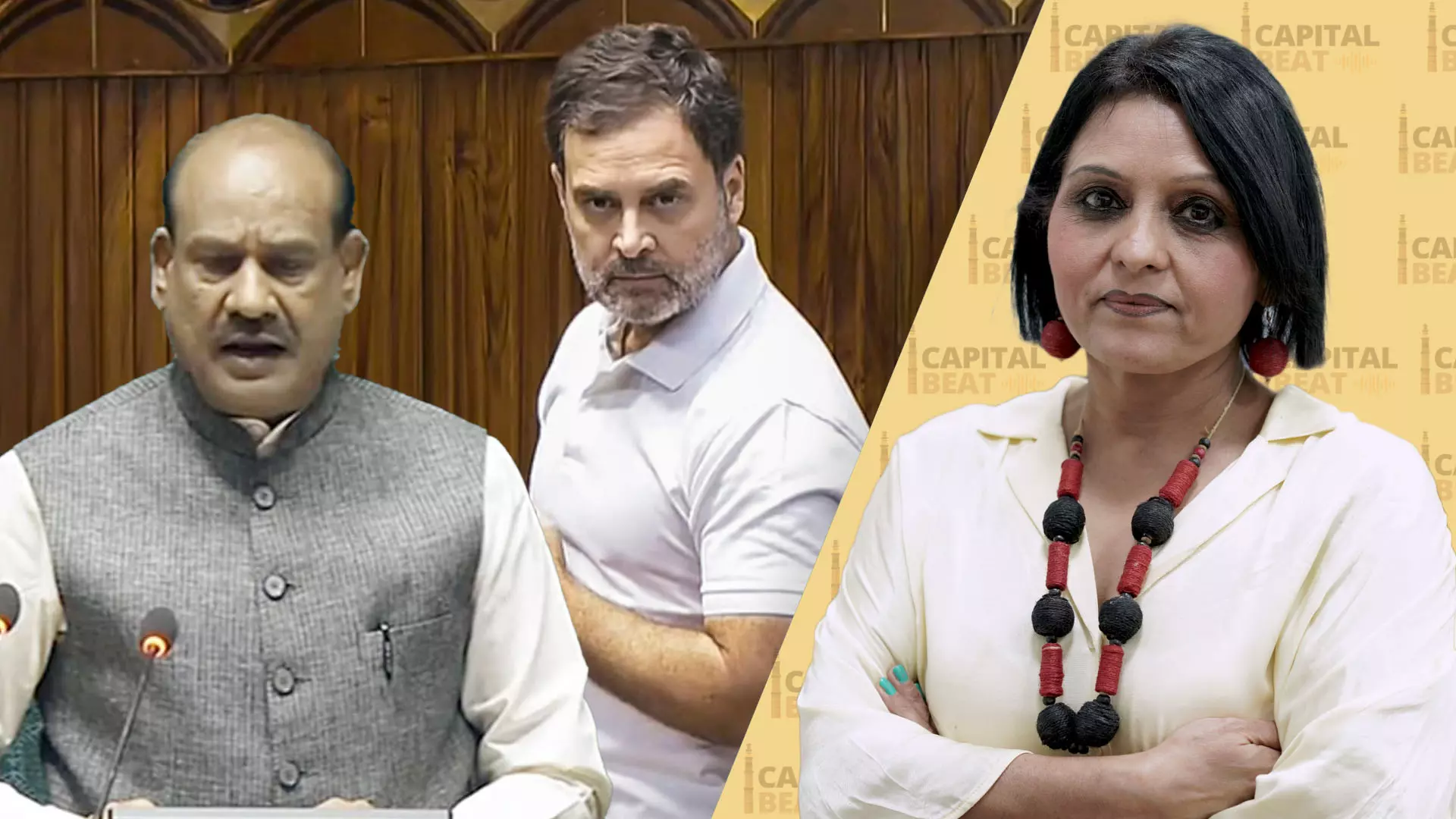
As the opposition Indian National Developmental Inclusive Alliance (INDIA) bloc considers moving a resolution under Article 94(c) of the Constitution to remove the Speaker of the Lok Sabha, Om Birla, over alleged partisanship and suppression of voices critical of the government, questions loom over the opposition's unity, procedural hurdles, and the broader implications for parliamentary democracy.
Also read: Why Rahul citing Naravane’s memoir sparked Parliament showdown | Capital Beat
The Federal spoke to Javed Ansari, senior journalist and political commentator, and PDT Achary, former secretary general of the Lok Sabha in this episode of Capital Beat, to unpack what the move means, why it is largely symbolic, and whether it can force accountability in a deeply polarised Parliament.
“This is not a knee-jerk reaction. A resolution to remove the Speaker is a serious, substantive parliamentary step and must be thought through carefully,” Ansari said, underlining the political and institutional stakes involved in the Opposition’s move against Birla, the 17th incumbent who has been serving since 2019.
Why the motion matters
The opposition’s decision to initiate a resolution seeking Birla's ouster marks an unprecedented escalation in parliamentary confrontation.
The grievances cited include the Speaker's alleged denial of speaking time to Leader of the Opposition Rahul Gandhi on the Motion of Thanks to the President's address, while not reining in BJP MP Nishikant Dubey from making controversial remarks against the opposition in the House, besides the suspension of eight Opposition MPs for the remainder of the ongoing Budget Session.
Also read: 'It is clear that all Governors are acting in concert' | Capital Beat
Ansari noted that even if the entire opposition votes together, the motion is certain to fail numerically. “Given the numbers, this will fail. But it is symbolic. It is meant to make a point and put things on record,” he said.
The symbolism also depends heavily on the opposition unity — something that remains uncertain.
INDIA bloc's cracks
A key concern discussed on the panel was the apparent lack of consensus within the INDIA bloc. While the Dravida Munnetra Kazhagam (DMK) is reported to be supportive, the Trinamool Congress (TMC) has remained non-committal. According to Ansari, this hesitation could stem from dissatisfaction with the Congress’s parliamentary strategy.
“The TMC and some other parties feel the Congress takes them for granted. They believe their views are not accommodated and that Parliament is being run with a Congress-centric agenda,” he said.
Also read: Is Raj Thackeray evoking ‘Marathi manoos’ sentiment with ‘rasmalai’, ‘lungi’ jibes?
If TMC stays away, Ansari warned, the optics would be damaging. “It will look like a divided opposition. That weakens the entire exercise politically,” Ansari added, stressing that it is incumbent on Congress leadership, particularly Rahul Gandhi, to reach out and build consensus.
Speaker removal explained
Achary provided a crucial constitutional clarity, emphasising that there is technically no such thing as a “no-confidence motion” against the Speaker.
“What exists is a resolution seeking the removal of the Speaker under Article 94(c) of the Constitution,” he explained. “The Speaker is elected by the House, and the House has the power to remove him.”
Achary outlined that any member could move such a resolution, provided it meets procedural requirements laid out in the (House) Rules of Procedure, starting from Rule 200 onwards.
Also read: Did Modi use RS to defend trade deals and target Congress? | Capital Beat
Importantly, he stressed that the opposition, as an integral part of the House, has every right to initiate such a move if it believes the Speaker has lost its confidence.
Technical hurdles
The former secretary general of the Lok Sabha cautioned that the success of even admitting the resolution depends entirely on technical precision. “The resolution must contain specific charges. Vague allegations, defamatory imputations, or loosely worded accusations can lead to rejection at the admission stage,” he said.
He recalled past instances where similar resolutions were dismissed on technical grounds, even before reaching debate. “This is why the opposition must be extremely careful in framing the charges,” Achary noted.
Once admitted, the Speaker has the right to respond to the charges on the floor of the House — a rare moment when the Speaker actively participates in proceedings rather than presiding over them.
Allegations under scrutiny
One of the most serious allegations discussed during the panel was Birla's statement in the House suggesting that women Opposition MPs could physically attack Prime Minister Narendra Modi, prompting him to advise against the latter's presence in the Lower House.
Also read: India-US trade deal: Is it a win or strategic compromise?
Ansari described this as a grave charge. “If such a threat existed, what was the follow-up? Was an FIR filed? On what basis was this claim made?” he asked, arguing that allegations of an attempt on the prime minister’s life cannot be made casually.
Achary concurred that if the resolution is debated, the Speaker will have to answer each specific charge. “He will need to defend his position with facts and evidence,” he said.
Symbolism versus outcome
Both panellists agreed that the final outcome of the resolution is a foregone conclusion. With the NDA holding a commanding majority, the motion will be defeated.
However, Ansari emphasised that the political purpose lies elsewhere. “This is about forcing accountability, about compelling the Speaker to answer serious charges in the House,” he said.
Yet, he cautioned that unless the entire opposition stands united, the exercise could backfire. “If this becomes a Congress-only affair, it will fall short of its political objective,” he warned.
'Both govt, Opposition act like gladiators'
Despite the confrontational tone, both experts underlined that parliamentary democracy thrives on dialogue. Ansari pointed out that the resolution has not yet been tabled, leaving room for negotiation.
“Until it is formally moved, the door for dialogue is open,” he said. The senior journalist cited recent attempts by Congress leader KC Venugopal to engage with the Speaker as evidence that backchannel communication still exists.
However, Ansari was blunt in his assessment of the larger problem. “There is absolutely no dialogue between the government and the opposition on any issue. Both sides behave like gladiators. That damages Parliament as an institution.”
Institutional damage
In his concluding remarks, Ansari delivered a stark warning. “Governments come and go. Oppositions change. But Parliament remains. And right now, it is Parliament that is being damaged.”
Achary echoed this sentiment, noting that Speaker removal motions are rare precisely because the office symbolises the dignity and authority of the House. “Moving such a resolution is not a simple matter. It reflects a serious breakdown of trust,” he said.
Both agreed that while the opposition has the constitutional right to pursue the motion, its true test lies in whether it strengthens democratic accountability—or deepens parliamentary paralysis.
The content above has been transcribed from video using a fine-tuned AI model. To ensure accuracy, quality, and editorial integrity, we employ a Human-In-The-Loop (HITL) process. While AI assists in creating the initial draft, our experienced editorial team carefully reviews, edits, and refines the content before publication. At The Federal, we combine the efficiency of AI with the expertise of human editors to deliver reliable and insightful journalism.