'Father of all deals': Tiruppur exporters bet big on India-US trade deal
Apparel export veteran A Sakthivel says the India–US trade deal could boost exports for a decade, but warns labour shortages and housing gaps may hamper growth

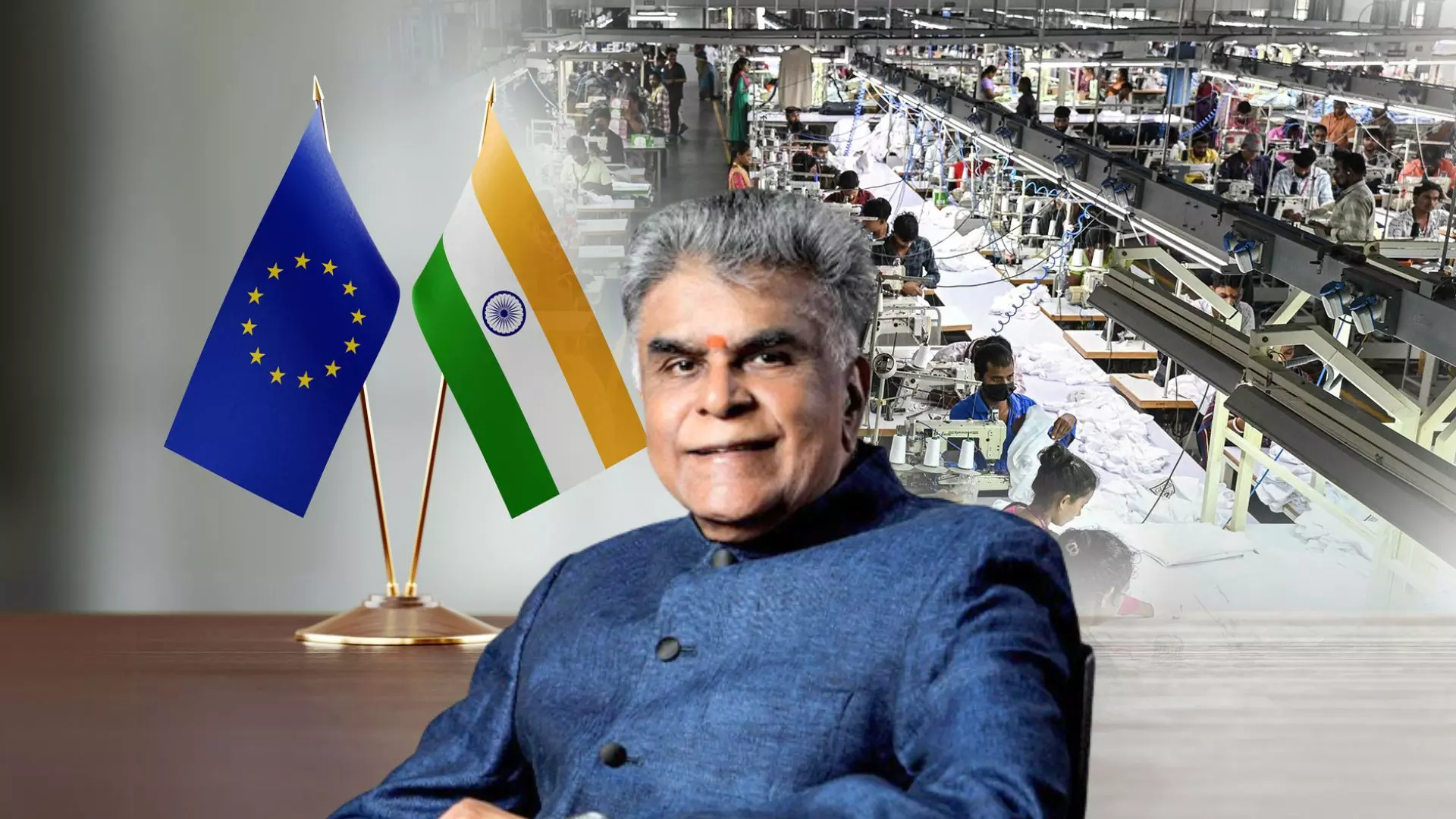
Calling the India–US trade agreement a “father of all deals,” apparel export veteran A Sakthivel says the removal of punitive tariffs and impending bilateral concessions could trigger a decade-long boom for India’s textile industry — but warns that labour shortages and inadequate worker housing could derail the opportunity if governments fail to act fast.
Against the backdrop of India’s expanding free trade agreements with the US, the EU, the UK and others, The Federal spoke to A Sakthivel, chairman of the Apparel Export Promotion Council (AEPC), on how these deals could reshape Tiruppur’s knitwear cluster, global competitiveness, and employment landscape.
Edited excerpts from the interview:
How will the latest India-US trade agreement impact orders and pricing for Tiruppur exporters?
It is going to be a boom period for this decade for the textile and apparel industry. First, we had the UK FTA, then New Zealand, then Oman, and then what was called the mother of all deals — the European Union with 27 countries. After that, we went through six months of turmoil when the US imposed a penalty tariff of 25 per cent.
Also Read: India-EU free trade pact sealed, marks major shift in global trade
The big news for us was that this tariff was brought down to 18 per cent. Not only that, we are now expecting a bilateral trade agreement with the US where duties may further reduce to around 15 per cent.
The US is extremely important because about 30 per cent of India’s garment exports go there. From Tiruppur and across India, we export around $5.5 billion worth of apparel to the US alone.
How did exporters cope when the US imposed a 25 per cent penalty tariff?
When the penalty was imposed, buyers did not want to leave us, and we also did not want to leave them. So we shared the burden. Out of the 25 per cent penalty, exporters bore nearly 80 per cent, while buyers absorbed around 20 per cent.
But after some time, our capital started eroding. Just when things were becoming unsustainable, the US reduced the tariff. That was a huge relief and a very big announcement for us.
Why do you describe the US deal as more significant than others?
The US is one country, but it accounts for nearly 30 per cent of our exports. Europe, with many countries combined, contributes around 35 per cent.
Also Read: Details of India-US interim trade deal: Which sectors benefit, what’s protected
The advantage with the US is that orders are large and they come throughout the year. That stability matters. So when I say the EU is the mother of all deals, I can confidently call the US agreement the father of all deals.
Do you credit the government for these outcomes?
I wholeheartedly thank and appreciate our Prime Minister and the Commerce Minister, Piyush Goyal, for their crucial support. They took time, yes, but they ensured that the interests of 140 crore Indians were protected.
They consulted exporters, fabric manufacturers, apparel makers, and ancillary industries before finalising these agreements. That is why this decision addresses most of the concerns of Indian exporters.
What kind of export growth do you expect now?
We are currently exporting around $5.25–5.5 billion. Within three months, we expect a 20 per cent increase. Within a year, it could go up by 40 per cent.
When apparel exports rise, it boosts the entire fibre-to-fashion value chain — spinning, weaving, accessories, cotton, everything. This growth benefits all sectors.
You have seen Tiruppur’s transformation over decades. How does this moment compare to post-1991 liberalisation?
I would not call this an impact — it is an opportunity. Until 1985, our exports were just $10 billion. Last year, Tiruppur alone did business worth ₹45,000 crore, which is around $5.9 billion.
Also Read: How Europe expects India-EU trade deal to boost its economy
About 70 per cent of India’s knitwear exports are manufactured in Tiruppur. We directly export nearly 50 per cent, while another 15 per cent goes indirectly through buyers in cities like Delhi, Mumbai and Bengaluru.
The next 30 years belong to us. With the UK FTA already implemented and EU agreements coming in, buyers have started evaluating Indian exporters for compliance, capacity and quality. Orders are already being discussed.
Will labour availability become the biggest challenge as orders increase?
Yes, absolutely. Labour mobilisation is our biggest concern. We are already facing a shortage.
Tamil Nadu labour refuses to work because the state government has spoiled the labour force by giving freebies. Nobody wants to come and work in Tiruppur anymore. We are forced to depend entirely on migrant workers.
What are migrant workers demanding now?
They want better working conditions, better accommodation and better facilities. When we recruit them, we show video clips of the hostels, the work environment, and even testimonials from existing workers.
Also Read: India seen as trusted trade partner: PM Modi in Malaysia after US, EU deals
We provide sports facilities, TV shows, volleyball grounds — everything. Even college hostels cannot match the quality of our women’s hostels. I can confidently say they are like five-star campuses.
If facilities are so good, what is stopping expansion?
Infrastructure like sheds and buildings can be financed through loans, and they are productivity investments. But women’s hostels are dead investments.
If we house 1,000 women, it costs around ₹40 crore. There is no direct productivity return. That is why we are requesting the Government of India and the Tamil Nadu government to provide a 50 per cent capital subsidy for women’s hostels and a 5 per cent interest subsidy on the remaining amount.
Without this support, expansion will be extremely difficult.
The Tamil Nadu government says freebies empower women. Why do you disagree?
You and I both know where direct cash transfers are going. I don’t want to say it openly. Instead of freebies, the government should focus on skilling.
Skills allow people to earn throughout their lives and understand the value of education and hard work. Free money creates dependency and discourages education and skill development. This policy is not welfare — it is vote bank politics.
How will these trade deals affect small and medium textile units in Tiruppur?
The government understands that 68 per cent of exporters come from the MSME sector. That is why budgetary support continues.
Textile mega parks, technical textile funding, and MMF incentives are all steps in the right direction. But one hostel per district is not enough. Tiruppur alone needs at least 10 to 15 women’s hostels.
Without that, exporters will move to states like Madhya Pradesh and Odisha. This shift has already begun.
How does India now compare with competitors like Bangladesh and Vietnam?
India has a huge advantage. We are a raw material-rich country. Everything — cotton, man-made fibre, accessories — is available locally. Competing countries import most inputs.
Also Read: India–EU FTA decoded: Trade expert Biswajit Dhar on winners, losers, and hidden risks
Bangladesh benefited for years as a least-developed country with zero or low duties. Now, with zero duty access to the EU and UK, buyers will shift to India because of quality, delivery assurance and political stability.
The unrest in Bangladesh has already scared buyers. Many are looking at India as a safer alternative.
Is this decade decisive for the apparel industry?
Without doubt. This decade belongs to textiles and apparel. If we solve labour and infrastructure issues, India can dominate global garment exports.
(The content above has been transcribed from video using a fine-tuned AI model. To ensure accuracy, quality, and editorial integrity, we employ a Human-In-The-Loop (HITL) process. While AI assists in creating the initial draft, our experienced editorial team carefully reviews, edits, and refines the content before publication. At The Federal, we combine the efficiency of AI with the expertise of human editors to deliver reliable and insightful journalism.)