Will Naravane’s memoir row trigger another prolonged stalemate in Parliament?
With eight MPs suspended and Rahul Gandhi denied a chance to speak, concerns are growing that Budget session could face a prolonged stalemate like previous ones

Repeated adjournments of the Lok Sabha over Rahul Gandhi being denied the opportunity to read excerpts from former Army chief General Manoj Mukund Naravane’s memoir has sparked concerns whether the Budget session too faces a prolonged stalemate like the other parliamentary sessions in the recent past.
More importantly, is the government running away from the reality of Naravane's revelations in the book on the 2020 Eastern Ladakh face-off when the government allegedly refused to take a strong stand and put the onus on him instead. This episode of Capital Beat had The Federal discussing these with Congress spokesperson Shama Mohamed, TK Rajalakshmi, Senior Editor, Frontline, and Samajwadi Party spokesperson Sarvesh Tripathi.
“The book was published, it was ready for release, but the government got scared of what was written in it,” Shama Mohamed said, accusing the Modi government of avoiding accountability on national security and China. She argued that Naravane’s memoir raises serious questions about the government’s response during the 2020 Eastern Ladakh face-off, questions the Centre is unwilling to answer in Parliament.
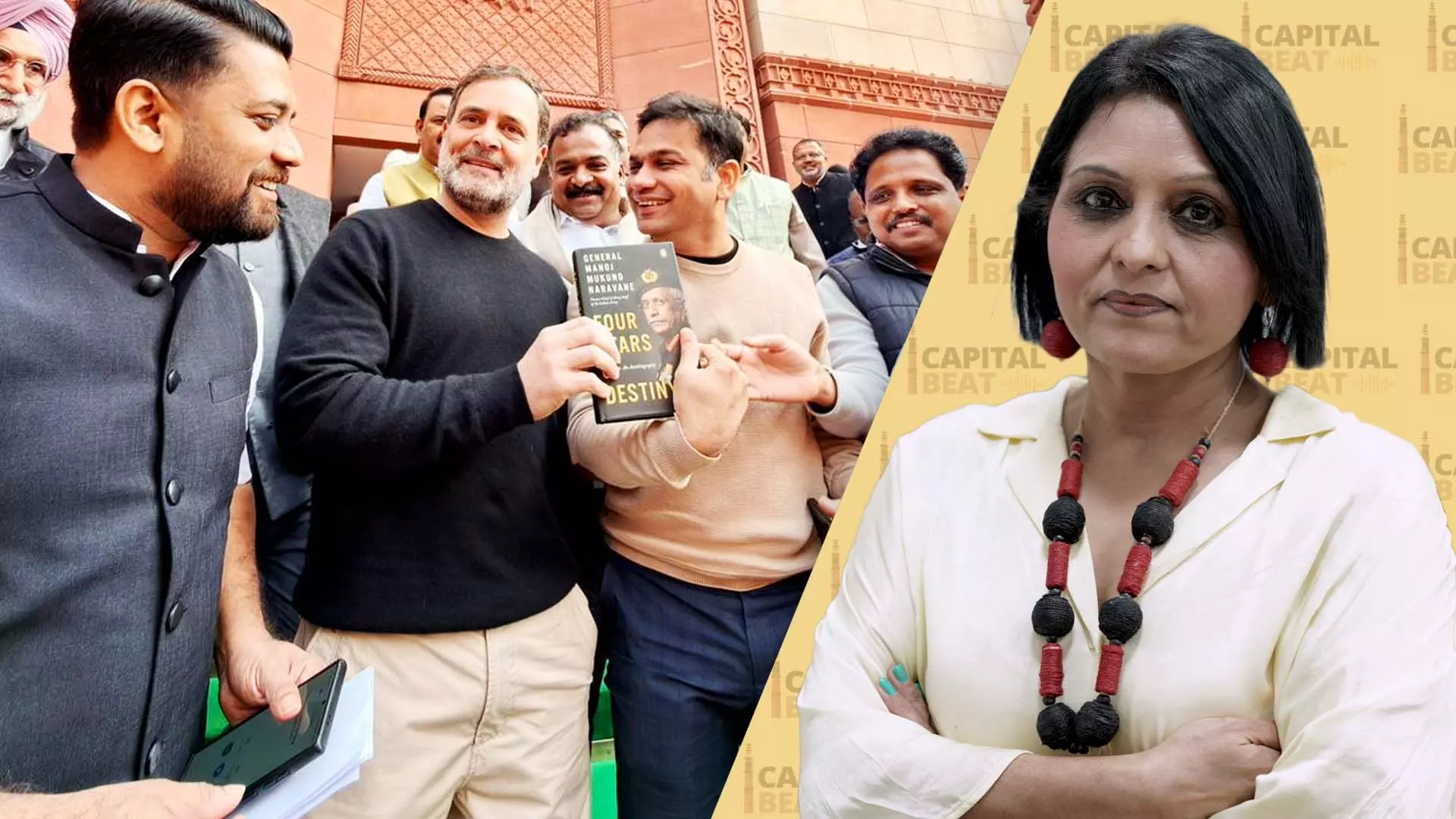
The remarks came after Leader of the Opposition Rahul Gandhi carried a copy of Naravane’s memoir Four Stars of Destiny into the Parliament, triggering an uproar from the treasury benches, the suspension of eight MPs, and allegations that the government was “running away from reality”.
The book dispute
The government maintained that the book was “unpublished” and therefore could not be cited in the House. Shama Mohamed rejected this outright. “The book clearly shows Penguin as the publisher. It is published, but not released. There is a difference,” she said, accusing the government of blocking its release after reading its contents. According to her, the memoir exposes indecision at the highest level during the Ladakh standoff with China in October 2020.
Also read: Has Naravane’s memoir been published? Online buying links vanish amid row
She cited excerpts discussed publicly, claiming that when the Army sought clear political direction, the leadership failed to act decisively. “Leadership is about taking a call. That was not done,” she said, adding that this contradicted the government’s nationalist image.
National security questions
Both Opposition panellists argued that the issue went beyond parliamentary procedure and into the realm of national security. Sarvesh Tripathi said Rule 349 of parliamentary conduct explicitly allows members to refer to books if they relate to House business.
“What is more connected to the business of the House than national security?” he asked. He noted that Prime Minister Narendra Modi and BJP MPs had previously quoted newspapers and books without objection.
Tripathi said the controversy stemmed from “four or five lines” in the memoir referring to an “indecisive chain of command”, which the government found politically uncomfortable. “That is what has pricked the balloon they have built around strong leadership,” he said.
Opposition silenced?
A major grievance raised by the panel was that Rahul Gandhi, as Leader of the Opposition, was not allowed to speak during the discussion on the President’s Address. Shama Mohamed described this as unprecedented.
Also read: What is former Army chief Naravane’s memoir ‘Four Stars of Destiny’ about?
“This is not how Parliament used to function. If the Leader of the Opposition wants to speak, what are they scared of?” she asked. She compared the situation with earlier governments, recalling that former Prime Minister Manmohan Singh regularly attended Parliament during debates on allegations like the 2G spectrum case.
Rajalakshmi agreed that the onus for smooth parliamentary functioning lay with the government. “The opposition is bound to ask questions, especially on grave issues like national security. I don’t see why any government should shy away from answering them,” she said.
Suspensions escalate row
The suspension of eight opposition MPs further deepened the confrontation. While Rajalakshmi acknowledged that tearing papers might have been an extreme step, she argued that suspensions only worsened the situation.
“It creates a perception that the government does not want certain issues to be discussed,” she said, adding that such actions had been taken before and had consistently backfired in public perception.
Tripathi echoed this view, questioning the purpose of Parliament if debates on China, terrorism, trade deals, and intelligence failures were repeatedly blocked. “If these issues cannot be discussed, then what exactly are we here to discuss?” he asked.
China and 2020 face-off
At the heart of the controversy is General Naravane’s account of the 2020 standoff with China, including the Galwan Valley clash in which 20 Indian soldiers were killed. Shama Mohamed said the government never allowed a full parliamentary discussion on Galwan, calling it a pattern of secrecy.
Also read: Rahul Gandhi cites Naravane memoir, targets PM Modi over China clash
“Did we discuss Galwan in Parliament? No. Did we discuss Pulwama? No. Did we discuss intelligence failures? No,” she said, arguing that accountability had steadily declined since 2014.
Tripathi drew parallels with earlier whistleblowers, including former Jammu and Kashmir Governor Satya Pal Malik, who had spoken publicly about Pulwama-related issues. He said Naravane’s memoir fit into a broader pattern of uncomfortable truths emerging from within the system.
Trade deal concerns
The Indo-US trade deal emerged as another flashpoint during the discussion. The panellists questioned why such a significant agreement was announced on social media rather than being tabled in Parliament.
Rajalakshmi said MPs themselves were unclear about the contours of the deal. “Announcements are made, but details are promised later. That raises legitimate concerns,” she said.
Shama Mohamed argued that India risked moving from a trade surplus with the US to a deficit, warning that agriculture and farmers could be adversely affected if tariffs were reduced. “We have always protected our farmers. Why the secrecy now?” she asked.
Also read: Rahul authenticates article on Naravane's memoir on India-China conflict
Tripathi said the Opposition had repeatedly demanded a debate on the deal but had been denied the opportunity.
Epstein files controversy
Another contentious issue raised was the reference to the Epstein files, which Opposition leaders claimed warranted discussion in Parliament. Shama Mohamed argued that the government’s silence would have been very different if Opposition leaders’ names were involved.
“We want to know what advice was being given and why there is such reluctance to discuss it,” she said, linking the controversy to broader concerns about transparency and foreign pressure.
Government’s dilemma
Rajalakshmi said the government faced a choice: engage with the Opposition or risk a prolonged stalemate. “This kind of deadlock doesn’t suit anyone,” she said, noting that the Budget session was already truncated and further disruptions would only deepen public mistrust.
Also read: Rahul Gandhi’s Naravane memoir remarks: What Lok Sabha rules say
She suggested that an all-party meeting could help de-escalate tensions, warning that repeated suspensions and refusals to debate key issues would reinforce perceptions of authoritarianism.
Stalemate ahead?
As the session continues, the panellists agreed that the Opposition was unlikely to drop its demands. The suspension of MPs, the unresolved status of Naravane’s memoir, and unanswered questions on China and trade deals suggest that disruptions may persist.
“The Opposition is not going to give up,” Rajalakshmi said. “The government will have to answer these questions sooner or later.”
(The content above has been transcribed from video using a fine-tuned AI model. To ensure accuracy, quality, and editorial integrity, we employ a Human-In-The-Loop (HITL) process. While AI assists in creating the initial draft, our experienced editorial team carefully reviews, edits, and refines the content before publication. At The Federal, we combine the efficiency of AI with the expertise of human editors to deliver reliable and insightful journalism.)