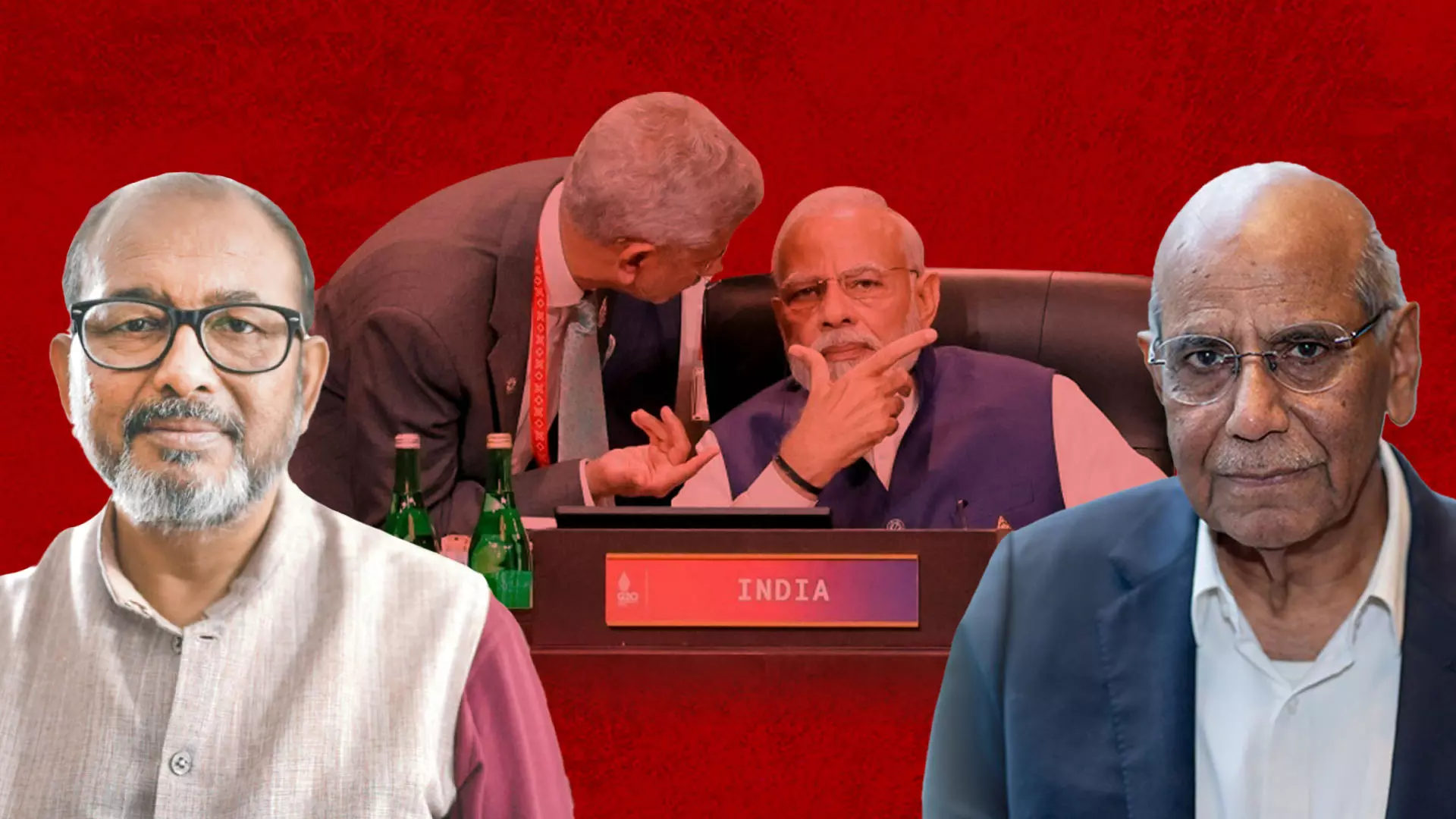
In this conversation, Shyam Saran assesses India’s foreign policy performance under pressure from Donald Trump’s America, an assertive China, a shifting neighbourhood, and the growing overlap between diplomacy, domestic politics, and ideology.
India’s multiple diplomatic crises: Shyam Saran on how New Delhi is coping
Former Foreign Secretary Shyam Saran discusses India’s ties with China, Russia, US, and others, and how Delhi navigates strategic, regional challenges

The Federal spoke to Shyam Saran, former Foreign Secretary of India and former Prime Minister’s Special Envoy for Indo–US civil nuclear issues and climate change, on a year he describes as turbulent not just for India but for the world. In this conversation, he assesses India’s foreign policy performance under pressure from Donald Trump’s America, an assertive China, a shifting neighbourhood, and the growing overlap between diplomacy, domestic politics, and ideology.
Has India’s diplomacy failed in a turbulent year?
Certainly, it has been a very turbulent year, but not only for India. It has been a turbulent year for most countries in the world, so we are not an exception in that respect.
To say that we have fallen short in dealing with these challenges would, in my view, be an exaggeration. There are certainly things we could have done better, and we can talk about those, but by and large, in dealing with an unexpected situation and a high degree of uncertainty — with many issues cropping up for the first time in recent years — we are perhaps not in a very different position from many other countries.
Also Read: Russian President Putin in Delhi: The high-stakes messages behind the optics
So I would take a more balanced view. There are areas where we could clearly have done better, but there are also areas where we have been a little more agile and adept in dealing with the uncertainties that have arisen. If you want to grade it, I would say not quite a C, maybe a good B — or what used to be called a B-plus. A B-plus was considered “chalega” when I was in university. An A-minus or an A would certainly have been much better, but a B-plus is still reasonably okay.
Has Trump ‘blackmailed’ India on oil and trade?
There is no doubt that President Trump has been following a policy of blackmail and bullying, not only with respect to India but with many other countries — both allies and adversaries. We must bear in mind that we are in the current situation precisely because the United States, still the most powerful country in the world, has a leader who conducts policy in this manner.
It is the world’s largest economy and most powerful military power, so what the United States does, and what its leader does, has an impact across the world, particularly on a country like India. Over the past 25 years, we have become used to a rising trajectory in India–US relations, and that trajectory has been of great benefit to India.
This relationship has given us access to cutting-edge technologies at a time when technology has become the major driver of growth. Having access to such technologies from the US has greatly benefitted us. There has also been a broad strategic convergence between the two countries on the challenges we will face in the future, including a rising and expansive China.
Also Read: India-Russia summit: Cautious talks, no big announcements as Trump’s shadow looms
If, for our own reasons, we want to constrain China’s ability to threaten our interests — and this is also a concern for the United States — then there are areas where this strategic convergence can work to our advantage and to the advantage of the US. So, having been used to that rising trajectory, facing a stalling of the relationship, at least in some respects, is a new situation for us.
I have argued that we are dealing with someone who is bullying countries across the world. My own view is that the way to deal with a bully is to withstand the pressure. The more you acquiesce, the more you set yourself up for even greater bullying in future. It is important for us to draw the line and make it clear that we will go this far and no further.
From what I can see, from outside government, we have made some meaningful concessions on trade, but that has not been enough from the US point of view. We are also being compelled to rethink our purchase of oil from Russia, not because of any other reason but because we are still reliant on a US-dominated financial and banking system. If our companies are cut off from that system, it becomes very difficult for them to do global business.
So, companies like Reliance Industries, which you mentioned, have had to adjust their purchasing policy. But several other companies that are not exposed to that financial system are still able to make spot purchases of Russian oil, and I suspect that will continue.
Also Read: What the India-Russia summit reveals about shifting global power
The imbalance in India–Russia trade is another constraint. We buy much more from Russia than they buy from us. If we settle trade in rupees or rubles, large rupee balances will accumulate in Russia, and there are not enough things they can buy from India to use those balances. One of the issues that will be addressed during President Vladimir Putin’s visit to India is how we can promote Indian exports to Russia — particularly perishables like fruits and vegetables and other goods for which there is large demand there.
So it is a challenging situation, but my sense is that, so far, while we continue to value our relationship with the United States, key components of that relationship remain intact — for example, the technology partnership and the defence partnership. We have recently renewed the 10-year defence cooperation framework, and cooperation in these areas has continued largely as before. It is in India’s interest to keep these components intact to the extent that the US does not interfere.
However, as far as trade and oil purchases from Russia are concerned, my view is that these sanctions have very little to do with trade or oil as such. If you are truly worried about India buying oil from Russia and thereby encouraging Russian aggression in Ukraine, why do you not sanction the Chinese, who are much larger purchasers of Russian energy? Why not sanction Turkey, a NATO ally, which continues to buy Russian oil? Why not sanction some European countries, such as Hungary, which has been given a one-year waiver to continue buying oil from Russia?
These double standards suggest that the reasons behind these sanctions are more political than economic.
Why has the Modi–Trump chemistry stopped working?
Two things. First, relations between countries are mostly determined by their perceived national interest. We should not move away from that principle. Ultimately, it is the leadership’s perception of interest in India and in the United States that shapes policy.
Personal relations between leaders, or any ideological affinity they may have, can enhance strategic convergence, but they cannot be a substitute for it. Good chemistry between leaders can help when interests converge, but it cannot supplant the underlying perception of national interest.
Today, the way Trump looks at the US national interest is different from Trump 1.0. Take the Asia–Pacific or what we now call the Indo-Pacific. During Trump 1.0, the US view — consistent with the Barack Obama and Joe Biden administrations — was that the centre of gravity of the global economy and global power was shifting from the transatlantic to the transpacific. This was seen as the arena where the main action would be.
Also Read: 'Putin–Modi summit won't go down well with Trump and US'
This was largely because of the emergence of China but also other powers such as India, Japan, South Korea, Australia and, for example, Indonesia. The perception was that, if the US wanted to retain global dominance, it had to maintain its dominance in the Indo-Pacific, not merely a balance of power. Hence, the Indo-Pacific strategy was articulated during Trump 1.0, and it was Trump who led the revival of the Quad.
Now that perception seems to have shifted. There is a lot of commentary in the US that the first order of business for maintaining global dominance is the Western Hemisphere — the Americas, including Latin America. You can see this in what is happening with Venezuela, or even the talk around Greenland and, in some ways, Canada. This reflects a shift in the administration’s perception that US national interest requires dominance in the Western Hemisphere, and that the Indo-Pacific has somewhat diminished in salience.
There is no doubt that this shift has taken place, even if it is tactical. The current posture towards China is not that the US and China have stopped being adversaries, but there is a greater willingness on Trump’s part to settle the relationship in some manageable way so he can focus on the Western Hemisphere.
Even if this is tactical, it has consequences for countries like India. We must recognise this shift. If the US strategic outlook is changing in this way, even strong personal chemistry between leaders cannot substitute for that changed outlook. We see the same trend in the US attitude towards Europe and NATO. NATO and the alliance with European countries have also diminished in significance in US calculations. Trump does not appear prepared to fully backstop Europe against Russia and is repeatedly reaching out to Russia despite its aggression in Ukraine and its hard-line stance.
We have to take all this into account before we decide what it means for India and for India–US relations. There is a changed context that we must understand.
Does Modi’s personalised diplomacy really help India?
We should not devalue the importance of leader-to-leader relationships. Indira Gandhi, for example, had very good relationships with a large number of global leaders. Personal relationships do matter, so I don’t think Prime Minister Modi is an exception in that regard.
It is true that he has tried to project his relationships with important world leaders as an asset for India. In some cases they have been an asset; in some cases they have not worked. He also claimed to have very good personal chemistry with Xi Jinping, but that did not prevent the Galwan clashes or Chinese intrusions in Arunachal Pradesh. So in some cases such relationships can enhance a strong relationship based on convergent interests, but where national interests clash sharply, personal ties do not count for very much.
Also Read: Putin’s India visit: What are the key takeaways? | Capital Beat
I would not make too much of a distinction between Prime Minister Modi and Prime Minister Manmohan Singh in this respect. I recall that when we were negotiating the India–US nuclear deal, there were moments when we ran into serious roadblocks. At those times, it was the personal intervention of Prime Minister Manmohan Singh with President George W Bush that enabled us to move forward.
When things are on edge and could go either way, the personal relationship between leaders — the fact that President Bush had great respect and, to some extent, even affection for Prime Minister Manmohan Singh — did help us in the negotiating process. I cannot deny that.
He may have projected his personal relationships differently from Prime Minister Modi and may not have made a public spectacle of them, but those relationships were important. So leader-level chemistry has a place, but it cannot override hard national interests.
Where does India stand today against China on the border?
Like you, I do not have full information on what is happening behind closed doors, but I can share my sense of the situation.
After the Galwan incident, the Chinese were surprised by the speed and scale with which India was able to deploy almost an equivalent number of troops along the Line of Actual Control (LAC). Their perception appears to have been that this was a relatively low-risk, low-cost operation — that they could make some advances, change facts on the ground, and do so with minimal investment.
They discovered that this was not the case. India had significantly improved its border infrastructure and its ability to respond. We were able to forestall the Chinese from making any significant gain at the LAC. I do believe that India today has the capability to prevent China from making any large advance across the border, though we may not yet have the ability to take back every area that the Chinese may already have occupied. But holding the line on the LAC is something we can do.
Also Read: India-Russia summit: Cautious talks, no big announcements as Trump’s shadow looms
That is a plus point, and our ability to do so is improving day by day, because this government has invested considerable resources in border infrastructure and the deployment of capabilities along the line.
However, the larger relationship between the two countries is overshadowed by a widening power asymmetry. China’s GDP today is roughly five times that of India. That is a very significant gap. In addition, China has benchmarked itself against the United States and, over several years, has made substantial progress in equipping its armed forces with high-tech weaponry and building capabilities to match or even overcome the formidable US deployment in the Indo-Pacific.
We also face a very close alliance between China and Pakistan. We saw that clearly in recent operations where Chinese weaponry was used more effectively, and there is evidence that China actively assisted Pakistan with targetting and intelligence information in a way we have not seen before. So we have a more troubling situation across two borders because of this link between China and Pakistan.
Also Read: India-US trade deal likely this year, says Commerce Secretary
Further, President Trump has been responding positively to Pakistan — giving credit to Islamabad for its role in Operation Sindhu, for nominating him for the Nobel Prize, or for suggesting Pakistan could become a centre for cryptocurrency, or provide rare metals and sensitive materials. Whether these things materialise or not is a separate issue, but Pakistan has managed to get Trump quite interested in what it has to offer.
Once again, the US appears to be looking at Pakistan as a factor if Iran becomes a major problem going forward, or if Afghanistan again becomes an issue in terms of terrorism. This brings into doubt the strong strategic convergence India and the US had begun to enjoy, particularly after the US withdrawal from Afghanistan.
In re-crafting our foreign policy, we have to take into account this changed geopolitical environment.
How should India handle the Sheikh Hasina and Bangladesh challenge?
On the specific question of Sheikh Hasina, we should respond to Bangladesh’s demand for her return in a calm, non-prickly manner. We should keep the temperature low. I think our position so far has been broadly correct: we have taken note of the judgement and the request, and we have said it is on the table, so to speak.
But we cannot hand Sheikh Hasina back to the current government in Bangladesh because that would almost certainly consign her to death. We should not forget that during her tenure as prime minister, India–Bangladesh relations underwent a major transformation. Even today, if you look at the economic linkages, they remain quite strong, though they may have diminished somewhat.
The interdependence, for example, in power cooperation remains largely intact because Bangladesh needs that power for its industry. It is not in their interest to undermine that. Transit facilities between the two countries likewise benefit both sides, and as long as we can keep those going, it serves our interests and, I believe, theirs as well.
Also Read: Trump says tariff threats helped prevent five global conflicts
So, despite the swing of the political pendulum, the economic pendulum has swung much less. That imparts stability to the relationship which would not exist if the economic dimension were absent. This is an important lesson for our relations with other neighbours: a strong network of interdependencies is in India’s interest.
We are not in a position to do much about Bangladesh’s internal political situation, and neither should we try to intervene. Let this play itself out in Bangladesh. They have to find their own way of working out their future. As long as they do not take actions that directly threaten India’s interests, we should be patient and see how the logic of interdependence gradually pushes the relationship in a more positive direction.
Patience is not always seen as a prominent aspect of foreign policy, but in this case it is worthwhile. Opportunities can arise. Take the example of Sri Lanka. We had a very fraught relationship there as well, but the government acted promptly and with urgency when Sri Lanka was going through a severe economic crisis — political turmoil, shortages of food, fuel, fertilisers, and foreign exchange.
India stepped in quickly with support, and that played a very important role — important enough that a party with a long history of hostility towards India is today perhaps more enthusiastic about expanding India–Sri Lanka relations than another regime might have been. India also responded promptly after the cyclone that affected Sri Lanka. These things matter.
In the Maldives, India did not react in an overly-prickly way to the hostility displayed by the current government. Once again, the logic of interdependence has helped stabilise the relationship.
Also Read: India ‘examining’ Bangladesh’s request to extradite Sheikh Hasina
So it is not all doom and gloom in the neighbourhood. We do have problems with Pakistan. We have concerns about developments in Nepal, especially because we share an open border. But we need to change our mindset about the neighbourhood.
We should look at our neighbourhood as an opportunity rather than a distraction or an irritation. Sometimes the attitude seems to be that we are being constantly snapped at the heels by smaller neighbours. That is the wrong way to approach the region.
We have also lost the ability to lead the regional integration agenda in South Asia. We are doing many things bilaterally, which is good, but we need a regional focus. We should be leading the regional connectivity agenda — not only between India and Bhutan or India and Bangladesh, but in terms of how all this fits into a broader connectivity framework for South Asia as a whole.
On SAARC, we have tried, unsuccessfully in my view, to pose BIMSTEC as an alternative simply because Pakistan is not in it. I do not think that is the correct approach. I am not saying we should not pursue BIMSTEC; it has its own logic. But it should not be seen as a substitute for SAARC.
Has India boxed itself in with a ‘continuous retaliation’ doctrine?
In diplomacy, you should never lock yourself into what you are going to do in the future. The situation later may be very different from how you perceive it today.
So yes, I would perhaps not have locked ourselves into a position that any provocation will invite an immediate, full-scale response. How you wish to respond is something the other side should not know in advance. You must maintain a degree of manoeuvrability on such issues. I think we should learn from what has happened.
There is also a larger point. Foreign policy will inevitably be influenced by domestic politics, particularly in relation to neighbours. But foreign policy should not become an instrument of domestic politics. That is an important distinction.
You should not use foreign policy as a tool to consolidate your domestic political constituency. Foreign policy exists to advance India’s external interests. If you turn it into a domestic political issue, what happens is that when you make a statement to a foreign interlocutor, you are actually speaking to your domestic audience. The nature of the conversation changes completely.
Also Read: Pakistan-Bangladesh axis emerges as India falls out of Dhaka's favour
If, while negotiating with a foreign partner, you are constantly thinking about how it will play domestically and whether you can get political brownie points from it, that will be a problem. In our Pakistan policy, I am afraid this has become an important dimension. We are not looking at Pakistan simply as another country with which we have to deal and a challenge we have to tackle. Instead, there is often a calculation about what domestic advantage can be derived from every step taken on Pakistan.
Perhaps this has become fixed in people’s minds since Pulwama. There is no doubt that the Pulwama incident gave a huge political boost to the ruling party. Maybe they now see this as a very effective weapon in domestic politics and are tempted to keep playing it. I do not think this is a good way to conduct foreign policy.
Foreign policy should be pursued to advance India’s national interest and deal with external challenges. Domestic politics will influence it, but when I talk to my foreign counterpart, I should not have to think primarily about how it will play back home.
We have seen similar patterns in references to Bangladesh when discussing illegal immigration, or during the Bihar election campaign when leaders spoke repeatedly about “infiltrators” to mobilise votes. From a practitioner’s point of view, I do not find that a good way to approach foreign policy.
This is not to say that illegal immigration is not a problem — it is. But perhaps not on the exaggerated scale at which it is presented in domestic political discourse, nor in a way that begins to distort our relationship with an important and sensitive neighbour.
How do ideology and religion complicate India’s foreign policy?
We have to be realistic. When there is a balance to be struck between domestic politics and foreign policy, domestic politics usually wins. So it is difficult to simply tell leaders, “Don’t bring this into foreign policy", if there are clear political pay-offs to doing so.
This is not unique to India. You see it in the United States, and you see it in Europe — these are mature democracies where such trends are also visible. We are facing a new ideological wave sweeping across the world. It may manifest itself more strongly in some countries and less strongly in others, but it is very much a reality.
You mentioned the ideological affinity between Trump’s America and Modi’s India. To some extent that is real. We have international conservative groupings and right-wing parties associating with one another because they see common interests and worldviews.
Also Read: India ramps up defence as Bangladesh–China threat grows around Siliguri corridor
There is not much that diplomats can do to forestall such ideological currents. What is important at this moment in history is to ensure that an alternative narrative remains alive — one that is more secular in orientation, one that recognises the universality of certain values, such as human rights, which are not just Western constructs but have relevance across societies.
Those of us who do not agree with a narrowly-nationalistic or narrowly-religious approach have to work harder to understand and articulate that alternative narrative. Political scientists and others need to study why this ideological wave is happening, what its roots and drivers are. There is frustration and bewilderment about it, but there are reasons behind it. Unless we understand those drivers and build robust alternative narratives, it will be difficult to deal with.
This is not only an Indian phenomenon. But I believe India is, in a sense, better placed than many others. My strong belief is that the greatest assurance of India remaining a vibrant and plural democracy is precisely its diversity. It is such a diverse country that any attempt to impose a monochromatic frame on this society will, after some time, not work and will not be accepted by the people.
(The content above has been transcribed from video using a fine-tuned AI model. To ensure accuracy, quality, and editorial integrity, we employ a Human-In-The-Loop (HITL) process. While AI assists in creating the initial draft, our experienced editorial team carefully reviews, edits, and refines the content before publication. At The Federal, we combine the efficiency of AI with the expertise of human editors to deliver reliable and insightful journalism.)