



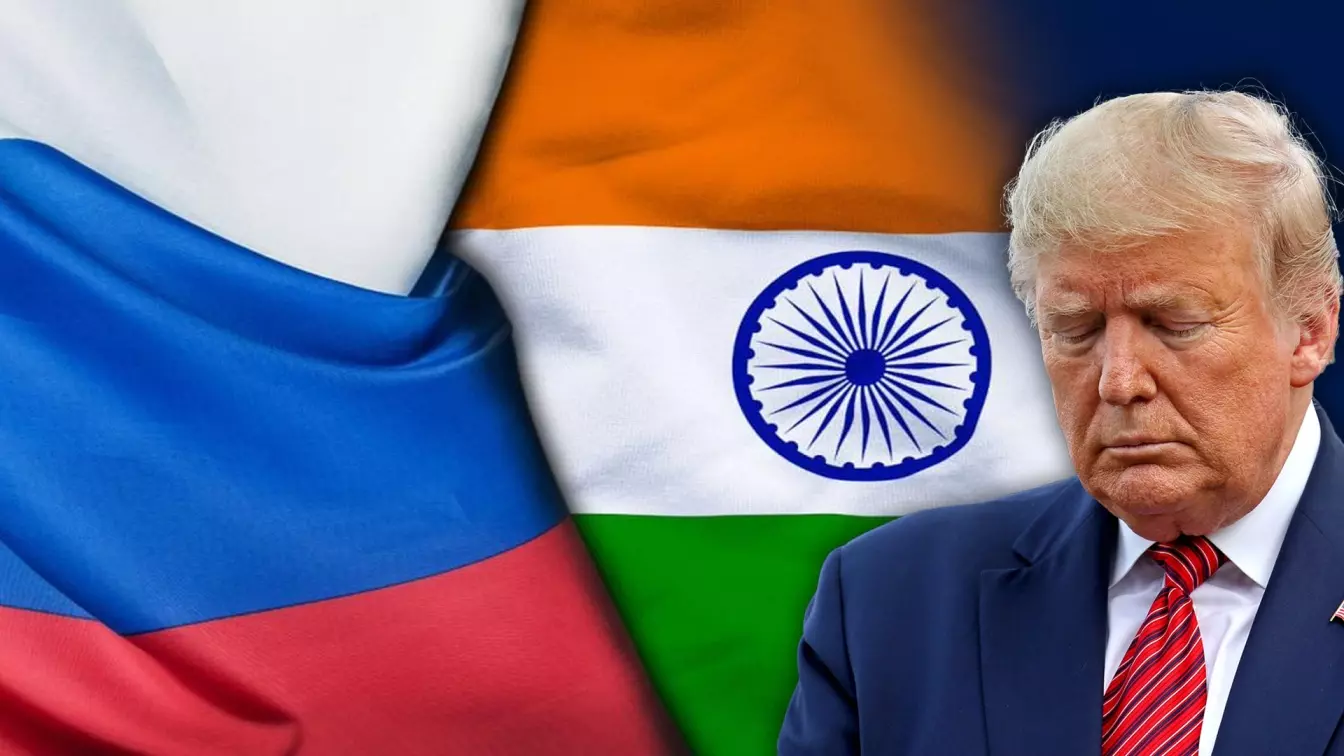
'Putin–Modi summit won't go down well with Trump and US'
India rolled out a warm welcome for President Vladimir Putin in the context of US pressure to keep off Russia. How will Washington read India’s choices, signals, and strategic priorities after this summit?

The Federal spoke to KS Dakshina Murthy, Consulting Editor of The Federal, and an international affairs analyst, to understand how Vladimir Putin’s high-profile visit to New Delhi will be viewed in Washington. He explains the geopolitical signals, energy politics, tariff tensions and the broader US–India–Russia dynamic reshaped by the summit.
How is Washington likely to read the warm Modi–Putin optics?
Vladimir Putin’s visit to India, and the kind of welcome he received, will not go down well with the United States. The US has always viewed India with suspicion regarding its relationship with Russia.
Trump’s reaction to India — the tariffs and punitive measures over oil imports from Russia — reflects that long-standing mistrust. India and Russia share a much longer and deeper relationship than India and the US. During the Cold War, the US was on the opposite side; it was the Soviet Union that stood with India.
A summit like this naturally provokes many in Washington, especially given the strong lobby that is not very favourable towards India. This visit reinforces their doubts. Trump may appear warm towards Modi individually, but his policies towards India have been harsh.
So the welcome India gave Putin will be watched with suspicion and irritation in the US.
How will Putin’s public criticism of US hypocrisy on Russian fuel be received?
Putin highlighted this in his interview with India Today. Everyone already knows it — Trump knows it, Europe knows it. But because Putin said it as the Russian President, it carries weight and draws global attention to the double standards.
In international politics hypocrisy is routine. Countries act in their interest. Much of the Russian oil India buys is refined here and then shipped to the European Union—it benefits them. At the start of the Ukraine war, oil was not included in Western sanctions because Europe relied heavily on Russian supplies.
It is only later—when Russia faced sanctions and India increased purchases—that the issue became sensitive. India's imports jumped from around 2% pre-war to nearly 40%.
India, however, is following what it assured Trump: a gradual reduction. Reports show India imported around 30% less Russian oil this October compared to last year.
So on the face of it, there is little for the US to object to except the optics. India has not criticised Russia nor taken an anti-West stand. It is playing to its interests. Washington will eventually accept that.
How will the US view India’s deeper economic and energy commitments with Russia?
All these signals show that India is deepening — not reducing — its engagement with Russia. This contradicts what Trump and Europe have been demanding. India has essentially said “no” to pressure to cut ties.
The logistics pact between India and Russia is especially significant. It allows Russian military personnel to access Indian facilities and vice versa, opening India’s access to the Arctic region. It has long-term strategic implications that outweigh several other bilateral agreements.
This shows India is taking its own path, not aligning with the preferences of the US or Europe. But this does not mean India is antagonising them. India recently signed a trade agreement with the UK and continues negotiations with the US on a trade deal.
India does not want to alienate anyone. But the Americans and Europeans will not view it that way. India must be prepared for the consequences.
Does this summit reinforce views in the US that India is unreliable—or simply autonomous?
Both views will persist. The US will see India as unreliable, but also acknowledge that India is pursuing strategic autonomy.
India is a part of the Quad, a grouping fundamentally designed to counter China and protect Western interests in the Indo-Pacific. At the same time India has signed a logistics pact with Russia and is maintaining working ties with China.
Also Read: Putin’s India visit: What are the key takeaways? | Capital Beat
For the US, ideal allies are those completely aligned—Japan, South Korea, Australia, the UK. India will never be that kind of partner.
When India aims for $100 billion in trade with Russia by 2030, it becomes a constant point of friction. It limits how close the US–India partnership can get.
What is the biggest takeaway for the US from the Modi–Putin summit?
The summit showed that Russia is not as isolated as the US wants it to be. That is the first takeaway.
Second, Putin expressed a positive view of Trump on resolving the Ukraine conflict. He said Trump is acting in “good faith,” which creates a mixed message.
As far as India is concerned, the takeaway is clear: India is asserting its independence. Russia has promised uninterrupted fuel supplies and discussed a possible special currency arrangement that keeps the dollar out. These are uncomfortable signals for Washington.
But New Delhi has shown that, tariff or no tariff, it will continue its long-standing policy of strategic non-alignment and avoid being tied to any single bloc.
The content above has been transcribed from video using a fine-tuned AI model. To ensure accuracy, quality, and editorial integrity, we employ a Human-In-The-Loop (HITL) process. While AI assists in creating the initial draft, our experienced editorial team carefully reviews, edits, and refines the content before publication. At The Federal, we combine the efficiency of AI with the expertise of human editors to deliver reliable and insightful journalism.


