From tariffs and oil pressure to China’s rise and Russia’s battlefield advantage, the Modi–Putin summit reflects India’s evolving foreign policy priorities
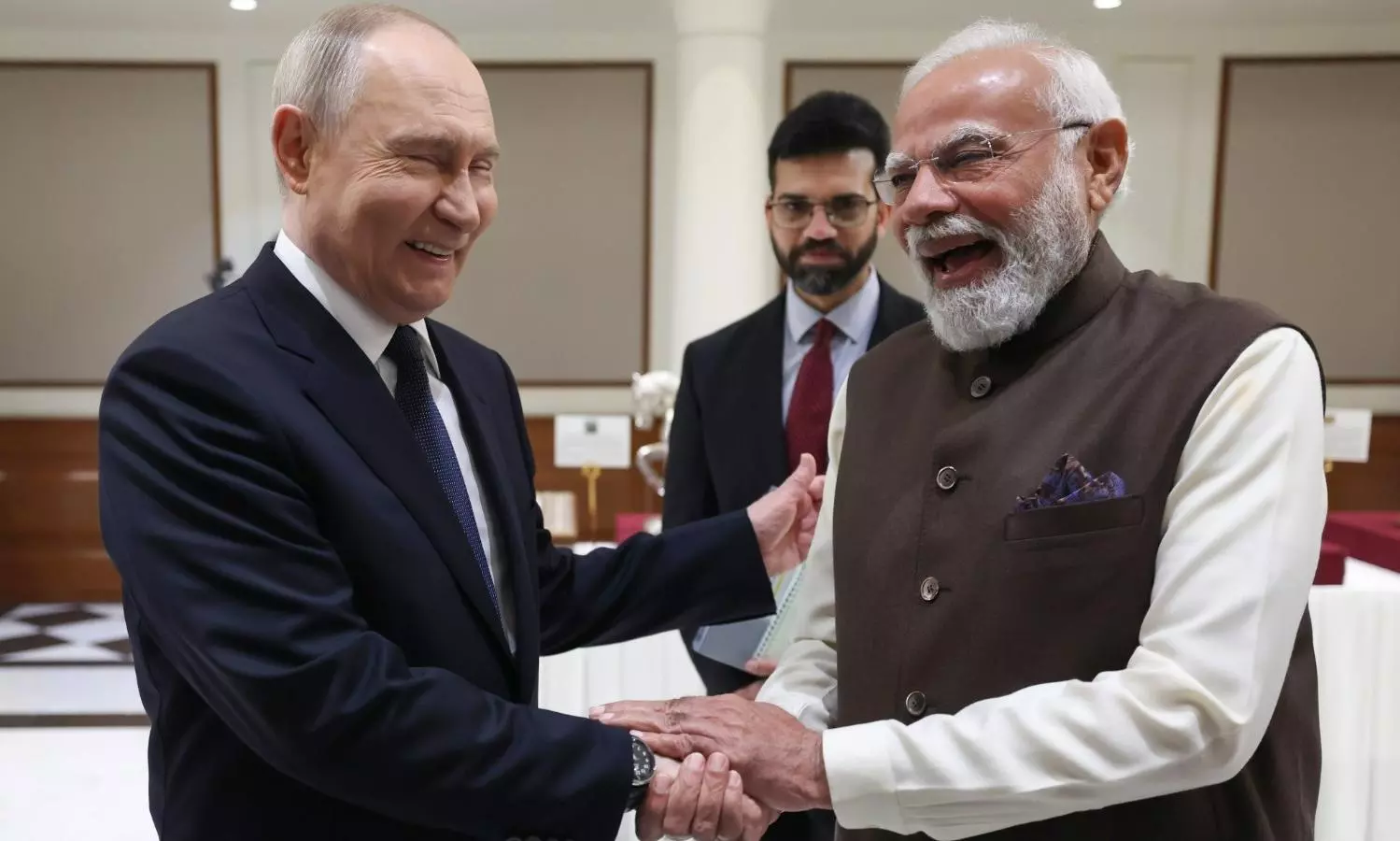
Russian President Vladimir Putin’s December 4–5 visit to India for the 23rd annual India-Russia summit carried added importance for both sides. For Putin, the trip came at a moment when he remains largely isolated by Europe, even as he pursues delicate negotiations with the United States to secure, if not a full resolution to the Ukraine war, at least a ceasefire.
Also read | 'Putin–Modi summit won't go down well with Trump and US'
As Russia has an advantageous position on the battlefield, Putin is negotiating hard to achieve some of the main objectives that led him to begin the war in February 2022. For Prime Minister Narendra Modi, this summit was an opportunity to show the US that India has important diplomatic cards on the political and economic front. He clearly felt that he had to do so at a time when the India–US trade deal had still not been finalised, and President Donald Trump had not reduced the 50% tariffs he imposed on Indian exports.
Optics versus strategic reality
Modi strongly signalled that India has important ‘friends’ by going far beyond protocol requirements to welcome the Russian leader. He received him at the airport and hosted a private dinner immediately afterwards at his residence, which was decorated in an unprecedented manner to welcome the Russian leader.
Russia is a major country, and India-Russian ties are important for Indian interests, especially in the fields of defence supplies, civil nuclear energy and space, but the fact is that for India’s interests, the US relationship is far more significant. This is an objective reality, though it does not mean that India should not work for upgrading the ‘privileged partnership’ it has with Russia.
Indian commentators are writing that the ‘world’ was watching the Putin visit closely. The fact is that what global observers, especially those in Europe and the US, were watching for were signals from Putin on the Ukraine war. He did not mention the war at all. These observers were also looking out for Modi’s message to Putin on the need to end the war. Certainly, the end to the conflict would be in India’s interest.
At the joint press meet, Modi said, “Since the beginning, India has consistently advocated for peace, with regard to the situation in Ukraine. We welcome all efforts being made for a peaceful and lasting resolution in this matter. India has always been, and will always be ready to contribute”. On his part, Putin merely said that he and Modi had discussed relevant regional and global issues.
Selective principles of power
The section on “Regional and International Issues” in the India-Russia joint statement also does not mention the Ukraine situation at all. This indicates that either Russian negotiators were unwilling to entertain the mention of the Ukraine issue or the two sides could not find a mutually acceptable formulation.
Also read | Putin’s India visit will not hurt ties with US, says Jaishankar
The section inter alia covers the situation in Afghanistan, West Asia and Iran. On these issues, it notes, “Both sides reiterated their commitment to peace and stability in the Middle East/West Asia, calling for restraint, protection of civilians and compliance with international law, and the need to refrain from taking actions that could further escalate the situation and compromise regional stability. They stressed the importance of resolving the Iran nuclear issue through dialogue. They expressed concern over the humanitarian situation in Gaza and strongly stressed the importance for all parties concerned to remain committed to agreements and understandings reached between them for cessation of conflict, humanitarian assistance and a sustainable peace.”
Ironically, Russia accepted that there should be “compliance with international law” in West Asia, but obviously does not consider that the same should be applicable in the Ukraine situation. This is yet another demonstration that for major powers, the use of international law is selective; it is never allowed to stand in the way of their interests.
Partnership shaped by priorities
It is good that India and Russia have decided to extend their ties in new areas, including skilled workers’ mobility and economic cooperation in the Central Asian Region. Naturally, the two countries also focused on traditional areas of cooperation — defence, energy, science and technology and space. Putin declared that there were no impediments to Russia’s supply of energy.
This was a clear indication that Putin was not deterred by Trump’s demand that Russian exports of oil should be curtailed. It is not surprising that Putin would like India to continue to buy Russian oil. However, reports indicate that India has severely reduced its offtake of oil from Russia. Modi’s priority is the reduction of Trump’s tariffs on Indian exports. He would hope that, with India having taken the steps Trump wanted regarding its purchase of Russian oil, he would withdraw the 25% tariff imposed on India on this issue. That has not happened as yet.
Also read | Putin’s India visit: What are the key takeaways? | Capital Beat
With the Arctic ice melting, the polar shipping route is likely to become important in the future. India and Russia decided to cooperate to make ships that will be able to use this route. This was a good decision because India’s interests demand that it look to the future. As India seeks to develop a major defence industry, Russia can become an important partner. However, India will have to go beyond dependence on technology inputs coming from Russia. It can be said to have developed a genuine defence industry only when it builds an independent base capable of producing weapons for future wars.
Diplomacy meets strategic limits
Just as the US shapes the India–Russia relationship, China is also a crucial factor. Putin indicated, in an interview, that he wants India-Russia relations to be like Russia-China ties. This is not possible because the objective reality is that Russia is greatly dependent on China. Also, China has overtaken Russia on several fronts. The earlier era of global rivalry between the US and the Soviet Union has given way to a new contest between the US and China. Therefore, Putin’s words do not reflect the reality of the current global power equation.
This summit showed that Modi wants to keep India’s options open. This is good diplomatically but it cannot obscure that the US continues to be the world’s pre-eminent power with the capacity to harm Indian interests.
(The Federal seeks to present views and opinions from all sides of the spectrum. The information, ideas or opinions in the articles are of the author and do not necessarily reflect the views of The Federal.)