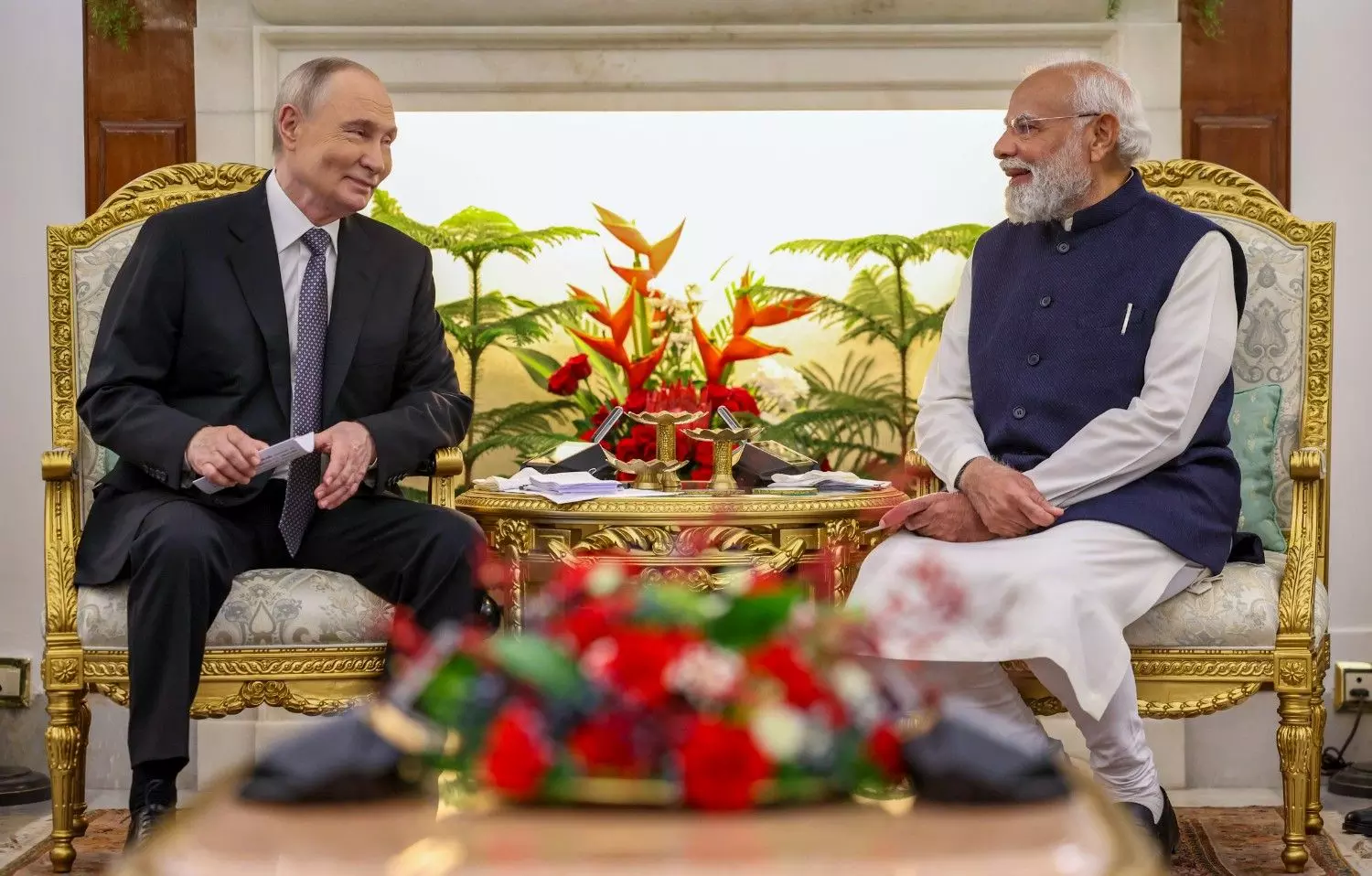
India-Russia summit: Cautious talks, no big announcements as Trump’s shadow looms
None of the 16 pacts has been released, and the pledges on cutting the trade deficit and raising trade to $100 billion by 2030 simply repeat 2024 commitments

The 23rd India–Russia annual summit, held in New Delhi on Friday, did not yield any major announcements on economic issues related to trade, industry or investment — despite these being “the focus”, as Foreign Secretary Vikram Misri later told the media.
Was it the fear of antagonising US President Donald Trump, who is pushing Russia to end the Ukraine war and nudging India to recalibrate its ties with Moscow? This indeed came to sharp focus when External Affairs Minister S Jaishankar categorically stated at a New Delhi event on Saturday that Putin’s visit wouldn’t complicate India’s relations with the US.
Also read | What the India-Russia summit reveals about shifting global power
India faces a 25 per cent penalty tariff (in addition to a 25 per cent reciprocal tariff) from the US for buying Russian crude – an act the White House views as indirectly funding the Russian war. Russia faces additional US pressure with sanctions on its two oil majors – Rosneft and Lukoil; Putin’s visit to India happened amid ongoing peace efforts by the US.
With a US trade delegation set to visit India next week and strong prospects of Washington lifting its 25 per cent penalty tariff, especially as India appears willing to comply with US sanctions on Rosneft and Lukoil, it made considerable diplomatic sense for New Delhi to avoid major economic or defence announcements during the summit.
India opts for non-sanctioned crude
On the trade front, there was no word on the continued Russian crude supply, although Putin assured of “uninterrupted supply of fuel” while speaking to the media after the summit.
Meanwhile, Reuters reported that oil PSUs – Indian Oil Corporation (IOC) and Bharat Petroleum Corporation Limited (BPCL) – have contracted crude supply from non-sanctioned Russian suppliers (other than Rosneft and Lukoil, which produce 49 per cent of Russian crude together) for January, due to the widening discounts.
India’s imports of Russian crude jumped in November to escape the US sanctions on Rosneft and Lukoil, which came into effect on November 21. Russia has also been highly adaptive to avoid sanctions. Sumit Ritolia of global real-time data and analytics provider Kpler told The Federal a few days ago that Russia’s strategies involve ship-to-ship transfers, mid-voyage diversions, complex logistics and increased discounts.
In short, as long as broader secondary sanctions don’t apply to India, the Russian crude would keep flowing, through direct (non-sanctioned Russian crude producers), indirect and less transparent routes.
When asked about crude supply, Misri avoided a direct answer and said Indian companies are guided by commercial considerations and market dynamics, while India's policy is to ensure stable and secure sourcing of its energy needs.
Key takeaways on trade and investment
The summit reiterated the previous commitment, made at the 2024 summit, to take the bilateral trade to $100 billion by 2030. At present, the bilateral goods trade is a little less than $70 billion ($65.7 billion in FY24 and $68.7 billion in FY25).
The trade, however, is heavily skewed against India. India’s trade deficit amounted to 87 per cent of the total trade in FY24 and 85.8 per cent in FY25 – putting the focus of India, at the summit, to seek a wider Russian market for Indian goods.
The bilateral trade saw a quantum jump in FY23, after the Russia-Ukraine war broke out, and the Russian crude was offered at a heavy discount when the US and EU targeted its energy sources. India’s trade jumped from $8.1 billion in FY21 and $13 billion in FY22 to over $60 billion.
Also read | Rare interview provides insights into Putin’s closely-held worldview
Fortunately for India, as Misri explained, Russia has swiftly opened its market for Indian exports of marine, agricultural and horticultural products, after the US imposed a 50 per cent tariff.
During the summit meeting, Misri said the Russian delegation assured India that it would allow exports in other areas as well. The wish-list Commerce & Industry Minister Piyush Goyal had presented at a Thursday event included automobiles, heavy machinery, textiles and food products. The progress of the free trade agreement with the Russia-led Eurasian Economic Union (EEU), comprising Russia, Armenia, Belarus, Kazakhstan and Kyrgyzstan, was also reviewed. This would expand and diversify markets for Indian MSMEs, farmers and fishermen.
In all, India and Russia signed 16 MoUs and agreements (but not made public) which include two each relating to migration and mobility, health and food safety, maritime cooperation and polar waters, customs and commerce (including e-tourist visas and group-tourist visas) and academic collaboration; one on fertiliser (India manufacturing in Russia) and five on media collaboration (including setting up of the India arm of state-funded Russia Today (RT) network).
Surge in national currency trade
One of the key areas of agreement was to promote trade settlements in national currencies.
India and Russia have, for decades, traded in national currencies. But after Russia launched a war on Ukraine in 2022, the US and EU and other Western countries excluded it from the global financial transaction system SWIFT, forcing India to pay in other currencies.
At the summit, both countries agreed to continue developing systems of settlements through their national currencies “to ensure the uninterrupted maintenance of bilateral trade”.
Just before the summit, Putin had told an Indian TV channel that “over 90% of our payments are already made in national currencies”.
New labour mobility framework
The two pacts on migration and mobility — the Temporary Labour Activity of Citizens of one State in the Territory of the Other State and Cooperation in Combating Irregular Migration — cover both curbing illegal migration and supplying skilled and semi-skilled labour from India.
The MEA spokesperson said that although the issue of illegal recruitment of Indian youth into the Russian army — duped by non-state actors or agents — came up during the discussions, it was not specifically mentioned in the pact.
Details of the labour-supply pact (a Government-to-Government or G2G agreement) are not available, as none of the pacts have been made public, but a national daily reported that Russia may be looking for 70,000 Indian workers in its IT-enabled services, construction and agriculture sectors.
Another area where major announcements were expected was defence and nuclear energy.
Defence talks muted, nuclear advances
On the defence front, there was no pact on the supply of long-range surface-to-air S-400 missiles, which played an effective role during the Operation Sindoor in May 2025. India had earlier initiated talks to add two more squadrons of this missile system as well as Su-57 fighter jets.
Russia has been agreeable to both. But there was no mention of these in the summit talks.
Also read | Putin visit shows Russia-India ties on even keel, despite oil import setback
Jitendra Singh, MoS in charge of the Department of Atomic Energy, had told the Parliament on December 3 that India is in talks to acquire nuclear small modular reactors (SMRs) from Russia. This, too, was missing from the summit talk.
Instead, the emphasis was on ensuring the supply of critical components for Units 3 to 6 of the Kudankulam Nuclear Power Plant (KKNP) in Tamil Nadu, which are being built with Russian technology and are designed as large-capacity reactors. The summit also reaffirmed the plan to identify a second site in India for another large-capacity nuclear project, as agreed under an earlier pact.
There was also an agreement to set up joint manufacturing of Russia-designed nuclear plants.
On the space technology front, both sides were for enhanced cooperation, including in the human spaceflight programmes, satellite navigation and planetary exploration.