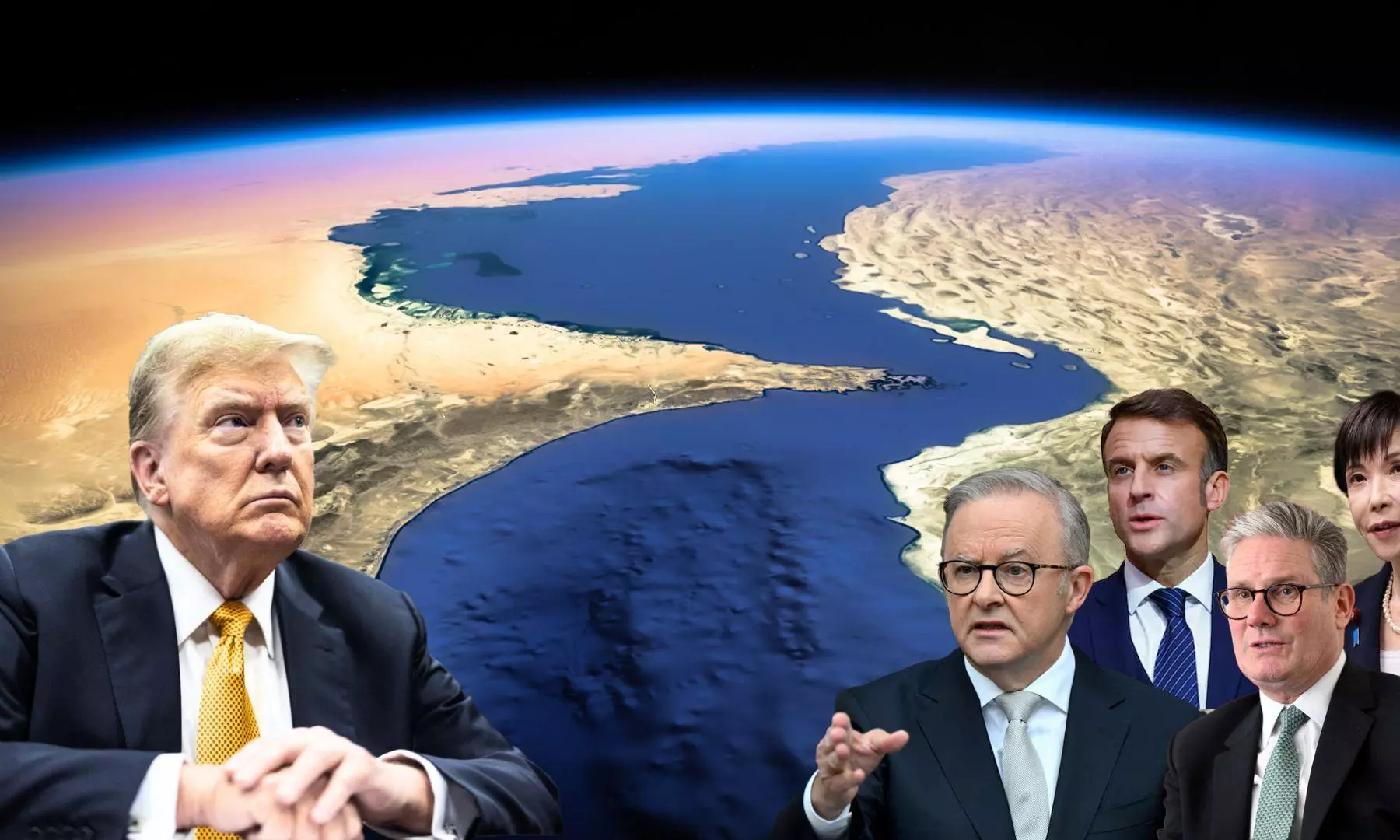
If US has the strongest Navy, why can’t it secure Strait of Hormuz alone?
US President wants a global naval force to secure Strait of Hormuz after tanker attacks, but geography, insurance risks and global politics make it complicated

The war involving the United States, Israel and Iran has reached one of the world’s most critical energy chokepoints, the Strait of Hormuz.
Nearly 20 per cent of the world’s oil supply passes through this narrow waterway every day, now closed by Iran. US President Donald Trump has proposed forming a global naval coalition to secure the passage after weeks of attacks on commercial vessels and disruptions to oil shipments.
Also read: Iran weighs 'China-only' terms for limited reopening of Strait of Hormuz
The proposal has sparked a major debate. If the US has the world’s most powerful navy, why can’t it simply secure the Strait on its own?Coalition plan
Trump has urged major powers, including China, Japan, South Korea, France, the United Kingdom and other NATO allies to deploy their naval ships to escort oil tankers through the Strait.
In a message posted online, Trump argued that countries dependent on oil shipments through the Strait should contribute warships to protect the route, while the US provides major military support.
“It would be nice to have other countries police that with us… I'm demanding that these countries come in and protect their own territory,” Trump said.
Also read: Jaishankar says no sweeping arrangement, talks with Iran ongoing as ships pass Hormuz
He added that the US does not depend heavily on oil passing through the Strait but continues to secure the route for allies. “You could make the case that maybe we shouldn't even be there at all, because we don't need it… we are the number one producer anywhere in the world,” Trump said.
But then, why does Trump even need his allies in his policing plans?
Geography challenge
At first glance, securing the Strait may appear straightforward. The US Navy operates 11 aircraft carrier strike groups, hundreds of warships and thousands of aircraft.
In comparison, Iran’s navy is significantly smaller.
But geography changes the equation.
At its narrowest point, the Strait of Hormuz is only a few dozen kilometres wide. The shipping lanes used by giant oil tankers are even narrower, roughly three kilometres wide for ships entering and as many wide for ships exiting.
Also read: This is the real Gulf War, and the world is paying the price
This creates a predictable choke point.
For Iran, vessels passing through the Strait become slow-moving targets following fixed routes.
Tanker risks
Oil tankers move slowly, often at speeds under 30 kilometres per hour. That makes them extremely vulnerable to missile attacks, drones or naval mines launched from Iran’s nearby coastline.
Because these attacks can originate from land-based systems close to the shipping lanes, defending forces may have only seconds to react.
Also read: Iran allows Indian ships safe passage through Strait of Hormuz after diplomatic talks
Even a few successful strikes could have major consequences.
If a tanker has been severely damaged or sunk in the narrow channel, it could block the shipping lane and disrupt global oil supplies.
Insurance barrier
Perhaps the biggest obstacle is not missiles or naval mines, but insurance.
Shipping companies are unlikely to send vessels into a war zone if insurers refuse to cover the risk.
That means even with US naval escorts, commercial ships may avoid the Strait unless the region becomes significantly safer.
To truly secure the passage, the United States would likely need to destroy or neutralise Iran’s land-based missile and attack capabilities, a much larger military operation.
Global response
So far, no country has publicly agreed to send warships for Trump’s proposed coalition. Several key US allies have already declined.
The United Kingdom said it is reviewing options but has not committed to deploying naval vessels.
France has stated that its military posture remains defensive and that it will not participate in the war against Iran.
Also read: US says it won't allow Iran to block Strait of Hormuz, calls threat ‘sheer desperation’
Japan has also not committed to sending escort ships. Japanese Prime Minister Sanae Takaichi said Tokyo is still evaluating its options within the country’s legal framework.
“As we have not yet received any such requests… the Japanese government is currently examining what necessary measures should be taken,” Takaichi said.
Australia has already made its position clear, saying it will not send naval ships to assist in reopening the Strait.
Asian powers
Two major Asian powers have not agreed to the poposal.
South Korea, which imports roughly 70 per cent of its oil from the Gulf region, says it is closely monitoring the situation and considering measures to protect energy supply routes.
China has also not agreed to join the coalition.
Instead, Beijing has called for an immediate end to hostilities and urged all sides to ensure stable global energy supplies.
Iran stance
Iran insists the Strait of Hormuz has not been completely closed.
Iranian officials say the passage remains open for international shipping, though not for ships belonging to the United States and Israel.
Iran’s leadership has also suggested that restrictions on the Strait could be used as leverage during the ongoing conflict.
Also read: Strait of Hormuz crisis: How insurers, not missiles, shut down world’s oil artery
Meanwhile, Iran’s Revolutionary Guard naval commander Alireza Tangsiri dismissed claims that Iran’s naval capabilities have been destroyed. He said the Strait of Hormuz is not blocked but remains under Iranian control.
Uncertain future
For now, the Strait of Hormuz remains one of the most dangerous maritime flashpoints in the world.
Also read: How Indian-captained oil tanker went ‘dark’ and crossed Strait of Hormuz safely
Trump’s proposed coalition aims to reopen and secure the vital oil route. But without strong international support - and with Iran still capable of launching attacks from nearby territory - protecting the passage could prove far more difficult than it sounds.
Because in this conflict, Iran does not necessarily need to fully control the Strait. It only needs to make it too dangerous for the world to use.
The content above has been transcribed from video using a fine-tuned AI model. To ensure accuracy, quality, and editorial integrity, we employ a Human-In-The-Loop (HITL) process. While AI assists in creating the initial draft, our experienced editorial team carefully reviews, edits, and refines the content before publication. At The Federal, we combine the efficiency of AI with the expertise of human editors to deliver reliable and insightful journalism.