







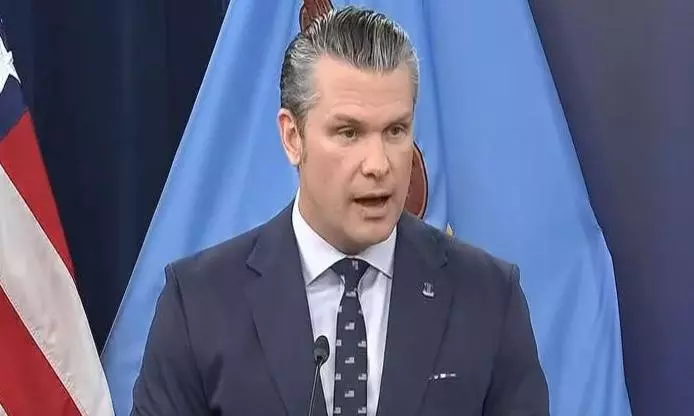
Hegseth said that the US was fully prepared to ensure freedom of navigation in the Strait of Hormuz. Screengrab: ANI
US says it won't allow Iran to block Strait of Hormuz, calls threat ‘sheer desperation’
US Secretary of War Pete Hegseth says Iran is responsible for disruption in the Strait of Hormuz and vow to ensure freedom of navigation

The Trump administration on Friday (March 13) made it clear that it would not allow any Iranian blockade of the strategically crucial Strait of Hormuz, with the US Secretary of War Pete Hegseth stating that his country would ensure that the strait remains uncontested.
Hegseth calls Iran move ‘sheer desperation’
Hegseth further stated that the US was fully prepared to ensure freedom of navigation in the Strait of Hormuz as he scoffed at the Supreme Leader of Iran, Ayatollah Mojtaba Khamenei's call for a continued blockade as “sheer desperation.”
Also Read: Strait of Hormuz not closed, some ships still passing: Khamenei’s representative
"As the world is seeing, they are exercising sheer desperation in the Strait of Hormuz - something we're dealing with; we have been dealing with it. Don't need to worry about it,” said Hegseth during a Pentagon briefing.
"The only thing prohibiting transit in the strait right now is Iran shooting at shipping," he added as quoted by ANI.
US says it has plan for all contingencies
Elaborating further, the US Secretary of War also dismissed Khamenei's threat of identifying sites that were claimed to be vulnerable to future strikes.
"We've heard them talk about taking various measures, and we're planning for all of them. We have a plan for every option here. That's not a strait we're going to allow to remain contested," he added.
US military calls Iran ‘belligerent’
During the briefing at the Pentagon, the Joint Chiefs' Chair Dan Caine described Tehran as the “belligerent” actor responsible for restricting movement through the strategic waterway.
Also Read: Trump tells G7 Iran ‘near surrender’, but then Tehran vows retaliation
Speaking alongside Hegseth, Caine acknowledged that limited shipping activity continued but insisted that Iran remained the main obstacle to normal commercial flow.
“The only thing preventing commercial traffic and flow through the strait right now—which there is some right now—is Iran. They are the belligerents here holding the strait closed, although there is still some traffic moving through there,” Caine said.
US targets Iran’s naval capabilities
He added that US forces had prioritised Iranian naval capabilities linked to potential disruption in the waterway.
“We have made it a priority to target Iran's mine-laying enterprise, mine layers, naval bases, and depots… and CENTCOM continues to attack those efforts,” he said, noting operations would continue in the coming days.
Iran leader signals continued pressure
Earlier on Thursday, Iran’s newly appointed Supreme Leader adopted a defiant tone in his first address to the nation, signalling that pressure through the Strait of Hormuz would remain part of Tehran’s strategy amid rising tensions.
Also Read: Four crew members dead in US KC-135 crash in Iraq, military rules out hostile fire
Addressing supporters, Mojtaba Khamenei said public sentiment in Iran favoured continuing what he described as a firm and effective defensive posture. He indicated that maintaining leverage over the Strait of Hormuz should remain a key tool in that effort.
Iran studies potential new fronts
Khamenei also suggested that Iranian planners had examined the possibility of expanding the conflict into areas where adversaries might be less prepared.
He said studies had been conducted to identify regions where opponents could be vulnerable and noted that additional fronts could be activated if the war continues and if doing so aligns with Iran’s broader strategic interests.