



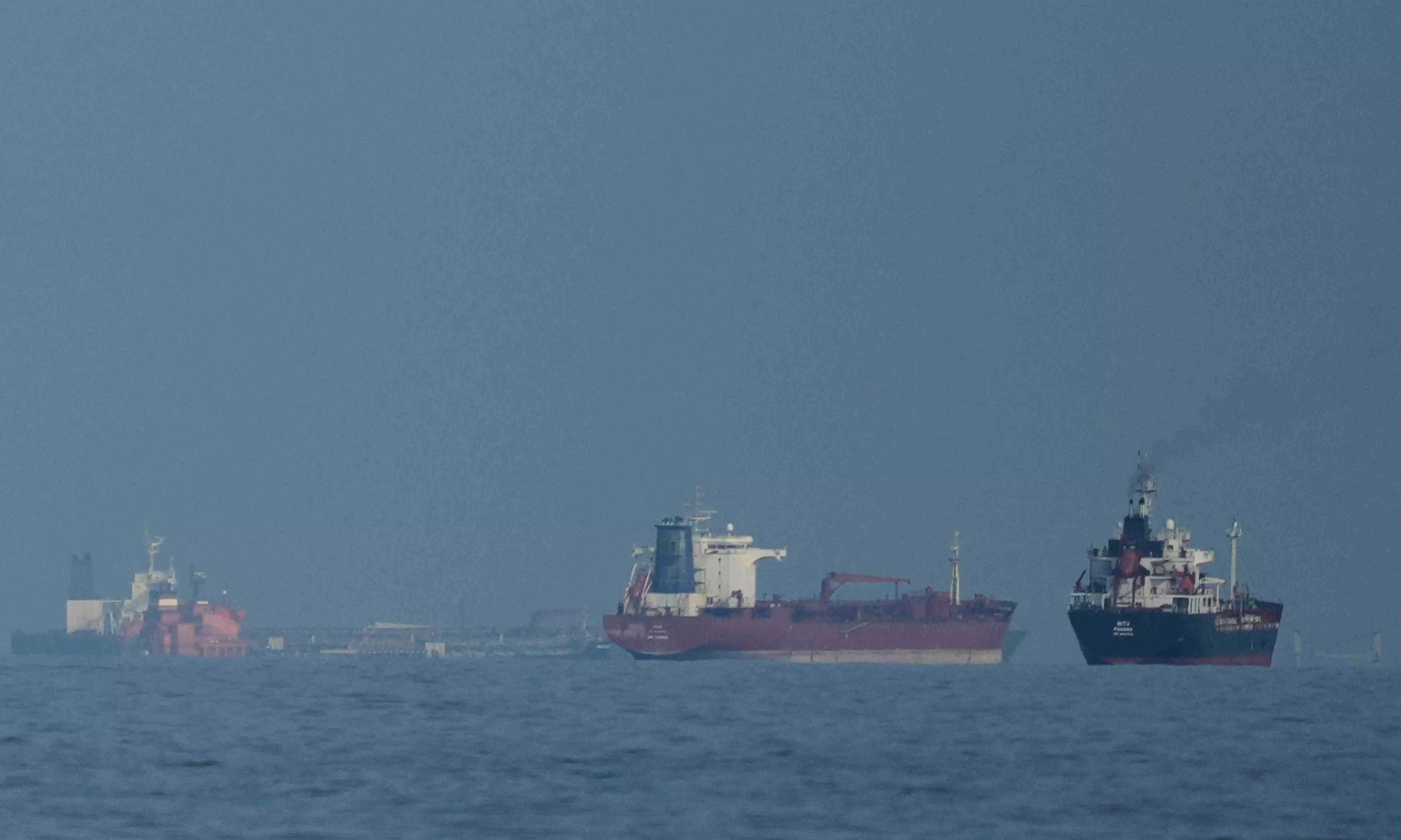
Oil tankers and cargo ships line up in the Strait of Hormuz as seen from Mina Al Fajer, United Arab Emirates. File photo: AP/PTI
Iran weighs 'China-only' terms for limited reopening of Strait of Hormuz
Media report indicates oil tankers would be allowed through one of the world’s most critical energy routes only if the oil cargo is traded in yuan

While Iranian Foreign Minister Abbas Araghchi has announced that the Strait of Hormuz remains operational for international shipping but excludes vessels linked to the US and Israel, a CNN report indicates that Tehran is mulling a condition for the use of the strategic trading route.
The news outlet has cited a senior Iranian official as saying that Tehran is considering permitting a limited number of oil carriers to pass the sensitive route, given the cargo is traded in Chinese yuan.
Also read: Strait of Hormuz not closed, some ships still passing: Khamenei’s representative
Oil transactions worldwide are largely settled in US dollars. However, sanctioned Russian oil is often traded in Russian rubles or Chinese yuan.
How the plan helps China and Iran
Iran's plan would impress Beijing, it is expected, since the latter has tried to make inroads for many years to buy oil in its currency, particularly in Saudi Arabia, countering the dollar, a plan which is yet to gain traction.
With close relations with Iran and significant dependence on West Asian oil, China views the Strait of Hormuz as a critical energy lifeline. About 45 per cent of its crude imports pass through the corridor, highlighting the route’s strategic importance for the world’s second-largest economy.
Also read: No Gulf hubs, no cheap tickets: How Iran war grounded low-cost air travel
For Iran, such a plan is aimed at circumventing American sanctions that have left a heavy impact on its economy. It also eyes stronger ties with China, one of the main buyers of Iranian oil, and reducing its dependence on the dollar-dominated international financial system.
Why is Strait of Hormuz critical?
The Strait of Hormuz is one of the world’s most critical maritime chokepoints, connecting the Persian Gulf to the Gulf of Oman and the Arabian Sea. A significant share of the world’s oil and liquefied natural gas shipments passes through this narrow waterway, making it vital for the global energy supply.
The closure of the strait by Iran in retaliation for the joint attacks by Israel and the US since February 28 has rattled the global energy markets, with Brent crude oil prices surging past $100 per barrel on March 8 and peaking as high as $126.
US President Donald Trump said that the US Navy would soon begin escorting oil tankers through strait. He also claimed that the American military bombed military installations on Iran’s Kharg Island, home to the West Asian nation's critical oil facilities.
Also read: This is the real Gulf War, and the world is paying the price
Since March 2, vessel traffic through the strait has dropped by approximately 97 per cent, with only a handful of ships attempting the passage. However, Iran has granted rare passage to certain "friendly" nations, including India, China and Turkey.