



Iran allows Indian ships safe passage through Strait of Hormuz after diplomatic talks
Indian-flagged ships allowed safe passage after Jaishankar-Araghchi talks; tanker carrying Saudi crude arrives in Mumbai after 'going dark' in Gulf waters

Iran has allowed Indian-flagged vessels safe passage through the Strait of Hormuz on Thursday (March 12) after External Affairs Minister S Jaishankar spoke with his Iranian counterpart Abbas Araghchi.
Jaishankar–Araghchi call
Speaking to reporters, External Affairs Ministry spokesperson Randhir Jaiswal said that the call focused on the issue of ensuring safe passage of ships and maintaining stable energy supplies through the region.
The phone call reportedly took place on Tuesday (March 9). The development comes at a time when concerns over the safety of global energy supply routes passing through the Strait of Hormuz linking the Persian Gulf with the Gulf of Oman.
"EAM and FM of Iran have had three conversations in the last few days. The last one discussed issues pertaining to the safety of shipping and India's energy security. Beyond that, it would be premature for me to say anything," Jaiswal said.
Also Read: Iran war: Congress slams Jaishankar's 'vapid' statement in Parliament
Vessels connected to the United States, Europe and Israel continue to face restrictions at the same time.
The question of ensuring safe movement of tankers through the Strait of Hormuz came up when External Affairs minister S Jaishankar held a conversation with his Iranian counterpart Abbas Araghchi late Tuesday. The discussion dealt with the developing situation in West Asia and marked the third time the two leaders have spoken since the Iran war began.
'9000 Indians in Iran'
Jaiswal further stated that around 9,000 Indian nationals remain in Iran as authorities continue to assist citizens amid the evolving security situation in the region. The group includes students, seafarers, professionals, businesspersons and pilgrims residing in different parts of the country.
Jaiswal said several Indians, particularly students, have already departed Iran and returned home. Others, including students and pilgrims who were based in Tehran, have been moved to safer locations within the country as a precautionary measure.
"We've had about 9,000 Indian nationals who were there or who are there in Iran. These 9,000 Indian nationals comprise students, seafarers, business people, professionals and some pilgrims. Several Indian nationals, mostly students, left the country and reached home. We have shifted several Indian nationals, including students and pilgrims, who were based in Tehran to other safer locations and cities in the country," he said.
"We are assisting Indian nationals who wish to travel to Azerbaijan and Armenia and from there take commercial flights to return home. We are providing help with visas and facilitating land border crossings," Jaiswal said.
Officials said Indian missions are coordinating requests from citizens seeking help to cross into neighbouring countries and arranging onward travel where required.
Iran warns shipping
Although Indian-flagged ships have been permitted to move through the passage, Iran has made it clear that vessels planning to cross the Strait of Hormuz must first obtain its clearance. Ships attempting the transit without approval could face attack.
Also Read: India favours peace, return to dialogue and diplomacy: Jaishankar on West Asia war
Rear Admiral Alireza Tangsiri, who heads the naval wing of Iran’s Islamic Revolutionary Guards Corps (IRGC), said two vessels were struck on Wednesday after ignoring Iran’s warnings while attempting to cross the strait.
“Were the ships assured of safe passage through the Strait of Hormuz? This should be asked of the crews of the vessels Express Rome and Mayuree Naree, who today, trusting in empty promises, ignored the warnings and intended to cross the Strait but were caught,” Tangsiri said in a post on X. “Any vessel intending to pass must obtain permission from Iran,” he added.
Tighter control over Hormuz
Iranian state media reported that Tehran has stepped up control over maritime traffic moving through the Strait of Hormuz after hostilities escalated with the United States and Israel.
Officials in Iran have also suggested that ships not operating in the interests of Washington or Tel Aviv would be able to cross the strait without interference.
Why Strait of Hormuz matters
The Strait of Hormuz is widely regarded as one of the world’s most sensitive maritime chokepoints. More than 20 million barrels of crude oil move through the narrow passage daily, representing roughly one-fifth of global oil consumption and nearly a quarter of all oil transported by sea.
Also Read: Iran war: At UN, 135 nations including India condemn attacks on Gulf nations, call for ceasefire
Large volumes of liquefied natural gas shipments also travel through the same route. Any interruption to traffic in the strait can quickly send shockwaves through global energy markets, influencing fuel prices, shipping routes and supply chains worldwide.
Tanker reaches Mumbai
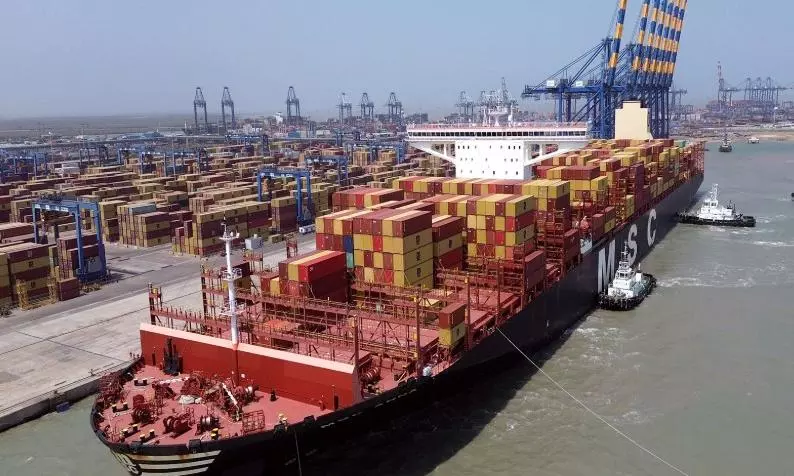
Meanwhile, a Liberian-flagged tanker carrying crude oil from Saudi Arabia has arrived at Mumbai Port after safely navigating the Gulf waters amid the US-Israeli war against Iran.
The Shenlong Suezmax tanker, commanded by an Indian captain, had crossed the conflict-hit Strait of Hormuz two days earlier.
Also Read: Investors' wealth tumbles by Rs 5.14 lakh crore as markets plunge nearly 2 pc
Rising tensions in the region and continued Iranian attacks on shipping lanes and energy infrastructure pushed global oil prices above $100 a barrel on Thursday, even as American and Israeli strikes targeted sites inside Iran.
The India-bound tanker reportedly crossed the volatile waters after briefly going “dark” to avoid detection, reported NDTV.
Ship went ‘dark’
The vessel had departed the Saudi port of Ras Tanura on March 1. Tracking data showed its signals disappeared inside the Strait of Hormuz on March 8, suggesting the crew switched off its automatic identification system while navigating the dangerous stretch.
The tanker later reappeared on monitoring systems and docked at the Jawahar Dweep Terminal in Mumbai carrying 1,35,335 metric tonnes of crude oil.
Indian ships in Gulf
The Union Shipping Ministry said 28 Indian-flagged ships are currently present in the Persian Gulf region. Of these, 24 vessels are located to the west of the Strait of Hormuz carrying 677 Indian seafarers, while four ships are positioned east of the strait with 101 Indian crew members onboard.
Also Read: Mamata to roll out SOP as Iran conflict hits Bengal’s fuel, LPG supplies
Officials said authorities are closely watching the situation, with continuous monitoring of Indian ships and crew operating in the area. A round-the-clock control room has been functioning at the ministry and the Directorate General of Shipping since February 28 to track developments and coordinate support.
Shipping companies, recruitment agencies and Indian missions across the region remain in regular contact to ensure the safety of Indian seafarers, officials said.
Meanwhile, the US Department of Energy said it intends to release 172 million barrels from the Strategic Petroleum Reserve beginning next week, as oil markets respond to volatility linked to the conflict and concerns about potential disruptions to supplies moving through the Strait of Hormuz.