Will Trump risk a ground invasion in Iran? | Capital Beat
Will the US launch a ground invasion in Iran? That is the big question in the West Asia conflict now; on Capital Beat, we decode the risks and global impact

Military build-up
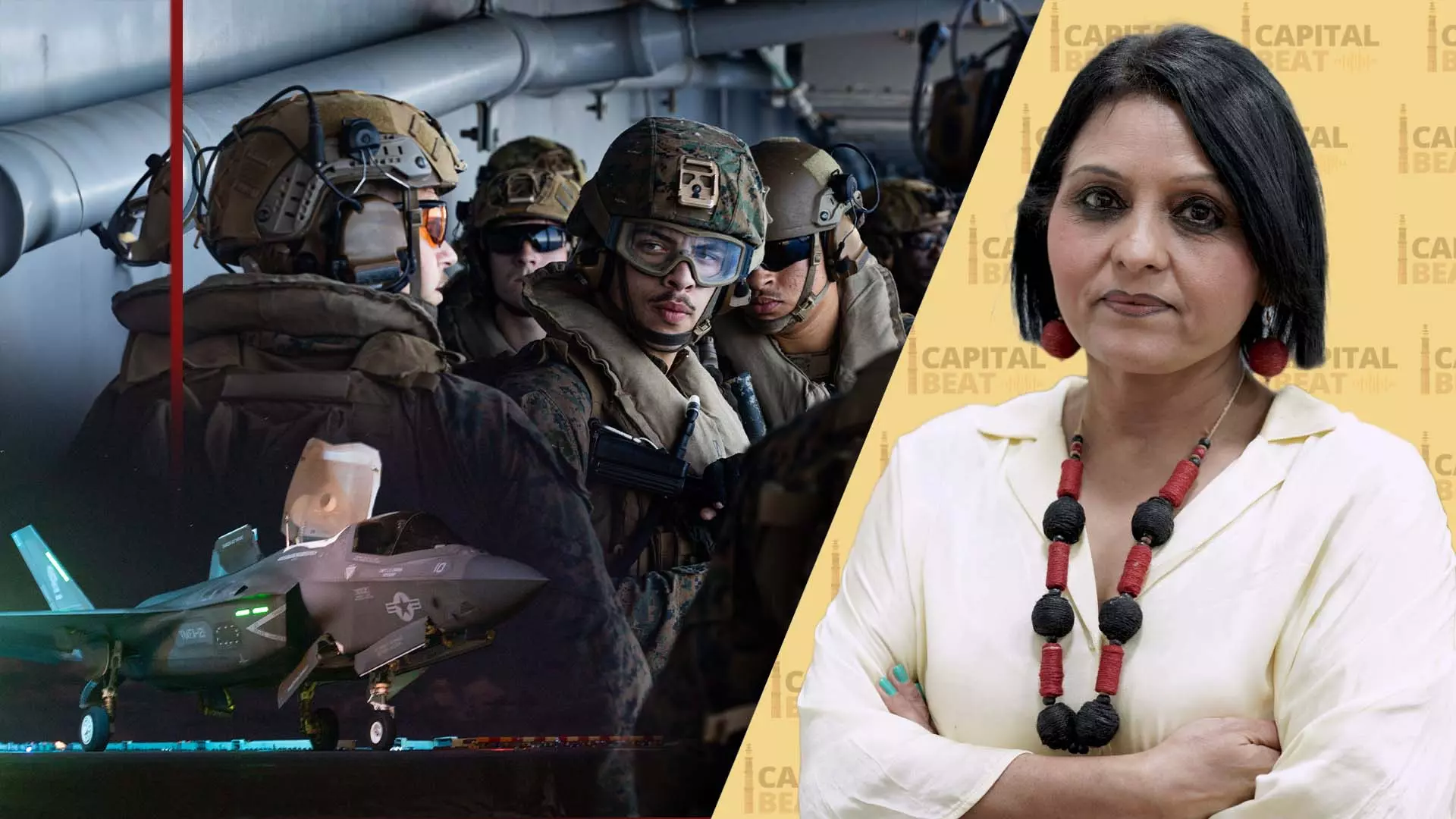
The United States has deployed thousands of additional Marines and paratroopers to West Asia, adding to an already significant military presence in the region. According to reports cited during the discussion, this is the largest military build-up in nearly 20 years.
The deployment includes the USS Tripoli amphibious assault ship, carrying around 3,500 personnel along with aircraft and tactical assets. This move has intensified speculation about a possible ground invasion.
Also read: Rupee at 95, Sensex in a spiral: Is India bracing for 2008-kind meltdown?
At the same time, Iran has responded with strong rhetoric. A Tehran Times front page warning declared that US troops entering Iranian soil would “leave only in a coffin,” signalling the high stakes involved.
War or pressure?
Despite the aggressive posturing, experts believe the military mobilisation may be part of a broader pressure strategy rather than a prelude to full-scale invasion.
Dakshina Murthy noted that the US appears to be pursuing a “multi-pronged approach” — combining military escalation, diplomatic signalling, and psychological pressure.
“There are two parallel tracks,” he said. “One is escalation with troop movement, and the other is repeated claims that a deal is close. This is about applying maximum pressure on Iran.”
He added that Washington may be trying to force Tehran into concessions by demonstrating its readiness for war.
Limited strikes likely
Pasha argued that while a full invasion is unlikely, limited military operations cannot be ruled out.
He suggested that the US forces could attempt targeted strikes or short-term operations aimed at key strategic assets, such as nuclear facilities or leadership targets.
Also read: If US plans Iran ground war, where does it launch it from?
“The idea could be to capture enriched uranium, destroy installations, or conduct symbolic operations,” he said.
However, he cautioned that even these limited operations would face significant resistance and logistical challenges.
Ground reality
According to Pasha, Iran is well-prepared for defensive warfare, particularly in critical areas like the Strait of Hormuz and Kharg Island.
He highlighted that Iran has fortified these regions with mines, artillery, missiles, and underground military infrastructure.
“They may land and show they have captured territory,” he said. “But sustaining control will be extremely difficult.”
He also pointed to a recent failed attempt by US helicopters in the region, where one was reportedly shot down, underscoring the risks involved.
Regional risks
Any escalation could have severe consequences for the broader Gulf region.
Pasha warned that Iran could retaliate by targeting critical infrastructure in neighbouring countries, including power plants and desalination facilities.
Also read: Modi wants ‘Team India’ to be energy independent, but how are the states placed?
“If the US attacks Iranian energy infrastructure, Iran will respond immediately,” he said.
He also raised concerns about the safety of commercial shipping in the Strait of Hormuz, noting that over 100 ships — including Indian vessels — could be caught in crossfire.
Negotiations falter
Diplomatic efforts, meanwhile, appear to be struggling. Talks involving multiple countries, including those held in Islamabad, have failed to produce a breakthrough.
Dakshina Murthy described negotiations as “a work in progress” but acknowledged deep mistrust between the US and Iran.
“Iran has a credibility issue with the US,” he said. “They fear walking into a trap.”
Iran has also rejected key elements of the US proposal, calling them unrealistic and excessive.
Unrealistic demands
The panel highlighted that US demands reportedly include Iran giving up its nuclear programme, ballistic missile capabilities, and enriched uranium stockpile.
Dakshina Murthy said such expectations amount to asking Iran to “completely surrender itself as a nation.”
Also read: US force build-up in West Asia belies Trump’s peace overtures; what’s Pentagon’s plan?
“This is not something any country would accept,” he said.
This explains Tehran’s hardened stance and its reluctance to engage in direct negotiations under current conditions.
Trump’s strategy
Both experts pointed to the unpredictability of Donald Trump’s approach as a key factor shaping the crisis.
Pasha described Trump as someone who “blows hot and cold,” alternating between threats of regime change and calls for peace.
Dakshina Murthy suggested that Trump may ultimately be seeking a way to declare victory and wind down the conflict.
“He is preparing multiple outcomes — escalation, pressure, and also an exit narrative,” he said.
Global players
Russia and China are emerging as important actors in the unfolding situation.
Pasha noted that Moscow, in particular, could play a mediating role and push for a ceasefire framework.
Also read: The Tehran 'toll booth'? Iran eyes to cash in on Strait of Hormuz disruption
He said Iran had shown some willingness to negotiate, including on nuclear issues, but under conditions that preserve its sovereignty.
“There is still some hope for negotiations,” he said, adding that external mediation could help bridge the gap.
Uncertain path
Despite ongoing diplomatic efforts, the situation remains fragile and unpredictable.
Experts agree that while a full-scale invasion is unlikely, the risk of escalation through limited strikes or miscalculations remains high.
The combination of military build-up, stalled negotiations, and aggressive rhetoric has created a volatile environment with global implications.
Also read: Iran war tests India's macroeconomic resilience, government data shows
As the conflict enters its 31st day, the world continues to watch closely, with the possibility of either de-escalation or further confrontation still on the table.
(The content above has been transcribed from video using a fine-tuned AI model. To ensure accuracy, quality, and editorial integrity, we employ a Human-In-The-Loop (HITL) process. While AI assists in creating the initial draft, our experienced editorial team carefully reviews, edits, and refines the content before publication. At The Federal, we combine the efficiency of AI with the expertise of human editors to deliver reliable and insightful journalism.)