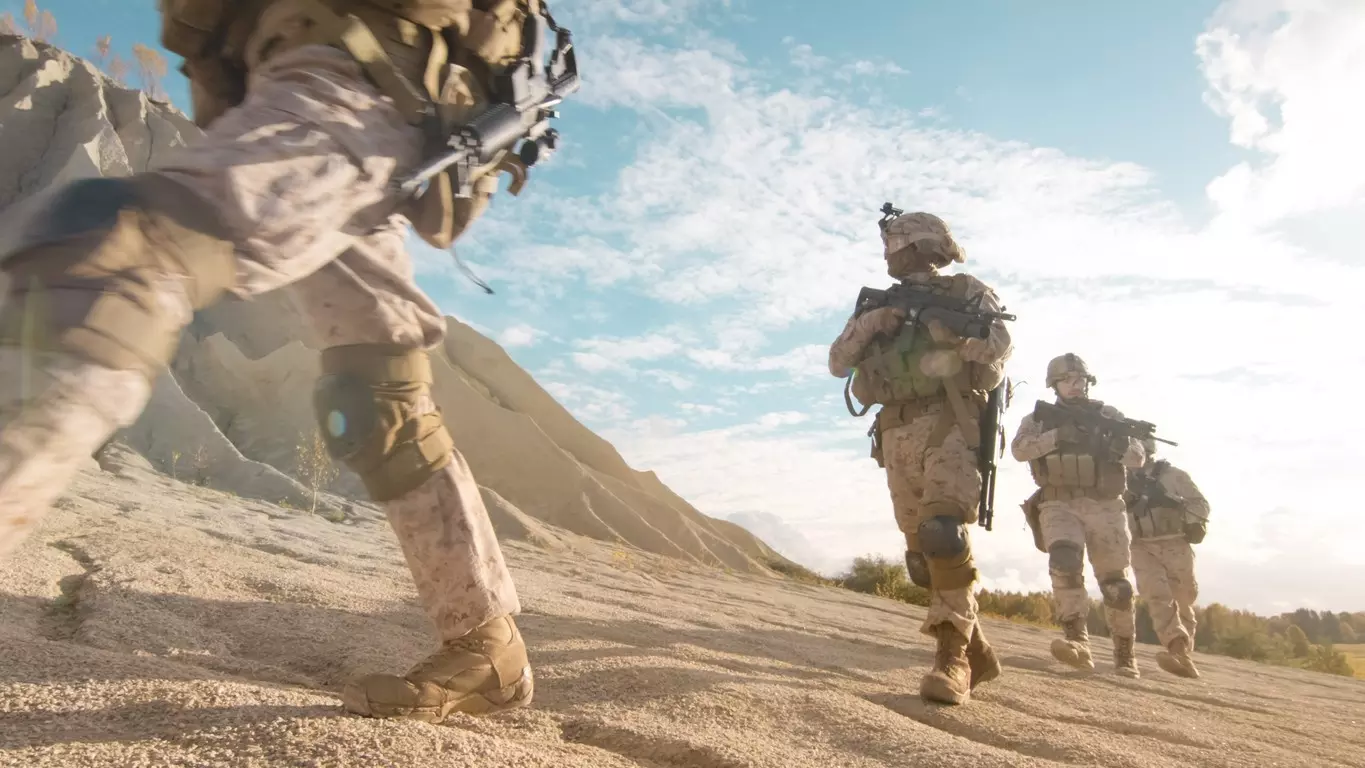
Speculation is rife over whether the US would launch a ground invasion of Iran, a month after pounding it from air. Representative Photo: iStock
If US plans Iran ground war, where does it launch it from?
Even as US troops arrive in the Gulf, and Washington has many options to attack Iran via land, it would be a mission easier said than done

Even as the Donald Trump administration pursues a zig-zag stance on continuing the attacks on Iran, the international community is feeling apprehensive over whether there would be a land invasion of the West Asian nation, something that could see an already precarious situation spiralling out of control.
Days after US President Trump boasted that the US has already won the war and his Secretary of State Marco Rubio claimed that Washington could achieve its aims in Iran without actually deploying its ground troops, The Washington Post cited American officials as saying that the Pentagon is in the middle of preparing weeks-long limited ground operations in Iran, potentially featuring raids on Kharg Island, which is key to Iran’s oil exports, and coastal sites near the Strait of Hormuz.
Also read: The Tehran 'toll booth'? Iran eyes to cash in on Strait of Hormuz disruption
The strait is a vital trade route that has been blockaded by Iran in the wake of the Israeli-US attacks on it.
Media reports said the US was deploying more troops in West Asia to bolster its presence, as a further 3,500 troops arrived in the region this weekend. The US Central Command announced on X that the sailors and marines belong to a unit led by the American warship USS Tripoli, which also has assault and transport equipment.
Iran and the Gulf region and the US's various options to launch a ground offensive against Tehran. (This map is AI generated)
While it was still not known whether Trump, the commander-in-chief, had approved of a ground strike, observers of international affairs were keeping their fingers crossed.
Can US afford another Afghanistan, Iraq?
Simon Tisdall, foreign affairs commentator of The Guardian, said in a piece that “It’s incredible to think that after all the mortal agony and anguish of Iraq and Afghanistan, a US president is once again seriously contemplating boots on the ground in the Middle East.”
However, he then said, “Trump must swallow his pride, admit his error, eat humble pie. Yet as all the world knows, the very idea that this most ignorant, reckless and narcissistic of US leaders might actually do so is utterly ridiculous.”
In case the worst indeed happens, what could be the US’s route to enter Iran?
What the ground ops can look like
First, what could the ground operations look like? They are expected to be a limited “raid-style” mission with the involvement of small units such as the special forces, marines and airborne troops.
The objectives could include: securing or destroying so-called nuclear facilities, capturing strategic sites such as the Kharg Island and making a quick exit after gathering intelligence about Iran’s current state of affairs and counterplans. These missions are expected to be fast and precise and short of occupation, something the US officials may have tried to convey.
The invasion could also see the landing of paratroopers (like the 82nd Airborne Division), backed by airpower, at key entry points. I could be followed by the entry of special forces that would hit targets and secure materials, such as enriched uranium, and then exit.
Also read: Iran war tests India's macroeconomic resilience, government data shows
There could also be amphibious missions whereby US Marines could reach Iran’s coasts and target its strategic islands and oil-export hubs near the strait.
Another strategy of ground warfare could be engaging in an indirect one, whereby the American forces may back local support groups, such as the Kurdish outfits, to wage war against Iran. The US had adopted such a strategy during the Afghanistan war (2001) and the Iraq war (2003) against the Taliban and Saddam Hussein, respectively. The American airpower and intelligence would be playing a major role in that scenario.
What could be the possible routes for an American invasion of Iran?
Iran's tough geography
Invading Iran would not be a cakewalk, even for a modern army like that of the US. The country is quite big in size (1.6 million square kilometres and two-and-a-half times larger than Afghanistan and three to four times bigger than Iraq) and has a challenging terrain. It has two major mountain ranges, Zagros and Alborz, while its central districts act as barriers. The coastlines are also militarised choke points, all the more during the ongoing conflict. If one considers Iran as a “fortress plateau”, it would be easy to visualise that it is easy to enter at the edges, but making a penetration is that much more difficult.
If we come to Iran’s surroundings, to the north it is bordered by Turkmenistan, Azerbaijan, Armenia, and the Caspian Sea. To the north-west and west, it has Turkey and Iraq. Countries such as Kuwait, Saudi Arabia, Bahrain, Qatar, Oman, and the United Arab Emirates do not have a direct border with Iran but they are close, sometimes across narrow water strips. To the east, Iran is flanked by Afghanistan and Pakistan, while to the south, there are the Gulf of Oman and the Strait of Hormuz, and the Persian Gulf is to the southwest.
Entering from north
Of these countries, entering Iran from the north is not easy. While Azerbaijan has said that its territory could not be used to attack Iran, despite its strategic ties with Iran’s rival Israel, Armenia has complex diplomatic ties with Iran and is unlikely to see it getting dragged into the conflict. As far as Turkmenistan is concerned, a far-left American website has said that the Central Asian republic is a viable choice for an American land invasion of Iran, recalling that the Mongols’ attack on Iran in the 1200s was through that route.
Also read: Is India’s silence on Iran’s missile message strategic restraint or a policy dilemma?
However, it is unlikely that Turkmenistan would be explored by the Americans as a route to attack Iran, because of logistical problems and Ashgabat’s neutrality constraints.
From the west: Iraq
A better route seems to be the Iraq border, but only comparatively. Since the Americans are familiar with expeditions in Iraq in the past, they would be easy to mark a Baghdad-Basra-Khuzestan (Iran)-Zagros Mountains-Central Iran route to reach the heart of the country, but the terrain would still be a tough barrier to overcome. Even during the 1980-81 war between Iran and Iraq, the Iraqi forces found it extremely difficult to breach the Zagros challenge.
From the east: Afghanistan
The Americans can also try the eastern route, which is through Afghanistan. Zaranj, near the Afghanistan and Iran border, can be an opening, leading into the Iranian plateau and the major deserts of Dasht-e Lut and Dasht-e Kavir, located in the eastern and south-central parts of the country. But the eastern boundary will be the least likely choice for the Americans. They would not pick Afghanistan, a quagmire from where they had a painful exit in 2021 after a prolonged stalemate and do not have much of a logistical advantage now. The deserts would also make it tough for the invading forces in the unsparing summer time, stressing their supply lines.
Moreover, Pakistan would not want the effects of the war touching its western neighbourhood when it is trying to play a mediator’s role to increase its diplomatic clout. Islamabad would also dread another conflict zone opening up to its west, while it always remains alert on its eastern front with India. The same applies to Turkey, which is also trying to de-escalate the tension and has also refused the US to use its air, land and maritime space to launch operations against Iran.
From Persian Gulf
Another option remains entering Iran through a sea-based mission in the Persian Gulf. The air forces can land the marines, who then access the coastal parts of the country and seek to move deep inside. This would be most effective for the Americans as they can target various strategic assets and areas of Iran, including the Strait of Hormuz. But they would also face the maximum resistance from the Iranian forces on this route, since Tehran has kept a strong military vigilance in this zone.
Also read: Iran war: Why have peace efforts not clicked yet?
While Persian Gulf had served as a vital base for the US forces during both the Gulf wars of 1991 and 2003, the Americans would remember how an airborne mission to rescue their hostages during the 1979 crisis had fallen flat and could not even reach Tehran, causing a massive embarrassment for Washington. Iran has already warned that if the US went ahead with its ground invasion, its soldiers would become "food for the sharks".
Using American bases in Gulf
The US’s biggest hope in launching a viable land offensive against Iran lies in using its military bases in many of the Gulf nations neighbouring Iran. But after facing Iran’s wrath as it attacked energy and vital assets in many of these countries that harbour (or even if they do not, like the UAE) American bases over the last month, not many of them are eager to take the risk of allowing the Americans to use their soil to further provoke the Iranians.
The Gulf nations were left exposed to the consequences of Israeli-US escalation without adequate prior coordination from Washington. They cannot afford to be treated just like platforms instead of equal partners, since the price they had to pay was immense.
Also read: 'India's silence over attacks on Iran not pragmatism, but cowardice' | Interview
Saudi, the largest state in the region, which is now among those trying to scale down the conflict, cannot see it fighting wars on multiple fronts, including along its southern border with Yemen, where Iran-backed Houthi rebels have scaled back years of attacks on Saudi territory only recently.
Also, allowing the US and Israel to carry on with their war would jeopardise these countries’ clout, which they have built over the years.
Can the US still march forward with its ground-invasion plan?