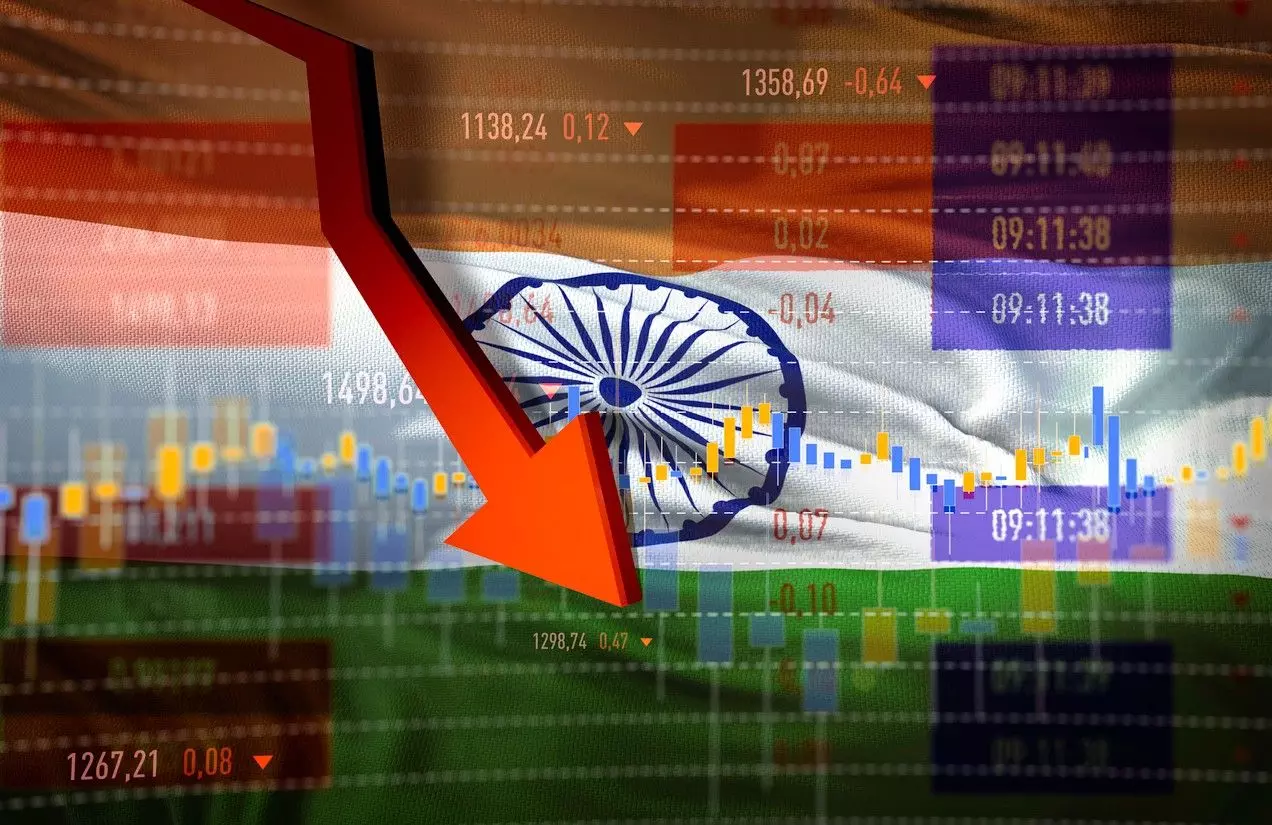
Rupee at 95, Sensex in a spiral: Is India bracing for 2008-kind meltdown?
As Iran war drives Brent crude soaring and triggers $42B foreign capital exodus, FinMin's "all's well" assurance faces a grim reality check from global analysts

As India faces the impact of the ongoing geopolitical and geoeconomic crisis in West Asia, including in the economic, financial and business sectors, with experts and common people wondering what’s in store, Union Finance Minister Nirmala Sitharaman assured the nation on Monday (March 30) its economic fundamentals are strong, and compared to other emerging market economies of the world, the rupee is “absolutely going fine” against the American dollar.
The fate of the currency has remained a subject of tense discussions, particularly after the conflict began on February 28. The rupee has depreciated by more than four per cent to close at almost Rs 95 a dollar as of March 27.
Also read: Reliance leads Rs 1.75L cr market rout as top Indian firms falter
While the FM said, “theek chal raha hai” (everything is going fine with the rupee), and the depreciation is not specific to the Indian currency alone, one cannot evade questioning whether India is heading towards a crisis akin to the Global Financial Crisis (GFC) of 2008.
Close watch on rupee
Minister of State for Finance Pankaj Chaudhary said both the government and the Reserve Bank of India are keeping a close watch on the value of the rupee.
Will the government’s assurance on the rupee dissuade the investors from abandoning hope of a major rally in the Indian stock market? Should they simply give up on expectations of high returns?
These questions are not untimely since the Indian stock market has seen a constant downward spiral since the escalation happened in West Asia. The investors have found themselves bleeding even as missiles are being hurled thousands of kilometres away.
Since the outbreak of the conflict, the BSE Sensex has plummeted 11 per cent, while the National Stock Exchange's Nifty 50 has dropped by 10.50 per cent.
During this period, Foreign Portfolio Investors (FPIs) have offloaded shares worth approximately $12.3 billion—equivalent to Rs 1.13 lakh crore—in the market. Consequently, the total market capitalisation of shares listed on the BSE has witnessed a decline of Rs 47 lakh crore.
What has made the situation worse is the rising Brent crude prices, which have touched $115-$116 a barrel on Monday, up from $65-$70 when the conflict started. Given India’s high dependence on crude imports, a rising crude price and falling rupee complicate the challenges for the policy-makers even more.
Goldman Sachs' many warnings
Top international financial bodies have also expressed concerns over the Indian situation. Goldman Sachs, for example, recently downgraded Indian equities to ‘marketweight’ (neutral) from ‘overweight’ and slashed its Nifty 50 target, pointing to falling macro conditions and warning about an earnings downgrade cycle led by the “energy shock”.
Also read: How West Asia conflict has left India's coastal economy with empty nets
This implies that the firm doesn’t expect superior returns from the Indian market. While it had previously projected that the NSE Nifty 50 index could touch the 29,300 mark, it now lowered its target to 25,900 points. The overall downgrading of rating on Indian equities doesn’t augur well for a fast-developing economy such as India.
The investment bank has conceded in a report that disruptions in crude oil supplies caused by the tensions in West Asia have erected new challenges for the Indian economy. It has cautioned that if energy prices continue to remain high for a long term, India’s economic outlook could weaken.
In a major move last week, it also downgraded India’s 2026 growth forecast to less than six per cent from the pre-war estimate of seven per cent. While the rupee’s depreciation also leads to inflationary concerns, widening the current account deficit (CAD) poses another threat.
Rising crude prices
The impact of rising crude prices will not be limited to the broader economy alone, Goldman Sachs has said. Even corporate earnings are set to face the brunt. Its report has reduced the earnings growth forecast for firms over the next two years, to eight per cent (FY26) and 13 per cent (FY27). The previous projects were 16 and 14 per cent, respectively.
Sectors closely tied to domestic demand—such as automotive, consumer goods, and other cyclical industries—are particularly vulnerable to the most severe impact on their earnings. Investor confidence—spanning both foreign and domestic participants—already appears to be waning.
Since September 2024, foreign investors have withdrawn approximately $42 billion from the Indian market. The West Asian crisis has not helped things at all.
Bernstein also rings warning bell
Bernstein, a leader in cash equities and equity research, has also released a report titled ‘India Strategy: How bad can it get from here?’ which explores the strategic outlook for India and examines how much the situation could get worse from this position.
“Wars do eventually end, markets rebound, and narratives move on; what should not be forgotten are India’s external vulnerabilities that such episodes expose,” the report, which was published on March 25, said.
In its report, Bernstein notes that the conflict between the US and Israel against Iran—coupled with rising crude oil prices—has sparked fresh concerns regarding the Indian economy. It warns that if this crisis becomes protracted, the situation could mirror that of the 2008 disaster.
Also read: Modi wants ‘Team India’ to be energy independent, but how are the states placed?
“Elevated crude and trade almost go hand in hand, with past cycles coinciding with a sharp spike in goods import - giving rise to a surge in merchandize trade deficit - we’ve seen that prior to GFC when crude surged beyond $100 by early 2008, staying there till July. We saw that from 2011-2014 and we again saw that after the Russian invasion of Ukraine. That part, almost certainly, is expected to spike up again,” it said.
Sensex, Nifty volatile
Indeed, over the past three months, the Sensex has witnessed a 15 per cent decline, the Nifty a 14 per cent fall, and the Nifty IT Index—which was already under pressure due to threats posed by Artificial Intelligence (AI)—has plummeted by 22 per cent.
Highlighting the risk of a global financial crisis moment, the Bernstein report recalls that the 2008 disaster had a profound impact on India's economy: growth was halved, inflation surged, and the rupee depreciated. The report suggested that there is a looming possibility of a precisely similar scenario unfolding in 2026.
It also identified expensive crude oil as the primary cause for concern, noting that India imports approximately 90 per cent of its crude oil requirements. Consequently, a rise in oil prices has a direct and immediate impact on the country's economy.
Inflation worries
Should the conflict persist, inflation could breach the six per cent mark, potential interest rate cuts could be deferred, and the pace of economic growth could decelerate. If conditions worsen further, the GDP growth could plummet to between two and three per cent, and the rupee could slide past the 100 mark.
The stock market could experience a significant downturn. India's foreign exchange reserves have recently declined, constraining the central bank to make a heavy intervention to tame volatility.
Also read: Iran war tests India's macroeconomic resilience, government data shows
If global conditions do not improve soon, the pressure on the rupee is likely to intensify. Furthermore, remittances flowing in from Gulf nations could diminish, potentially widening India's Current Account Deficit.
Bernstein stated that it has lowered by two per cent the Nifty 50 target of 28,100—a bullish projection it had issued earlier this year, prior to the outbreak of the war. However, should the recessionary crisis deepen, the Nifty could tumble to the 19,000 level. Nevertheless, the firm has set a Nifty target of 26,000, which represents a 15.55 per cent upside from current levels. Bernstein has also maintained a “neutral” stance on Indian markets, projecting that the market is likely to remain flat in 2026. This situation has undoubtedly added to the investors’ woes.
Systematix Group says it's uncertain
According to a report by Systematix Group, a Mumbai-based brokerage house, India's equity market is currently navigating a phase of uncertainty, driven by concerns regarding corporate earnings, capital inflows, and valuations. Even prior to the outbreak of the conflict, the performance of the Indian stock market had remained lacklustre since mid-2024. The market capitalisation of the Indian market has fallen by approximately Rs 64 lakh crore from its 2024 peak. A study of nearly 400 stocks revealed that 63 per cent of them have yielded negative returns.
Retail investors—particularly those who invested after being swayed by social media trends and "finfluencers"—have seen a significant erosion of their capital. FPIs have offloaded shares worth $43 billion since September 2024. However, the market received support from domestic institutional investors (DIIs) and equity mutual funds, which collectively invested $59 billion.
Also read: Is India’s silence on Iran’s missile message strategic restraint or a policy dilemma?
Since October 2024, the number of systematic investment plans (SIPs) has remained stable, although the average assets under management (AUM) has grown by 20 per cent. This suggests that the "affluent segment"—i.e., those with substantial financial resources—is increasing their investments, while smaller investors are grappling with the crisis of negative returns.
Amidst this scenario, stock market investors find themselves at a loss as to how to proceed, compelled to watch their mounting losses unfold on their screens day after day. The leading advisers have suggested that the investors remain cautious in the current environment and avoid making hasty decisions.
(This article was originally published in The Federal Desh.)