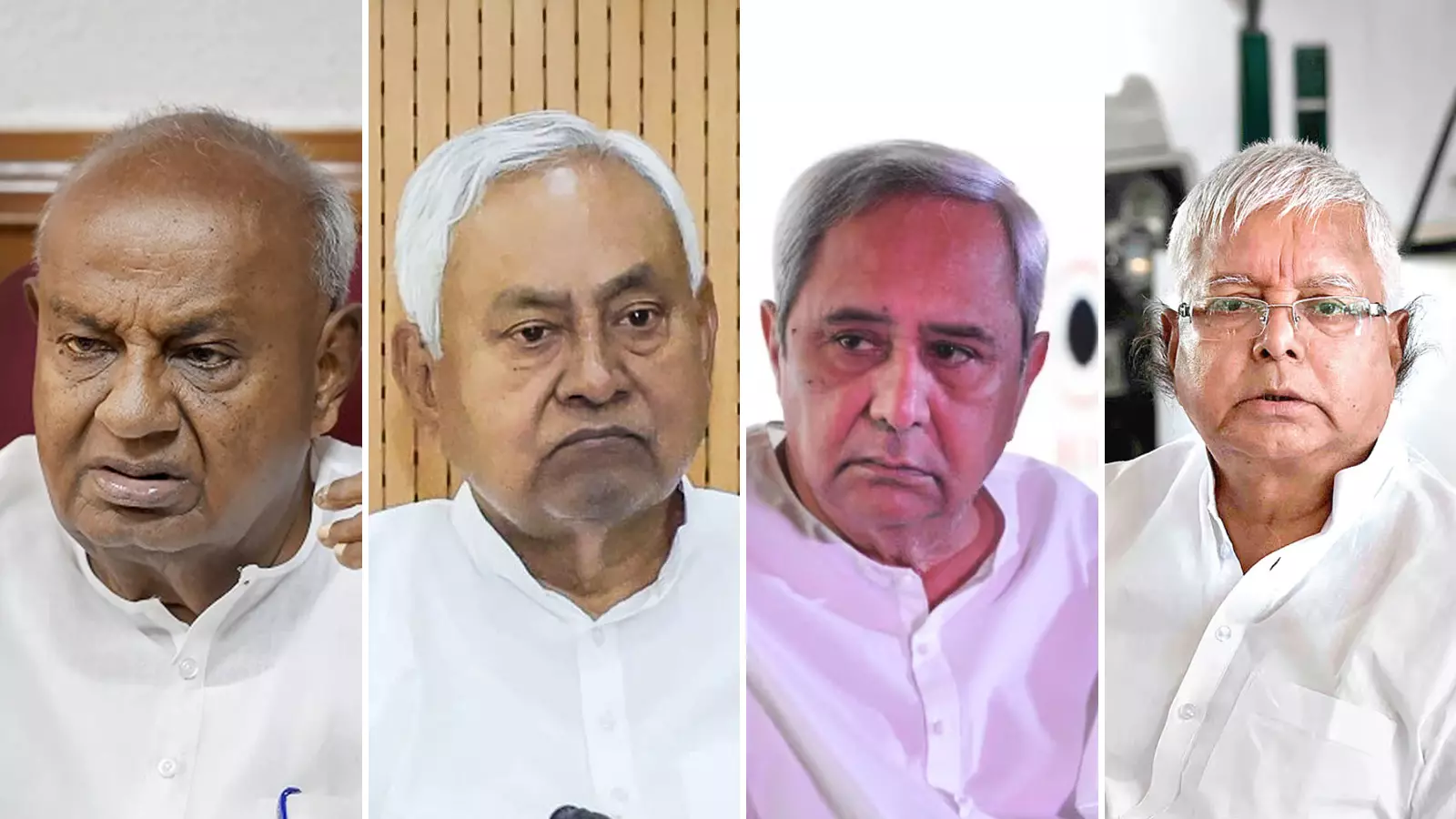
With the slow-and-steady decline of strong regional political parties such as Janata Dal (United) in Bihar and Janata Dal (Secular) in Karnataka, has led political observers to ask — whether this marks the final chapter of the broader Janata Parivar tradition that emerged after the 1977 Indian general election, that brought the Janata Party to power, uniting the diverse anti-Congress forces after the Emergency imposed by Indira Gandhi in 1975.
Over time, the Janata coalition has fragmented into multiple regional parties. Only the JD(U) and JD(S) remained active after the Bharatiya Janata Party's (BJP) strategic attempts to contain, shrink, and in some cases eliminate the influence of regional parties and the broader political opposition. This consolidation intensified in early 2026, following the BJP's victory in the 2024 Lok Sabha general elections.
Autumn of the patriarchs
When the JD(S) and JD(U) joined hands with the BJP-led National Democratic Alliance (NDA), it signified a pivotal shift — a return to a dominant party system reminiscent of the earlier eras of Indian politics. By merging their fortunes with the NDA, these once-formidable regional powers have effectively diluted their distinct, independent identities.
This trend reflected a broader consolidation around the BJP. The influence of these two parties has gradually shrunk, following the recent developments in the JD(S) and in the JD(U). Between the JD(S)'s ageing HD Deve Gowda’s Rajya Sabha bid, his son HD Kumaraswamy’s integration into the Union Cabinet, and JD(U) supremo Nitish Kumar’s exit from active politics in Bihar, the old guard appears to be fading. This transition marks more than just a change in leadership; it clearly reflects the autumn of socialist, secular politics in the country.
Nishant Kumar, son of Nitish Kumar, who recently joined the JD(U), could possibly be named Bihar's deputy chief minister. But this move comes even as Bihar is preparing to have its first BJP chief minister.
The case of Biju Janata Dal
The fading Janata Dal story doesn't end with the two outfits from the north and the south. In Odisha, the Biju Janata Dal (BJD) is another case in point. Though the party was formed by Naveen Patnaik, the son of the state's iconic leader Biju Patnaik, who was also a Janata Dal leader and spearheaded the anti-Congress politics in the state, it is also an offshoot of the Janata Dal/Parivar.
Formed months after the death of Biju in April 1997, the party went on to dominate Odisha's politics for many decades, with Naveen serving as the chief minister for 24 years. However, after he lost power in the 2024 Assembly elections and with the growing
dissent from within its ranks against the ageing leadership, which has been accused of having no blueprint ready for the future, the BJD's future also doesn't look rosy at the moment and it would be the BJP which stands to gain the most if the regional party collapses.
Then there is Lalu's RJD
In fact, there is another offshoot of the Janata Dal which functions in Bihar, and it is the Rashtriya Janata Dal (RJD) of the state's former chief minister Lalu Prasad Yadav. Also formed in 1997, the RJD doesn't have a major succession concern like the JD(U) after an ageing and ailing Lalu with his son Tejashwi Yadav having already taken over the baton from his wily politician father, but the debacle in the 2025 Assembly elections does pose a challenge to its new-generation leadership as to how to match the juggernaut of saffron politics, which looks advantageously placed in the state at the moment.
It is to be seen whether like the old guard of the Janata family which fought the Congress, the new guard can take on the BJP or evaporate under its dominance.
JD(S) to retry luck in state politics?
Coming back to the JD(S)'s story, in the midst of fast political developments, HD Deve Gowda clarified to the media that, “Kumaraswamy becoming chief minister of Karnataka again is in the hands of Prime Minister Narendra Modi and Home Minister Amit Shah”. Meanwhile, Kumaraswamy, the Union minister for steel and heavy industries, has expressed his desire to return to state politics in 2028, when Karnataka goes to the polls.
Speaking to The Federal, Kumaraswamy said that he returns to the state due to "the insistence of the people, especially the rank and file of the JD(S)”.
In recent days, he has been seen more often in the old Mysore region, travelling through the Vokkaliga belt to boost the morale of the party workers. The JD(S), which holds sway over this region, forged an alliance with the BJP during the 2024 Lok Sabha polls. BJP leaders realised they could capitalise on the JD(S) vote bank and win some seats.
In a chat with The Federal, Tumakuru Rural BJP MLA B Suresh Gowda ruled out any possibility of the Congress winning even a single seat in the Old Mysore region. According to him, the BJP and JD(S)'s alliance in 2028 will prevent the ruling Congress from winning any seats in the Old Mysore region.
Political analysts point out that what is changing is the balance of power — the BJP’s organisational strength, ideological clarity and electoral machinery have helped the saffron party to move into a space once occupied by fragmented regional groups.
JD(S) and JD(U)
The comparison between the JD(S) and JD(U) stems from several structural similarities between the two parties. Both originated from the broader Janata movement and built their political bases around regional and social coalitions. Both are led by prominent leaders, whose personal authority has shaped the identity and direction of their respective parties. In both cases, the party founders have grown old and have raised questions about leadership,
However, there are fundamental structural differences between the two regional behemoths.
Unlike its counterpart, the JD(S) continues to retain a relatively cohesive regional base and caste-based support rooted in its traditional Vokkaliga heartland of southern Karnataka. This localised caste-consolidation acts as a strategic buffer, providing the party with bargaining power within national alliances.
By anchoring itself to a specific geographic and social identity, the JD(S) ensures its continued relevance as a crucial powerbroker in Karnataka’s increasingly polarised political theatre.
In contrast, the JD(U)’s influence in Bihar has been more state-wide, and its alliance dynamics with the BJP have evolved in response to changing electoral arithmetic and political realignments.
JD(S) at 25
The JD(S) recently celebrated its silver jubilee, marking a significant milestone for a party whose electoral relevance has fluctuated over time, but whose political importance appears to be just tokenistic.
The party, which has oscillated between kingmaker, survivor and outlier, marks its 25 years of existence, thanks to shifting national winds and the enduring arithmetic of caste politics.
However, Ramesh Babu, once a close associate of Deve Gowda and currently a Congress MLC, observed, "The JD(S) lost its Vokkaliga bastion to BJP, especially in the belt stretching from Bengaluru rural to Mysuru, and Hassan to Bengaluru. This shift occurred after the party compromised its secular and socialistic values, allowing communal and nationalistic narratives to take root in the region. The BJP successfully captured these areas by transforming them into a Hindutva laboratory, and recent communal disturbances in Channapatna, Mandya, and Srirangapatna prove this transformation."
Failure of Kumaraswamy's son
Successive election defeats of Nikhil Kumaraswamy, son of HD Kumaraswamy, attest to the fact that the JD(S) is losing its hold on the Vokkaliga belt.
Nikhil lost the 2019 Lok Sabha election in Mandya, the 2023 Assembly polls in Ramanagar and the 2024 Channapatna Assembly by-elections.
GT Deve Gowda, a veteran JD(S) leader and sitting MLA from Chamundeshwari Assembly constituency since 2013 and defeated Chief Minister Siddaramaiah in the 2018 polls to the Assembly, has been completely sidelined by the party leaders, Deve Gowda, Kumaraswamy and Nikhil Kumaraswamy. HD Kumaraswamy openly declared in Mysuru recently that GT Deve Gowda “is no more with us”.
HD Deve Gowda had sidelined many senior party leaders earlier to promote his son and make him his heir apparent and chief minister of Karnataka. Muslim leaders, including the party's former state working president N M Nabi, Mohammad Altaf, senior vice-president Syed Saifulla Saheb, C M Ibrahim, have all deserted the JD(S).
The paradox
The paradox here is that the JD(S) was founded by former prime minister H D Deve Gowda in 1999 when he split from the erstwhile Janata Parivar. The JD(S) was born due to a split in the Janata Dal, when a faction led by then Karnataka chief minister J H Patel aligned with the NDA.
The JD(S) was registered in November 2004. Since then, it has never been out of the equation in Karnataka’s complex political landscape, asserting its regional identity, while frequently oscillating between the BJP and the Congress in its attempt to stay in power. However, the JD(S), which had opposed teaming up with the NDA so as to firmly maintain its secular and anti-communal credentials, ultimately fell into the lap of the saffron alliance.
Beginning of the decline
The political trajectory of the JD(S) cannot be fully understood without examining the turning point that occurred after the 2008 Assembly elections in Karnataka. Despite retaining a significant social base in the Old Mysore region, particularly among the Vokkaliga community, the party has struggled to regain the political influence it once held in the state. The period after 2008 marked the beginning of a gradual but persistent decline that reshaped the party’s role in state politics.
One of the most significant factors contributing to the decline was the political fallout of the breakdown of the power-sharing arrangement between the JD(S) and the BJP in 2007.
The development generated a widespread perception of political opportunism and eroded trust among voters and political partners alike. This episode significantly changed the credibility of the JD(S) beyond its core support base. The 2008 polls reflected the consequences of this political rupture and resulted in the BJP’s B S Yediyurappa becoming the chief minister, and the JD(S) saw its position reduced to that of a smaller regional party, with its influence largely confined to the old Mysore region.
Dip in vote share
The current strategic alignment between the JD(S) and the BJP reflects an attempt to adapt to this changing political environment. But this partnership raises questions about the long-term independence of the JD(S) and whether it may eventually become part of a broader coalition framework. The JD(S) cut a sorry figure in 2004 when its 21.1 per cent vote share dipped to 13 per cent.
JD(S) turns into BJP's irritant
The problem started in 2011, when Kumaraswamy was stuck in a legal tangle as a petition was filed against him in the Karnataka High Court, accusing him of ‘planning a second marriage with a Kannada actress’. Though this case damaged Kumaraswamy's reputation, the accusations could not be proved.
When Kumaraswamy was the chief minister, his son Nikhil was allegedly involved in ransacking a pub. Somehow, the issue got buried. The JD(S) has also been plagued by the Prajwal Revanna episode in more recent times. Kumaraswamy and family conveniently distanced themselves from that episode.
Prajwal, grandson of HD Deve Gowda, and son of HD Revanna and Bhavani, stands accused of prima facie "serial sexual harassment". This has shocked many. Similarly, there was a case against another son of H D Revanna, Suraj Revanna, who was arrested for allegedly sexually assaulting a male worker. The BJP, the NDA and Gowda himself are stuck in an embarrassing situation.
The BJP and the NDA are now thinking twice about continuing their alliance with the JD(S). Reacting to a question on whether this alliance will hold, a senior BJP leader exclaimed, “Oh My Gowda. Explain, is this the culture of JD(S)?” He was referring to the sex scandals plaguing the Gowda family.
Understanding the political situation, the JD(S), which had considered earlier to contest the local body polls on its own strength, took a sharp U-turn and announced its decision to ally with the BJP. No final decision, however, has been taken yet in this regard. At the same time, cracks are developing in the BJP-JD(S) alliance, and the tensions appear to be out in the open.
A recent protest by the BJP against the price hike has exposed the cracks and lack of coordination among the two alliance partners. JD(S) legislative party leader Suresh Babu told The Federal, “Saffron party leaders also didn’t take JD(S) into consideration when they protested against the MUDA (Mysuru Urban Development Authority) scam”.
JD(S) on revival mode
At this juncture, the BJP-JD(S) alliance struggles to survive amid internal conflicts.
Meanwhile, the nonagenarian HD Deve Gowda has not lost his fighting spirit and has declared that he will tour across the state to motivate party workers. However, the veteran has health problems as he is being treated for kidney-related problems. But the rank and file of the party and its workers are frustrated with the party affairs and are trying to defect to either of the two national parties to pursue their political careers.
CM Siddaramaiah, who was once in the JD(S), slammed HD Deve Gowda aligning with the BJP and not protecting Karnataka's interests. He also said, "The JD(S) is a spent force, daydreaming of returning to the helm”.
Similarly, Karnataka's former chief minister and octogenarian B S Yediyurappa, who earlier succeeded in making his son B Y Vijayendra the party’s state president, is trying to push his son's candidature for the CM’s post in 2028. The same leader who had utilised the JD(S)'s strength to build the BJP, now told media, “The BJP will come to power on its own in 2028."
BJP's growing dominance
Observing the political developments both in Karnataka and Bihar, senior politician and former parliamentary affairs minister MC Nanaiah summed it up thus to The Federal: "After 1990, regional parties in India face the challenge of maintaining political relevance amid the growing dominance of national parties. It has become a challenging task. Recent developments in Bihar and Karnataka point towards a parallel journey for these two Janata Parivar parties.
"The rise of the BJP has created a powerful national pole that increasingly absorbs or sidelines smaller regional formations, particularly those that once emerged from the Janata Parivar lineage. In the end, leaders and voter bases that once sustained these parties are often drawn toward larger, more electorally dominant political parties."
A shift that doesn't augur well for powerful regional parties across the country.