BJP’s Mathura bet: Why Ayodhya formula may not work in 2027 UP elections
The BJP is turning to Mathura to revive temple politics, but the SP's PDA push and a fraying Hindu coalition may blunt the payoff

Ayodhya huyi humari, ab Mathura ki baari (Ayodhya is ours, now it’s Mathura’s turn), with these lines, Uttar Pradesh Deputy Chief Minister Keshav Prasad Maurya sounded the battle cry for the 2027 assembly elections at the BJP's two-day Chintan Shivir in Mathura on Monday (November 16). The remarks left little ambiguity about the party's attempt to appropriate the Krishna Janambhoomi dispute as the next major plank in the BJP's familiar repertoire of identity politics.
On Monday, Maurya, who was in Mathura with senior party leaders and grassroots workers, said a grand Krishna temple would be built at the Shri Krishna Janmabhoomi-Shahi Idgah complex, either through judicial intervention or mutual dialogue.
Maurya further attempted to catch Samajwadi Party (SP) chief Akhilesh Yadav in a political straitjacket by asking him to join the kar sevaks in building the temple. The politically charged statements of leaders like BJP MP Hema Malini, among others, that followed, left little doubt that the party is gearing up to replicate the Ram Mandir movement. The irony of it, however, is difficult to miss.
Also read: 2027 UP polls: Who’ll call the shots in BJP? 209-name list row exposes Yogi-Shah friction
In the late 1980s, the BJP was still a fledgling outfit struggling to find its place in the crowded political landscape of the Hindi heartland. It is now the commanding political force and not the challenger. The objective this time is not to capture power but to prevent it from slipping away.
Electoral challenges
Speaking to The Federal, political analysts and academics contested that the renewed emphasis on religious identity has become the party’s political compulsion, as its ideological moorings have been muddied due to controversies over embezzlement of donations at Ram Mandir funds and the growing corporatisation of spirituality, where the profits of a few have reportedly taken precedence over religious sentiment and social justice of many.
Besides, the SP’s expanding Pichhda (Backward Classes), Dalit, and Alpsankhyak (Minorities) (PDA) coalition poses a direct challenge to the very consolidation of Hindu voters under a single political umbrella that the BJP had engineered, leveraging the Ram Mandir movement.
Yet, experts contest that it is far from certain that the Krishna Janmabhoomi can generate the kind of electoral traction that the Ram Mandir movement did nearly four decades ago. “A lot of water has flown under the bridge since the Ram Mandir movement. The historical, social and electoral circumstances have changed considerably. The Ram temple has been built, the Mandal-era churn has made Dalits and Backward Classes politically assertive, and years of polarising politics have produced a degree of voter fatigue,” pointed out veteran political analyst Sharat Pradhan.
Also read: 'Damdar Dalit': Akhilesh Yadav’s sharp bid to outmanoeuvre BJP, BSP, Azad
“The BJP may well end up discovering that a movement that helped it acquire power is considerably harder to replicate when the task is to defend an entrenched political position,” he added.
Issue simmering
The Krishna Janambhoomi dispute has not dawned upon the BJP’s political reckoning overnight. Instead, the saffron party has kept the issue simmering for a while, hoping to unleash it at the right time.
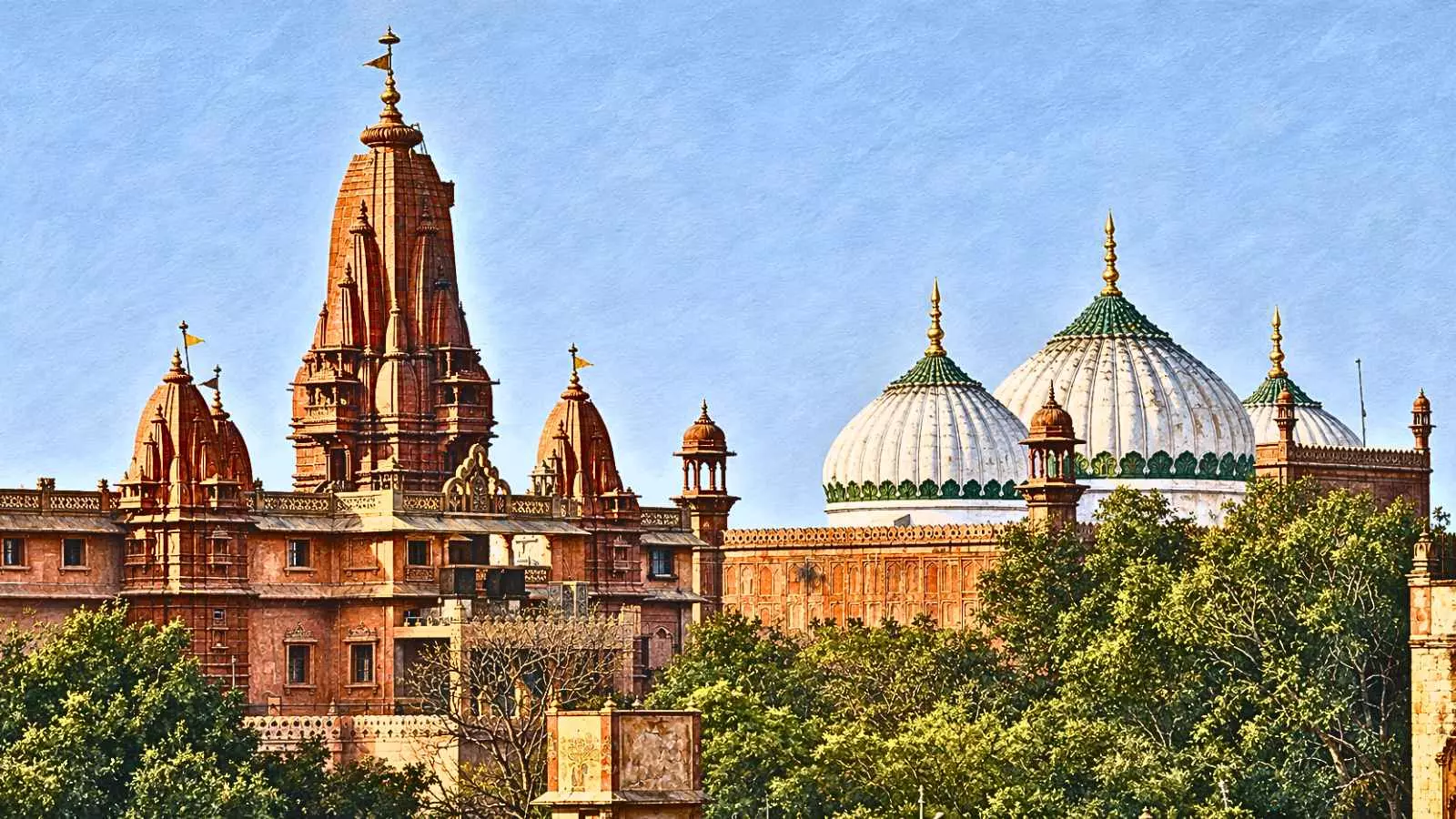
Since 2020, shortly after the Supreme Court ruling paved the way for construction of the Ram Mandir in Ayodhya, around 18 civil suits have been filed over the ownership of 13.37 acres of land in Mathura, where the Shahi Idgah mosque stands adjacent to the Krishna Janmasthan temple.
Ahead of the 2022 assembly elections, the party flirted with the issue to test the waters, but did not follow through. “Perhaps because Ram Mandir construction was still underway. Moreover, the electoral debacle of the party in the state during the 2024 Lok Sabha elections was yet to come as a rude awakening,” said Gorakhpur-based political scientist Harsh Sinha.
Renewed push
Since early this year, however, there has been a renewed pivot towards the issue. In June, CM Yogi Adityanath challenged Akhilesh to openly support a movement that the saffron camp was gearing up to kickstart for the ‘liberation’ of Krishna Janmabhoomi. It was an unmistakable parallel with the Ram Janmabhoomi movement that led to the demolition of the Babri Masjid in 1992.
“UP Vikas Model is a stillborn child and people are now asking questions that the government doesn’t want to answer. So, the party is scrambling for some readymade issue that can be deployed to divert attention and mobilise voters. Marta kya na karta (What won't a desperate man do),” noted Lenin Raguvanshi, Varanasi-based social activist and author of Justice, Liberty, Equality: Dalits in Independent India.
Also read: SP-Congress seat talks: Akhilesh’s 'add 1 to 180' quip is the start of a negotiation, not a rupture
The embezzlement of donations at the Ram Mandir has proved particularly awkward for a party that has projected the temple as its crowning achievement.
“Moreover, mutilation the iconic Dalmandi market and the Manikarnika Ghat in the name of development has further hurt Hindu sentiments and raised questions overs party’s tall claims on preserving Sanatan culture,” Raghuvanshi added.
Cracks in Hindu coalition
The party’s predicament has been further compounded by SP’s aggressive expansion of its PDA coalition to galvanise simmering resentment among BJP’s core voter base into a potent electoral force to dent the party’s formidable umbrella coalition of Hindu voters. Akhilesh Yadav even committed to visit Ram Mandir on December 12.
BJP attempted to turn the tables by invoking the troublesome memory of firings on Kar Sevaks during Mulayam Singh Yadav’s regime and asked the SP chief to apologise. Akhilesh Yadav responded by announcing his visit to Vrindavan as well.
Thus, by raking up the Krishna Janambhoomi dispute, the BJP is attempting to make Akhilesh Yadav’s visit to Vrindavan a litmus test of his religious credentials and political commitments to the SP’s Muslim vote bank.
“It is a political trap designed to make either silence or a response costly. Endorsing it would risk unsettling the Muslim voter base of the party. Rejecting it, meanwhile, would allow the BJP to portray him as champion of the minority interests at the expense of his own community's religious and cultural identity,” Pradhan argued.
Changed political landscape
The BJP's attempt to replicate the Ram Mandir movement's mobilisation, experts caution, may prove unyielding.
That movement emerged when the BJP sought to break out of its upper-caste political outfit and stitch an overarching Hindu identity that challenged the subaltern politics of the SP and BSP and the secular nationalism of Congress.
Also read: BJP expands UP panel, brings back old guard as Yogi eyes third term in 2027
"That project has since achieved much of what it set out to accomplish. The Ram temple has been built, the BJP has become the unstoppable political juggernaut, and the vocabulary of Hindu nationalism has moved from the margins to the centre of mainstream political discourse. And secularism, once a defining force in politics, has been brushed under the carpet," pointed out VN Mishra, Mahant (head priest) of the Sankat Mochan Hanuman Temple in Varanasi and a professor at IIT (BHU).
Mathura’s identity
Another clear distinction lies in the social and cultural history of Mathura and Vrindavan. Unlike Ayodhya, it is not a region where Hindu religious identity needs political validation. Krishna worship is deeply embedded in the everyday cultural and economic life of the Braj region. The temples, ghats, ashrams and pilgrimage circuits of Mathura and Vrindavan have for centuries drawn devotees from across the world.
“The Krishna bhakti movement and Vrindavan has for long been the nerve center of the Vaishnavite cult just as Kashi has been the fountainhead of the Shaivite cult. No Hindu is demanding the BJP to deliver any justice there. That’s why their Gyanvapi experiment failed to gain traction and even the Mathura rendezvous will end up as a disappointment for them,” Mishra averred. “Moreover, the Ram Rajya they promised requires inclusive governance, which is beyond them. Hindus are not fools to not see through this façade,” Mishra added.
Legal and historical differences
More importantly, the Krishna Janmabhoomi dispute has a different legal and institutional history. Unlike Ayodhya, where the central question concerned the disputed site on which the Babri Masjid stood, in Mathura, the Krishna Janmasthan temple already exists adjacent to the Shahi Idgah mosque.
A compromise was reached between the Shri Krishna Janmasthan Seva Sangh and the Shahi Masjid Idgah Trust in October 1968, under which the boundaries and use of the adjoining properties were settled. The arrangement was subsequently formalised through a court decree in 1973.
What further complicates the BJP’s Mathura project is that the larger Sangh Parivar is not entirely persuaded by the proposition of opening another front. Following the Supreme Court's Ayodhya verdict in 2019, RSS chief Mohan Bhagwat cautioned against turning every mosque into a subject of fresh religious confrontation.
Also read: Caste maths, fluid allies: What will decide Purvanchal in 2027 UP election
The Vishwa Hindu Parishad, too, distanced itself in August this year from a call by seers for a fresh kar seva in Mathura, insisting that the matter should be resolved through the courts. Its international president, Alok Kumar, explicitly argued that the circumstances surrounding Mathura were vastly different from those in Ayodhya.
The danger for the BJP, therefore, is that it may be attempting to extract another political dividend from a reservoir of sentiment whose electoral resonance may have been substantially eroded.
“A political formula that once helped the BJP conquer the establishment may prove considerably less effective when deployed by the establishment to defend its hold on power,” Sinha added.