'Damdar Dalit': Akhilesh Yadav’s sharp bid to outmanoeuvre BJP, BSP, Azad
'Damdar Dalit' is not a whimsical rechristening of the D in the party’s PDA coalition, and neither is Agra an accidental choice to launch the voter outreach

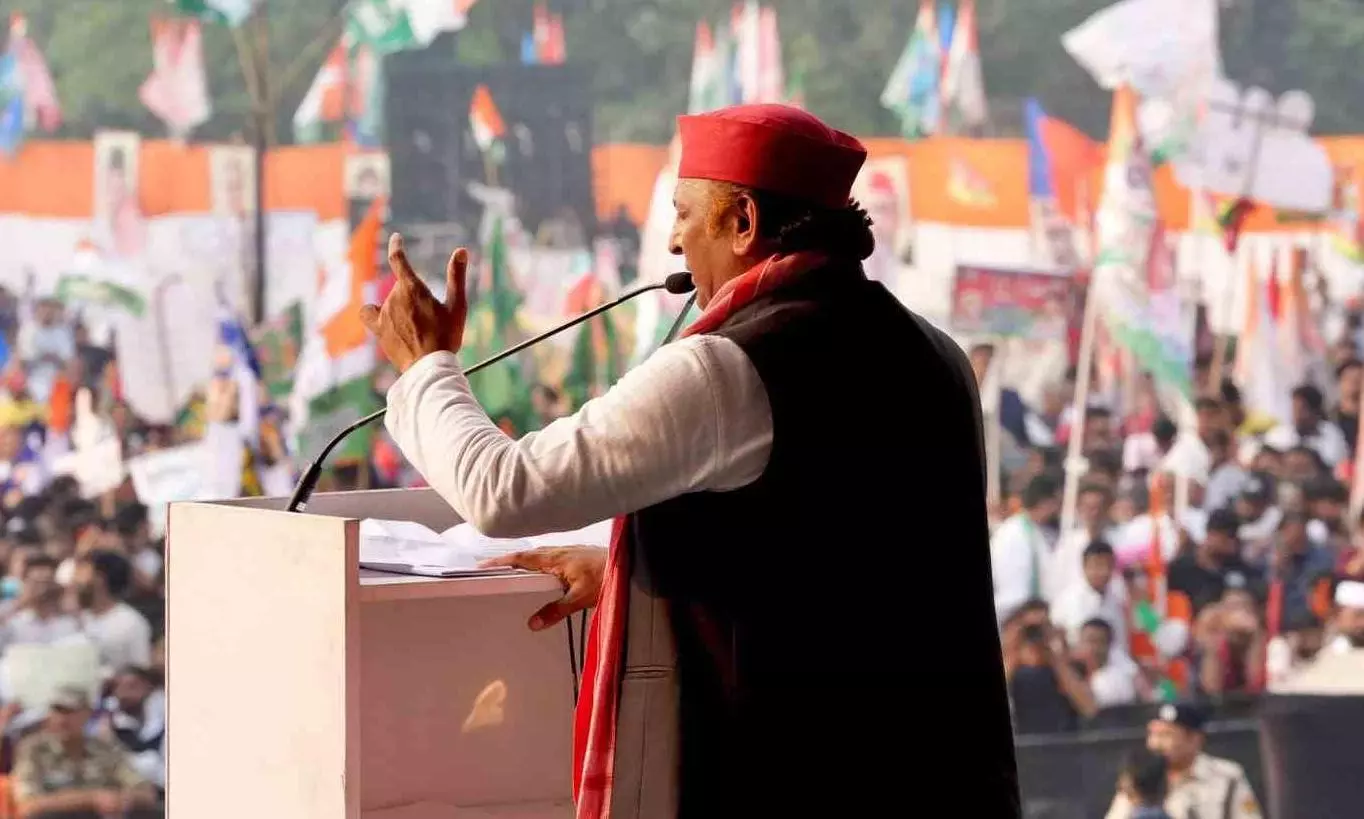
With the 2027 Assembly elections approaching, Samajwadi Party chief Akhilesh Yadav has taken the fight for Dalit votes to Agra, the epicentre of Dalit politics in Uttar Pradesh. The party’s new battle cry is ‘Damdar Dalit’ (powerful Dalit).
Damdar Dalit is not a whimsical rechristening of the D in the party’s PDA (Pichhda, Dalit, Alpsankhyak) coalition. Nor is Agra an accidental choice.
The city has long been a centre of the Ambedkarite movement and a BSP bastion. Over the past decade, it has also emerged as a stronghold of the ruling BJP. It is also where Bhim Army chief Chandrashekhar Azad is gaining influence among restive Dalit youth.
A three-pronged strategy
By urging Dalits to fight to protect the Constitution and reservations and defeat the BJP, Akhilesh has signalled his intent to bring into the SP fold a constituency that drifted from the BSP to the BJP. He hopes to unsettle the BJP’s expansive Hindu voter coalition, built with smaller regional parties and now showing signs of strain.
Also read | Will Nishads steer Akhilesh Yadav’s PDA boat to power in 2027 UP elections?
Political analysts see Akhilesh’s mega Dalit convention in Agra as a three-pronged strategy: mobilising Dalit assertion against the BJP, stepping into the vacuum left by the BSP’s decline and outflanking Azad’s growing influence in western UP.
“To wrest power back from the BJP and to foil its effort to turn the electoral battle from bipolar to four-cornered contest, it is imperative for the Samajwadi Party to render a massive blow to the electoral calculus of the BJP and the political ambitions of Chandrashekhar Azad right where it hurts. Agra is the capital of Dalit politics and has larger bearings on the Braj and Awadh region,” said Dalit thinker and activist Ravi Kant Chandan.
Why Agra and why now?
Akhilesh could have launched the Damdar Dalit outreach from Gorakhpur, Chief Minister Yogi Adityanath’s bastion, or the BJP's Achilles heel in Purvanchal. Yet, he chose Agra.
Experts offer three compelling factors that may have dictated Akhilesh’s choice of region to mount this mega Dalit outreach. The first is the region’s demography and its association with Ambedkarite mobilisation, from Bhimrao Ambedkar to BSP founder Kanshi Ram.
According to the 2011 Census, Scheduled Castes account for nearly 23 per cent of the electorate in the region. The share rises to around 27 per cent when extremely backward classes are included.
“Traditionally, it has been the stronghold of Mayawati. A sizeable section of the Jatav voters still support her. But a major chunk of that non-Jatav Dalits drifted to BJP since 2014. However, cracks began to develop during the 2024 Lok Sabha elections when a section of that voter base switched allegiance to the INDIA bloc,” Ravi Kant told The Federal.
The second factor is the emergence of leaders such as Azad, who have sought to fill the vacuum created by Mayawati’s decline and appeal to restive Dalit youth. After his decisive victory from Nagina in the 2024 Lok Sabha elections, Azad allied with Asaduddin Owaisi’s AIMIM to expand the Azad Samaj Party (Kanshi Ram)’s footprint across western Uttar Pradesh and beyond.
“By launching a mega Dalit outreach from Agra, Akhilesh Yadav has taken up Azad’s challenge head-on and is attempting to prevent him from inheriting the lost ground of the BSP,” said Lenin Raghuvanshi, a Varanasi-based social activist and author of Justice, Liberty, Equality: Dalits in Independent India.
BJP’s Agra fortress shows cracks
“Besides, it’s too early to write off Mayawati. She’s planning a mega rally in the region on December 6. And Akhilesh Yadav knows that she can still swing a sizeable vote in her favour if she gets active,” Raghuvanshi added.
The third factor is the SP’s bid to challenge the BJP where it expanded its social coalition by drawing sections of Mayawati’s erstwhile support base into its fold. The BJP won all nine Assembly seats in Agra in both 2017 and 2022.
That consolidation, however, is showing signs of strain. The BJP’s hold is arguably at its weakest since 2017, giving Yadav an opening to prise apart its fortress through Dalit assertion.
Also read | Owaisi-Azad alliance puts Akhilesh Yadav in a tight spot ahead of 2027 UP polls
“There’s growing fatigue with the ruling BJP in the region. The Dalits, especially, are restive and looking for options. For Akhilesh Yadav, it offers a good opportunity to make the most of it and get a section of Dalits and non-Yadav OBCs under its PDA fold. That would severely dent the BJP’s electoral prospects,” said veteran political analyst Anand Vardhan.
The SP gained momentum with its recent victory in the Agra Teachers’ MLC election.
Dalit disenchantment with BJP
The strategy seeks to tap Dalit disenchantment with the BJP over poor representation, rising atrocities and little improvement in living conditions.
In Agra’s Lohamandi, Valmiki sanitation workers, once considered a bedrock of the BJP's social coalition, have protested against poor living conditions, inadequate sanitation, a lack of schools and hospitals, and limited employment opportunities.
In neighbouring Hathras and Firozabad, Dalit activists have flagged dilapidated homes, clogged drains, lack of clean drinking water and continued segregation of Dalit settlements, accusing the BJP government of ignoring their plight.
Akhilesh has repeatedly accused the BJP government of failing to safeguard Dalit interests and provide the social security they seek.
Figures presented by the Union Ministry of Social Justice and Empowerment in Parliament lend weight to his criticism: cases of atrocities against Dalits rose from 11,829 in 2019 to 14,642 in 2024.
“Besides, the discontent extends to extremely backward classes as well that went with the BJP in the last two Assembly elections but drifted away to the INDIA bloc in the 2024 Lok Sabha elections,” Anand Vardhan told The Federal.
Sharpening social justice pitch
At the Agra convention, Akhilesh alleged that more than 200 Ambedkar statues had been vandalised across the state and accused the government of undermining constitutional safeguards. His remarks drew an animated response from the crowd.
He also targeted the government over school closures, unemployment and alleged irregularities in implementing reservation. Yadav promised a dedicated budget for Scheduled Castes and Scheduled Tribes, protection for Ambedkar’s statues, the filling of vacant reserved posts and better wages for workers in Agra’s footwear industry.
“The SP has also sought to give this grievance a more tangible political dimension by circulating lists and compilations documenting killings, alleged fake encounters and custodial deaths involving members of PDA communities during the BJP's tenure,” Ravi Kant said.
Betting big on Dalit candidates
The outreach also signals the SP’s intention to repeat its 2024 strategy of fielding Dalit candidates in general constituencies, not just SC-reserved seats. “In fact, we may even increase their representation in many seats to make the fight tougher for the BJP and also show that our party’s social justice is for real,” a senior SP leader told The Federal.
Also read | Why Yogi Adityanath is falling back on Hindutva and the 80-20 formula in UP
Ravi Kant believes greater representation for Dalits and extremely backward classes could give the SP an electoral edge. “In 2024 they did it in two seats—Awadhesh Prasad in Ayodhya and Sunita Verma in Meerut. If they can do this in at least 15-20 seats this time, it could help them to corner the BJP not only in Western UP but also reap considerable dividends in the Awadh region. BJP, meanwhile, could be in serious trouble to reach even close to half-way mark,” he argued.
The Damdar Dalit pitch, therefore, is more than a battle cry. It is Akhilesh’s bid to turn Dalit disenchantment into political assertion, challenge the BJP and deny rivals the space to inherit the BSP’s waning electoral appeal.