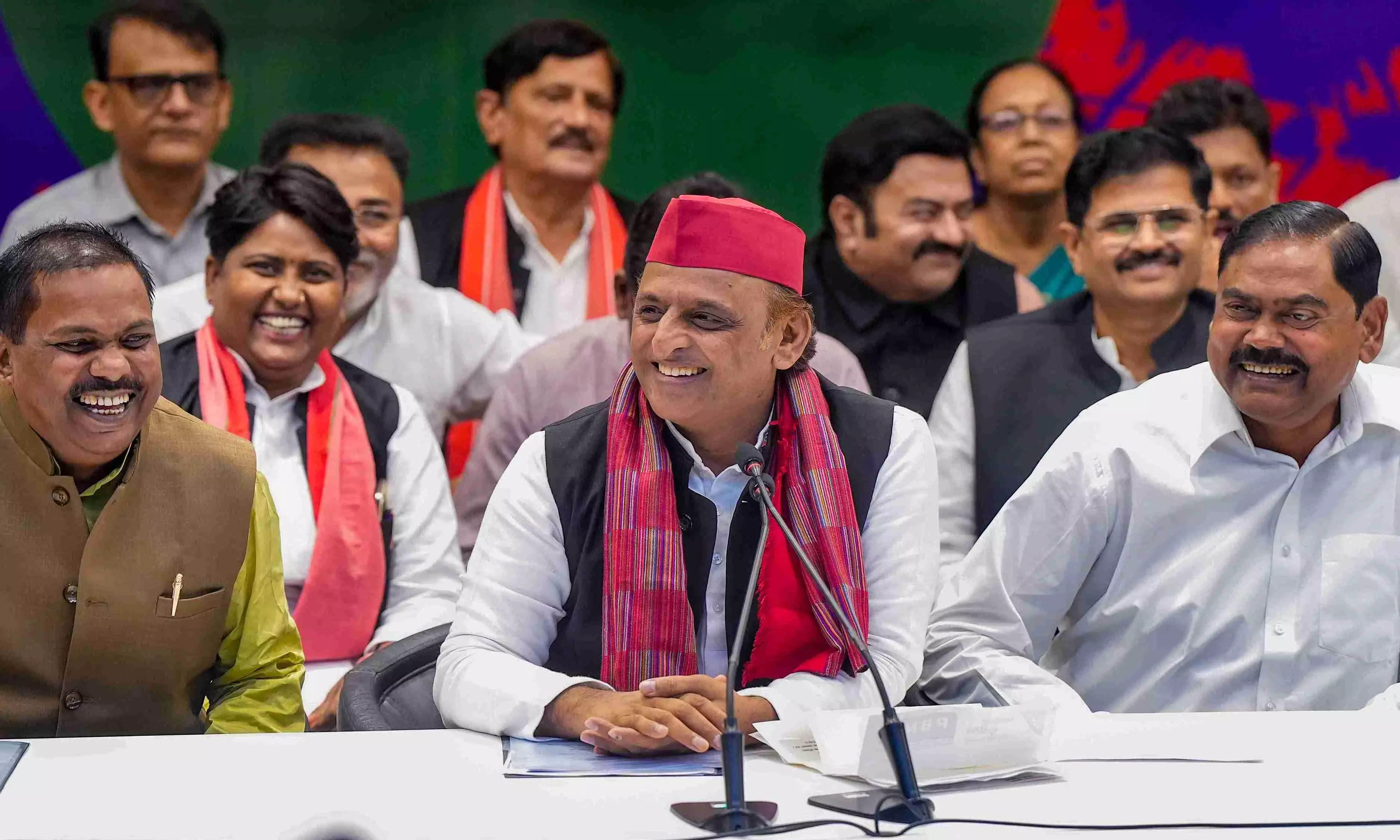
Barely days before the SP and Congress initiated seat-sharing talks, SP chief Akhilesh Yadav (centre) drew a 'Lakshman rekha' on where the Congress should stop. File photo: PTI
SP-Congress seat talks: Akhilesh’s 'add 1 to 180' quip is the start of a negotiation, not a rupture
The Congress’s maximalist 181-seat ask and the SP’s firm red line are classic coalition bargaining, but public brinkmanship could squander the 2024 gains

Samajwadi Party (SP) president Akhilesh Yadav playfully smiled at the moderator at a media event on Saturday (November 14) and said “add one to 180”, in response to the query (after a couple of revisions on the figure), if the Congress was asking for the aforesaid number of seats while negotiating the alliance for the impending Uttar Pradesh elections. With four casual words, barely days before the two parties initiate much-anticipated seat-sharing talks the SP chief, drew a Lakshman Rekha on where the national party should stop.
The message to Congress was not broadcast by Akhilesh in a stentorian manner. Instead, he gently boxed the Congress in by pairing the numerical disclosure with an assertion that the SP has already “made up its mind on how many seats we will contest”. The indistinct statements also broadcast a message for his party cadres – anxious about ceding winnable turf. Akhilesh’s declaration that the SP leadership has zeroed in on the number of seats it will contest is an assurance to cadres that the party will hold firm against what it considers an inflated claim.
Seat arithmetic
The ganit or arithmetic, underscoring the friction, is straightforward. For the 2024 Lok Sabha elections, the SP-Congress alliance, as part of the INDIA Bloc, outperformed the Bharatiya Janata Party (BJP) in Uttar Pradesh, winning 43 of 80 parliamentary seats and polling 43.52 per cent of the vote, a fraction less than the BJP’s. The success of the partnership was one of the primary reasons behind Prime Minister Narendra Modi’s failure to secure a third consecutive parliamentary majority for his party.
Also read: UP Assembly polls: SIR, SSR take centre stage as parties switch to election mode
According to the alliance’s terms, the Congress contested 17 Lok Sabha seats and won six. This meant that in percentage terms, the Congress share of seats contested was 21.2, and it won almost 35.3 per cent of these.
If one proportionately extrapolates the 2024 formula to the 403-seat UP assembly, the Congress can at best be allocated approximately 85 seats. The demand for 181 seats, as Akhilesh informed, is not a small enhancement over the 2024 share, but a bid to rewrite the terms of the partnership from junior ally to near-equal stakeholder.
Would the Congress accept anything like this in any other state at any time? Certainly not! After all, the last Congress chief minister in UP, Narayan Dutt Tiwari, bowed out of office, way back in December 1989.
Lessons from Bihar
As the two parties head into the poll season in India’s numerically largest state, the two parties have to keep the Bihar experience in mind. Last year, prolonged seat-sharing wrangling between the Rashtriya Janata Dal (RJD) and Congress resulted in overlapping candidates, divergent campaigns and electoral losses, resulting in a massive sweep by the BJP-Janata Dal (U) combine.
But for those who have long tracked the opposition parties being their own greatest opponents, a public disagreement over nearly half the constituencies in UP just months before polls are due early next year smacks of familiar disarray.
The demand of the Congress, which Akhilesh has put in the public domain, does not rest on historical precedent. Instead, the party’s woeful record has to be recalled – the Congress contested 399 seats alone in the 2022 Assembly elections and won just two, trailing far behind the SP’s tally of 111.
That solo campaign was spearheaded by Priyanka Gandhi, who was appointed in 2019 as AICC General Secretary in charge of UP East (and later the whole state), on the back of a campaign featuring the "Ladki hoon, Lad Sakti hoon", women-centric manifesto and promise of 40 per cent tickets to women. Yet, the party has made little head way electorally and also in reviving the organisational network of the party.
Also read: Owaisi-Azad alliance puts Akhilesh Yadav in a tight spot ahead of 2027 UP polls
There is a fair justification in the view of the sceptics that the party lacks booth-level depth across vast stretches of Purvanchal, Bundelkhand, and western UP. The party realistically, cannot field competitive candidates in 181 seats without inadvertently handing marginal contests back to the BJP.
The alliance's electoral appeal
However, it would be political short-sightedness to interpret early brinkmanship on part of either opposition parties purely as unpreparedness or brinkmanship. Unlike previous election cycles marked by last-minute panic, both parties have initiated constituency-level vetting in mid-November and are now taking the talks to the next level.
While the Bahujan Samaj Party’s traditional base has visibly eroded, the entry of All India Majlis-e-Ittehadul Muslimeen’s Asaduddin Owaisi, in partnership Bhim Army chief Chandrashekhar Azad, has potential to queer the pitch. But the two leaders also have limited potential because of the absence of organisational network.
It is going to be tough to dent Akhilesh’s – Pichhda-Dalit-Alpsankhyak (PDA) social coalition and this coupled with the Congress’s minority and upper-caste pockets, makes the two a formidable alliance.
Congress's seat demand
The sharpest debate surrounding the 181-seat claim centres on the mindset of the Congress high command. The party’s detractors, including rival politicians and wary regional allies, have frequently in the past, flagged such demands as symptoms of institutional arrogance flowing from Rahul Gandhi downwards.
The Congress should not overread its 2024 parliamentary rebound in UP from one seat to six as proof of an independent revival. It cannot forget that those victories relied heavily on Samajwadi Party vote transfers.
If the party is being accorded a leading role by its regional allies in national level agitations, protests and debates – as evidenced in the recent rally calling for resignation of Chief Election Commissioner, Gyanesh Kumar and the roll-back of the Special Intensive Revision of electoral rolls, in Delhi on November 1, the Congress leadership must also send a message to its state leaders to check its over-exuberance and accept the SP as the leader of the alliance.
Also read: BJP expands UP panel, brings back old guard as Yogi eyes third term in 2027
Undeniably, Rahul Gandhi has come a long way from the early days of the Modi regime and has emerged as a sharp articulator of the government’s failing and is considered as the natural leader of the anti-BJP opposition parties. But, the party’s primary objective is to lead the INDIA Bloc, or any other anti-BJP alliance that may emerge ahead, to a victory in the next parliamentary polls. Consequently, it has to play a secondary role in states where a powerful regional ally is the primary player in the opposition flank.
The negotiating strategy
Yet, as the SP and Congress head into negotiations, it has to be remembered that during coalition bargaining, maximalist opening bids are standard practice; asking for 181 creates negotiating room to settle between 70 and 90 seats while preserving political dignity. Equally important is internal party management.
But, for newly appointed state president Aradhana Mishra ‘Mona’ and senior leaders like Imran Masood, the challenge is the existential crisis of the party organisation they have been asked to shepherd ahead. The reason behind the exaggerated claim, that Akhilesh brought out in public, stems from the fear of the Congress being left with a minimal allocation of 30 to 40 seats, by a ready-for-action SP.
In such a scenario, the new state leaders face the risk of complete organisational atrophy across more than 80 percent of the state. Projecting ambition is standard tactic and is often the only way to rebuilding party as this keeps local ticket aspirants and cadres engaged.
The SP too has to realise the necessity of support from the residue of the traditional Congress social base and those sections of Muslims and Dalits, who have turned to it again, to be able to pose a formidable challenge to the BJP.
Ultimately, Akhilesh Yadav’s “add one to 180” quip is best read as the opening call of a necessary negotiation rather than a sign of impending rupture. But it would require the senior leaders of both parties to not lose sight of their primary goal, that of dislodging the Modi regime in the next parliamentary polls.
There is no denying that, divided, they invite a repeat of 2017 and 2022; united on realistic, winnability-driven terms, they pose a genuine threat to the BJP.
This is the time when the two parties must move swiftly from political bargaining to flagging issues on which the BJP can be cornered; clearly the swindle of donations made to the Ram temple in Ayodhya has to be revived and harnessed after having fallen off public discourse in the phase following the return of street politics, or the era of satirical youth populism.
BJP's internal contradictions
In the backdrop of how the relationship between SP and Congress is playing out, it is worth examining internal friction within the BJP –between Chief Minister Yogi Adityanath and the central leadership of Modi and Home Minister Amit Shah. If the opposition camp has to disentangle the inter-party relationship, the BJP faces the trial to resolve the unspoken conflict stemming from issues of intra-party hierarchy.
Shah and Adityanath recently projected a deliberate "united show of strength" during the state BJP working committee meeting, but Shah's step into UP also has the potential to unnerve diehard Yogi’s backers. Since 2017, when the BJP wrested the state in the Modi era, his dilemma with a mass and charismatic regional leader remains unresolved, and this becomes acuter with whispers of ‘succession’ issues becoming stronger.
Also read: Akhilesh backs Owaisi-Chandrashekhar alliance, says BJP could lose 2-3 pc votes
The Modi model of governing with a centralising authority and preventing emergence of a regional power centre remains a challenge in UP, with Yogi too displaying political ambition. It would not be easy for the Modi-Shah duopoly to easily sideline Adityanath ahead of the polls without risking a catastrophic split in their core ideological base.
The core issue within the BJP will also be over seat sharing; what is the share of each camp when the candidates’ list is finalised – will it be tilted in favour of the central duopoly or be more suitable for Adityanath. Additionally, the central leadership has often circumscribed Lucknow’s autonomy through organisational appointments, most recently with the appointment of state BJP president, Pankaj Chaudhary.
The road to 2027
As UP heads toward the 2027 polls, neither camp enjoys an unassailable path to Lucknow: the BJP must navigate a decade of local anti-incumbency, youth employment anxieties, and delicate caste-balancing within its own ranks, while the SP-Congress alliance risks squandering its 2024 momentum if public brinkmanship over seat-sharing overrides electoral realism.
Ultimately, the verdict will turn not on which coalition projects greater confidence today, but on which side proves more adept at managing its own internal contradictions before voters head to the booths. In the fiercely bipolar state, victory may well belong to whichever side blinks less under the weight of its own vulnerabilities.