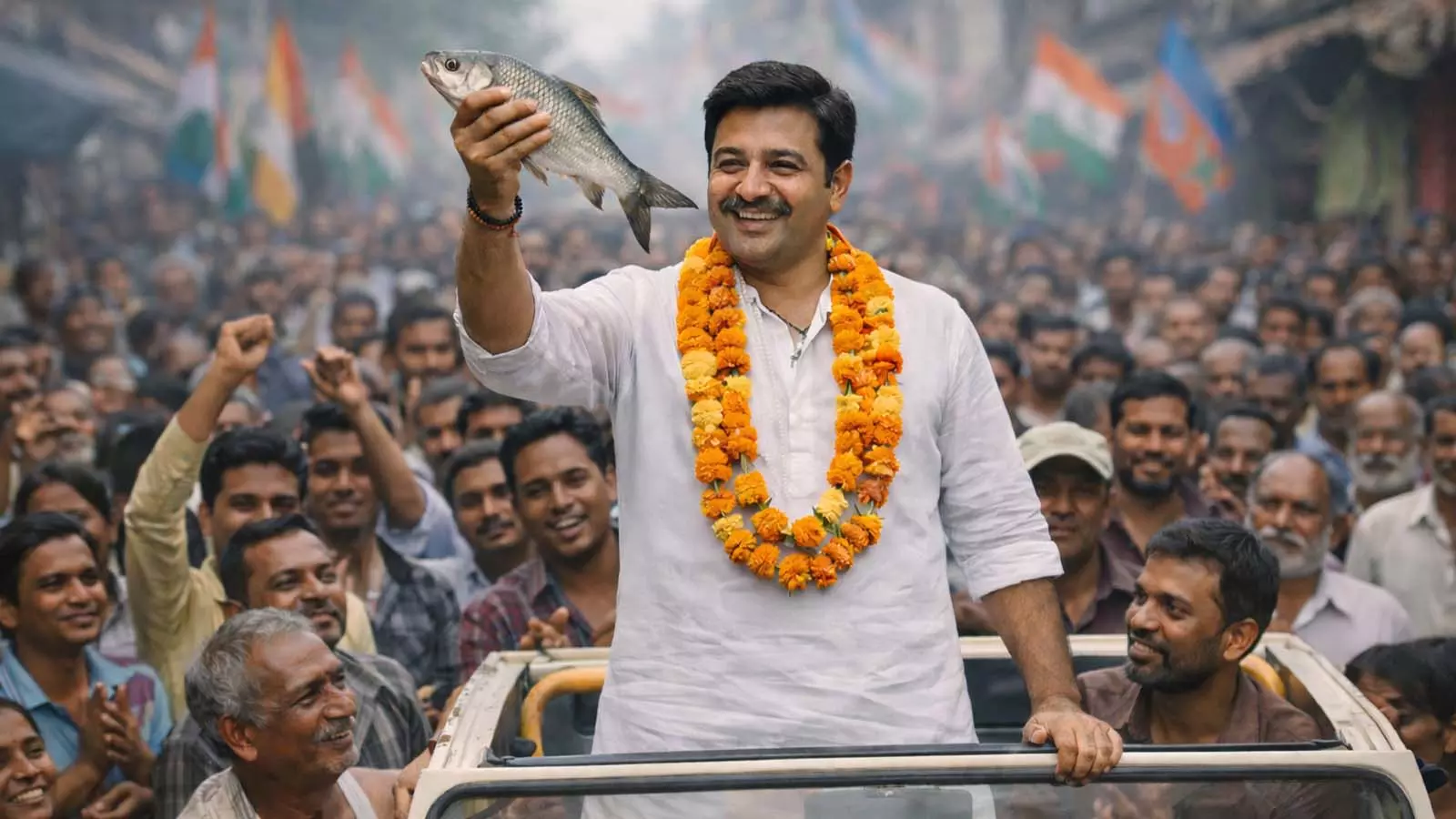
Fish, a cultural symbol of West Bengal, has evolved into a major election issue in the state with the ruling TMC and Opposition BJP finding them in a tug of war over it. (The photo is AI generated)
In Bengal, TMC fiercely defends bastion as BJP tries to melt fish-loving Bengali heart
As the BJP embraces Bengalis' favourite food to shed its 'outsider' tag in Bengal, Mamata weaponises 'Bangla Asmita' to frame the election as a fight to save Bengali culture

As the 2026 West Bengal Assembly elections evolve into a theatre of an open confrontation over identity politics, a key aspect of the Bengali identity, the fish, has come up for grabs.
While the top leaders of the two main contenders, the state’s ruling Trinamool Congress (TMC) and the Bharatiya Janata Party (BJP), the main opposition party, have exchanged serious verbal volleys over Bengal’s fish production and Bengalis' fish-eating habits, the lower rung, particularly of the BJP, has not remained aloof either.
BJP candidates campaign with fish, at fish markets
Take, for example, Dr Sharadwat Mukhopadhyay, the BJP candidate taking on the TMC heavyweight Sujit Bose in Bidhannagar, close to Kolkata. He was seen dangling a 'Katla' fish (a South Asian carp) from his hand as he campaigned across the constituency, clearly suggesting that the saffron party is in no mood to drop the competitive Bengali identity politics even if it eclipses other pressing matters, including governance.
Also read: Holy Mackerel! BJP, TMC in serious debate over fish ahead of Bengal polls
That Mukhopadhyay was playing as per a broader strategy was corroborated by Dilip Ghosh, a former state chief of the BJP and contesting this election from Kharagpur Sadar constituency in Paschim Medinipur district. The firebrand politician is frequently seen visiting fish markets in his constituency, with his wife Rinku Mazumdar.
While fish markets are often great places for public outreach exercises in Bengal, Ghosh has also brought a larger focus on fish by pledging to make Bengal self-sufficient in its production if the BJP is voted to power, mixing the larger economic and employment issues with cultural symbolism.
That is not all with the BJP’s fishing for votes. In Balurghat constituency in South Dinajpur district in central Bengal, Sukanta Majumdar, a Union minister, local MP and another former BJP state president, launched his campaign for the party’s local candidate, Bidyut Kumar Roy, on Wednesday (April 8). And guess what? He did it from Balurghat city's Boro Bazar fish market.
BJP's 'fish' route to shed 'outsider' tag
In a state where fish is as much, if not more, a cultural marker as a dietary staple, the BJP’s emphasis on it is a calculated attempt to dispel perceptions of ideological reservations about non-vegetarianism, an allegation the ruling TMC has been quick to weaponise to portray the saffron party as culturally out of sync with Bengali identity.
Also read: AIMIM exits alliance with Humayun Kabir ahead of Bengal elections amid video row
“They will not allow (if the BJP comes to power) you to eat fish, eggs or meat,” Chief Minister and TMC supremo Mamata Banerjee has been saying repeatedly on the campaign trail, ahead of an election where her party has placed “Bangla Asmita”—Bengali identity—at the centre of its poll narrative.
Its slogan this election, “Jotoi koro hamla, abar jitbe Bangla” (“No matter how much you attack, Bengal will win again”), carries a veiled political message casting the BJP as an aggressor or invader.
TMC's 'Bengali identity under threat' card
Political observers say the slogan subtly equates the party’s victory with Bengal’s self-assertion, linking electoral choice with cultural allegiance.
“The TMC, through its campaign slogan and song, widely circulated on social media and played at rallies, frames the election as a defence of Bengal itself against the alleged injustices done to the state, its people and its culture by the BJP,” said political commentator and author Amal Sarkar.
The TMC’s framing seeks to tap into pockets of resentment in the state stemming from a set of recent developments. These include concerns over the Special Intensive Revision (SIR) exercise leading to the deletion of names of many bona fide voters, instances of Bengali-speaking migrant workers being targeted and branded as Bangladeshis in BJP-ruled states, the alleged withholding of substantial central funds due to Bengal, and recent curbs on the open sale of meat and fish in the neighbouring Bihar, which is ruled by the BJP-led National Democratic Alliance.
“The BJP has deprived Bengal and its citizens. The BJP has started a procession of death with the SIR exercise. So many people’s names have been deleted from the voter lists. If the CM (Mamata Banerjee) had not been there to fight against it, many more names would have been deleted. Even now, only TMC is standing by the people,” TMC spokesperson Kunal Ghosh, also a candidate in this year’s Assembly election, said at a presser on Thursday.
The idea is to interweave all electoral issues with Bengali identity to give an emotive edge to the messaging.
“They (the BJP government at the Centre) have stopped our rightful funds. Over Rs 2 lakh crore is due, and yet they talk of development,” Mamata said at a public rally on Thursday (April 9), attempting to counter the BJP’s charges of underdevelopment in the state with her narrative that Bengal is being selectively victimised.
Mamata hits back at Modi over Haldia fish remarks
“They talk of building ‘Sonar Bangla’ (golden Bengal). Today in Haldia, he (Prime Minister Narendra Modi) stated that there is not enough fish production in Bengal. But what about the fact that they themselves do not allow fish in Bihar, UP, Rajasthan? In Delhi, shops selling fish and meat are attacked. You do not let people speak in Bengali—are you not ashamed of it? And then you come to teach us a lesson on fish production,” she said at the same rally.
Also read: Why Tathagata Roy is confident BJP will oust Mamata Banerjee
The prime minister made an all-out attack on the TMC in the port city of Haldia the same day, saying it did little to help Bengal become self-reliant in fish production, and its government was not cooperating with the Centre on improving the fisheries sector either.
Both sides have been making statements linking cultural pride with governance criticism.
BJP's cultural blending for Bengal elections
Desperate not to be outmanoeuvred in a game of identity politics that it has largely mastered nationally, the BJP has recalibrated its strategy in Bengal, blending its Brahmanical Hindutva imagery, largely rooted in vegetarian Vaishnavite traditions, with the state’s non‑vegetarian Shakta Hindu practices.
Analysts caution that while such symbolism may mitigate perceptions of cultural disconnect, its electoral impact will depend on how voters weigh identity alongside other issues such as jobs, infrastructure, and inflation.
Historically, Bengal’s religious and cultural practice has been shaped by Shakta worship and tantric currents, where offerings of fish, meat and other non‑vegetarian delicacies are integral to popular devotion, a contrast to the saffron camp’s own image as supporters of vegetarian asceticism.
By courting symbols like fish and repeatedly invoking “Bangali” cultural markers on the campaign trail, the BJP seeks to mitigate perceptions of cultural disconnect and counter the TMC’s charge that it is out of step with Bengali ethos.
Also read: Poll-bound Bengal rocked as Humayun Kabir's anti-Mamata 'plot' video surfaces
BJP leaders, including state president Samik Bhattacharya, have repeatedly declared that “no one can stop Bengalis from eating fish,” aiming not only to neutralise the TMC’s narrative but also to assert their own Bengali Hindu identity.
“These are not just random assertions,” Sarkar said. “Food, language, culture, they are all political signals.”
However, without independent data on voter priorities, it remains speculative how decisive these signals are among the electorate at large.
Are voters really moved?
Despite the high-decibel campaign around identity by the state’s two main political players, ground-level responses reveal a more complex reality.
“It is nice when our culture is recognised and promoted,” said Saptarshi Chatterjee, a 35-year-old graphic designer from Kolkata's Jadavpur area. “But what we see here feels like a leap service, a way to pit one identity against another. I will not vote just for that.”
Such voices suggest that identity alone may not be the dominant factor for all voters.
Both the TMC and BJP, however, appear certain that Bengali identity rhetoric will resonate strongly with voters.
TMC, BJP are not only players eyeing Bengali identity
The recent growth of Bengali advocacy groups like Bangla Paksha could further reinforce their assessment.
The activism of Bangla Paksha, which has campaigned aggressively for linguistic and economic rights and against what it describes as the marginalisation of Bengalis in public life, has further sharpened debates around identity, occasionally even triggering tensions over language use in commercial spaces and public institutions.
Also read: Bengal SIR’s 91 lakh voter deletions shrink TMC cushions, unsettle BJP’s Matua base
“Bangla Paksha does not have electoral weight, but it has narrative power,” said Debashis Chakrabarti, a Kolkata-based political columnist, professor and Commonwealth Fellow.
But there is a striking irony to this identity politics, revealing the hypocrisy inherent in the compulsion to win elections.
Ironically, parties are fielding non-Bengali faces too
Despite emphasising the Bengali pride, both the TMC and the BJP, as well as the other parties, have fielded several non-Bengali or Hindi-speaking candidates across constituencies, showing that they cannot ignore the state’s multi-cultural reality.
The contradiction is particularly visible in urban constituencies with mixed populations, where parties prioritise winnability over cultural symbolism.
In Jorasanko, the birthplace of Bengal’s greatest cultural icon, Rabindranath Tagore, for instance, candidates from all four major parties, the TMC, BJP, Communist Party of India (Marxist), and Congress, are Hindi-speaking, highlighting the gap between rhetoric and reality.