



Bengal SIR’s 91 lakh voter deletions shrink TMC cushions, unsettle BJP’s Matua base
With 90.83 lakh names deleted, TMC’s minority and women bases weaken while BJP’s Matua stronghold faces uncertainty, leaving 120+ seats on edge

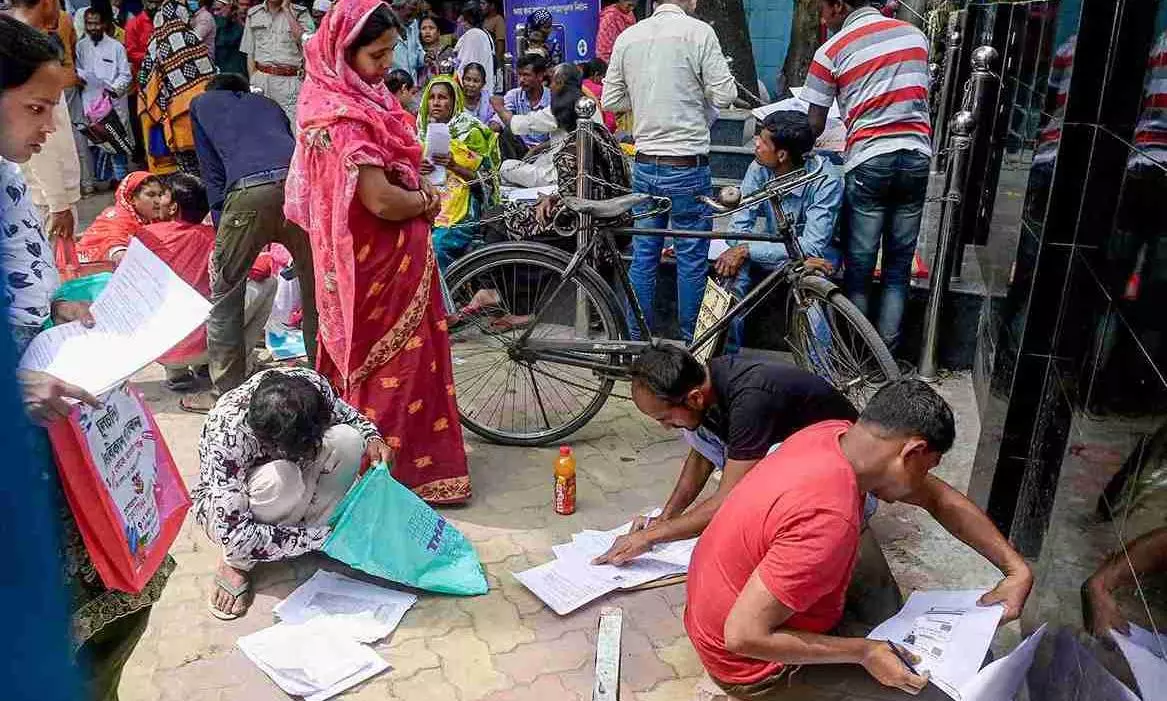
Kolkata, Apr 8 (PTI) West Bengal's 2026 assembly elections will be fought on an electoral map radically redrawn by the SIR, which has wiped out over 90.83 lakh names from the rolls, upending the arithmetic in scores of constituencies and throwing both the TMC's citadels and the BJP's expansion zones into fresh uncertainty.
The state's electorate has shrunk from 7.66 crore to 6.77 crore, forcing the TMC and the BJP to fight the two-phase elections later this month on terrain very different from the one on which Mamata Banerjee stormed back to power in 2021.
The deepest cuts have come in the districts that have long determined who rules Bengal -- the minority-heavy belts and the southern zone that have underpinned the TMC since 2011, and the Matua-refugee pockets of North 24 Parganas, Nadia and parts of north Bengal that powered the BJP's rise after 2019.
Yet the political fallout is not uniform. The TMC's once-formidable cushions in south Bengal appear thinner, while the BJP remains entrenched in north Bengal and Junglemahal, but the party's most prized social constituency -- the Matua vote -- suddenly looks far less secure.
The heaviest blow has fallen on the districts that have formed the electoral spine of the TMC since 2011.
North and South 24 Parganas, Murshidabad, Nadia, Malda, Hooghly, Howrah, Uttar Dinajpur and Purba Bardhaman -- together accounting for 178 of Bengal's 294 assembly seats -- have witnessed nearly 66.6 lakh deletions, or almost three-fourths of the statewide reduction.
At the same time, the SIR has shaken 55 seats spread across the Matua belt, unsettling the refugee vote that has been the BJP's most dependable political asset.
The sharpest churn is visible in the districts along the Bangladesh border, where the citizenship issue and migration have for years defined the political contest between the TMC and the BJP.
North 24 Parganas, with 31 assembly seats, alone lost 12.6 lakh voters. South 24 Parganas, the TMC's largest stronghold with 33 seats, saw 10.91 lakh names deleted. Murshidabad, where the ruling party has traditionally dominated most of the district's 22 assembly segments, lost 7.48 lakh names, while Nadia, with 17 constituencies, shed 4.85 lakh and Malda, which has 16 seats, lost 4.59 lakh.
"The TMC's statewide arithmetic rests on three pillars -- the minority belt, women voters and the two 24 Parganas. If its leads in these segments shrink even marginally, the BJP becomes competitive in dozens of additional seats," political analyst Biswanath Chakraborty said.
The gender balance of the electorate has also shifted subtly but significantly. Before the Special Intensive Revision of electoral rolls, Bengal had 959 women voters for every 1,000 men.
After the revision, the figure has dropped to 950, suggesting that women's voting bloc, another constituency that has consistently backed Mamata Banerjee since 2011, has also taken a hit.
Yet the SIR may also have produced a countervailing political effect.
In minority-dominated districts, the revision has triggered a sense of insecurity that appears to be pushing Muslim voters towards a tighter consolidation behind the TMC, potentially squeezing out smaller Muslim parties such as ISF, AJUP and AIMIM.
"That is where chemistry could override arithmetic. If the sense of threat produces near-total consolidation, the TMC may recover much of what it loses numerically," political analyst Suman Bhattacharya said.
For the BJP, the bigger concern lies in the Matua refugee belt, where community leaders claim nearly 70 per cent of Matua families have been touched by the SIR exercise.
With more than 1.3 crore voters spread across at least 55 assembly constituencies, the Matuas have long been one of Bengal's most consequential political blocs.
Party insiders say Matua and other refugee-dominated pockets accounted for more than half of the BJP's tally of 77 seats in the 2021 assembly election, and that this support base remained largely intact in the 2024 Lok Sabha polls.
In Nadia, nearly 78 per cent of the voters placed under adjudication were eventually deleted -- the highest strike rate in the state.
The party, however, believes it may still find compensation in north Bengal, where its political footing remains stronger and the deletions appear to have fallen more heavily on minority-dominated pockets.
Cooch Behar lost 2.42 lakh voters, Jalpaiguri 2.01 lakh, Darjeeling 1.9 lakh and Uttar Dinajpur 3.63 lakh. The BJP has dominated much of this region since 2019 and believes the deletions there may blunt the TMC's gains in the minority belt.
In Junglemahal too, the BJP's core vote appears relatively undisturbed. Jhargram lost only 55,364 names, while Purulia shed 1.91 lakh and Bankura 1.43 lakh.
"We believe the revision has removed ineligible names in areas where the BJP was historically weak, which could partly offset the losses in the refugee belt," another BJP leader said.
A TMC leader, however, argued that the deletions have fallen disproportionately on minorities, women and migrant workers, the very groups that have sustained TMC's dominance since 2011.
"This is not a roll revision but a political redrawing of Bengal's electoral map to help the BJP. But we will still win,” he said.
The greatest uncertainty lies not in the strongholds of either party, but in the marginal belt where the electoral arithmetic has become impossible to predict.
Across more than 120 assembly constituencies, the number of deleted voters is higher than the victory or leading margin recorded either in the 2021 assembly election or in the 2024 Lok Sabha polls.
In 2021, the TMC won at least 45 seats by margins of less than 10,000 votes, while the BJP secured around 20 within the same range.
The 15 districts voting in the first phase on April 23 account for 39.57 lakh deletions across 152 seats, while the eight districts going to the polls in the second round on April 29 carry 49.38 lakh deletions across 142 seats.
In Bengal's post-SIR election, the battle may finally be decided not just by voters who turn out, but also by those whose names were deleted. PTI