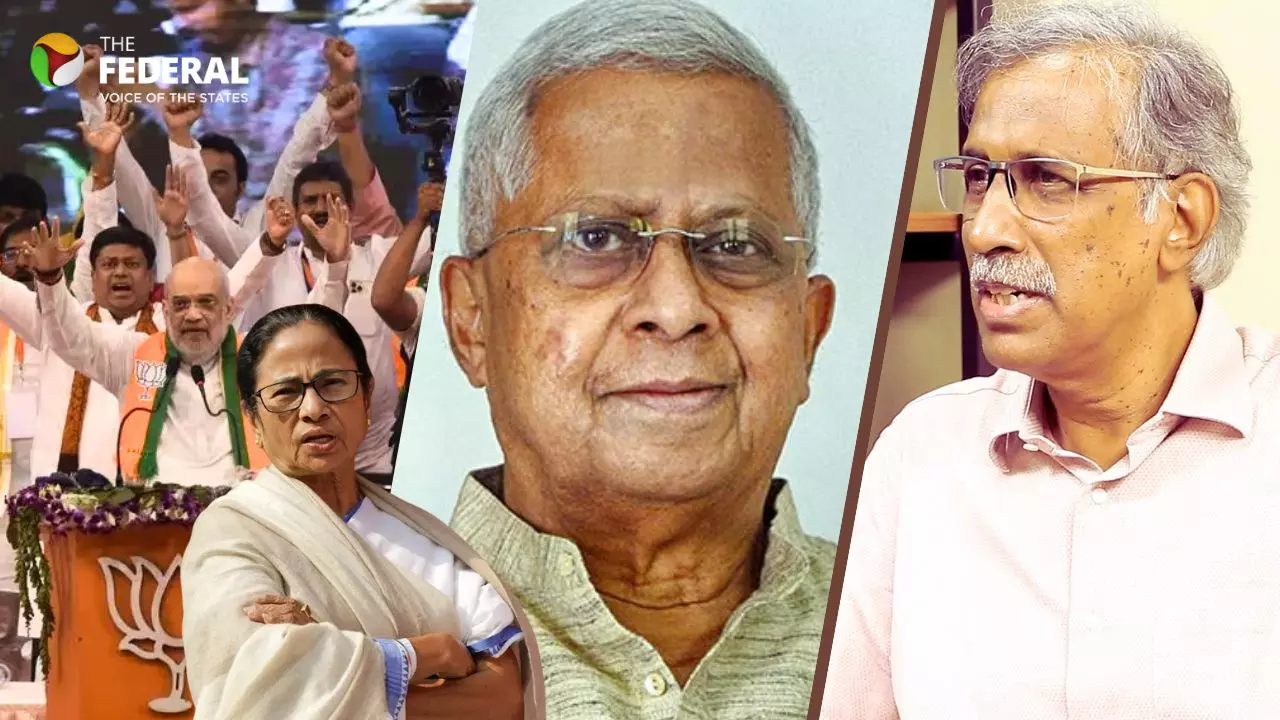
Why Tathagata Roy is confident BJP will oust Mamata Banerjee
Roy cites corruption, infiltration concerns and voter anger as key factors, and believes the BJP has corrected all its mistakes of the 2021 West Bengal election

A strong anti-incumbency wave, corruption charges, and concerns over infiltration will help the BJP beat Mamata Banerjee's Trinamool Congress in the West Bengal elections, according to Tathagata Roy, former Governor and former West Bengal BJP chief.
In an exclusive interview with The Federal, Roy expressed confidence that the BJP could meet or even exceed its ambitious seat target.
The Federal spoke to Roy about the party’s prospects, strategy, and the key issues shaping the 2026 Assembly elections. Edited exerpts:
How do you assess the BJP’s prospects in the 2026 West Bengal elections?
I would say the political landscape in West Bengal has become completely binary. Smaller parties hardly matter anymore. Earlier, people were disillusioned with the CPI(M), which ruled for 34 years, and gave Mamata Banerjee a chance.
But Mamata Banerjee turned out to be worse. She copied the CPI(M)’s methods, politicised the police and administration, and corruption became rampant. People who once believed she was honest have now lost faith.
Also read | Bengal polls: Days to go for phase 1, chaos continues over missing names after SIR
There are strong allegations against her—corruption, poor economic performance, appeasement politics, and administrative breakdown. People are disgusted. I am confident that the BJP will win the elections and she will be ousted.
What went wrong for the BJP in 2021, and what has changed now?
The 2021 election was a disaster. The BJP had a real chance but the people in charge of managing the campaign did everything possible to damage its prospects.
Candidate selection was flawed. Issues were not identified properly. There was no understanding of Bengal’s cultural context. The campaign was run like a Hindi heartland election, which does not work here. There was also a serious lack of bona fides.
But those people are no longer in charge. This time, the BJP is better organised, led by experienced people, and is trying to bring in a Bengali flavour.
One thing I am not fully satisfied with is the absence of a declared chief ministerial face, though it is quite clear who it will be.
What is the BJP’s strategy this time?
The party has identified clear issues. One major issue is what I see as Mamata Banerjee’s pandering to the Muslim vote bank and allowing Bangladeshi infiltrators into the state.
Also read | Wild East? BSF may use snakes, crocodiles to guard porous Bangladesh border
Even the Border Security Force (BSF) has struggled to get land for fencing in sensitive districts like Murshidabad. This reflects a deliberate policy.
Secondly, corruption is a massive issue. Ministers and party leaders have been jailed. The scale of corruption is so obvious that the Trinamool Congress avoids discussing it altogether.
There is also a breakdown of law and order, and no real economic progress. Industries are leaving the state. Investors do not trust the environment.
Is corruption still a major election issue?
Yes, very much. Corruption has increased significantly in the last five years. Two ministers and key party functionaries have been jailed. In one case, huge amounts of cash were recovered from a minister’s associate. These are documented cases.
People are not getting jobs. Even recruitment processes have been found to be corrupt by courts. This has angered the public. Trinamool leaders have no answers, so they avoid the topic.
What impact will the voter list revision (SIR) have?
The revision was necessary. It had not been done properly since 2002. This time, it has removed a large number of duplicate, dead, and illegal voters. Around 58 lakh such names were identified initially.
Also read | From ‘Didi-o-Didi’ to welfare push, softer tone, cultural reset: BJP reworks Bengal playbook
There is a lot of noise around it in West Bengal, but not in other states. That itself shows something.
I believe the Election Commission is acting fairly. I see no reason to doubt its findings.
What about concerns that genuine voters may be excluded?
That is a matter of facts, and only the Election Commission can verify it. It is true that no genuine voter should be left out. But including lakhs of fake voters is a bigger threat to democracy.
Between the two, ensuring a clean electoral roll is more important.
Does the BJP have the organisational strength on the ground?
There are challenges. The Trinamool Congress has created an atmosphere of fear by politicising the police and administration. Many BJP supporters are hesitant to come out openly.
Also, after the 2021 setback, it took time to rebuild the organisation. The current election machinery was properly put in place only around 2024. So, there are constraints, but the situation has improved significantly.
Has the BJP adapted its Hindutva strategy to Bengal?
Hindutva and Bengal’s cultural identity are not identical, but they overlap. West Bengal was created due to the efforts of Syama Prasad Mukherjee to protect Bengali Hindus during Partition. That history was not highlighted enough earlier.
Now, people are becoming more aware. There is also concern about the situation of Hindus in Bangladesh. Over time, people have begun to feel that protecting their identity is important for their survival.
Can the BJP convert this into seats? What is your prediction?
Amit Shah has set a target of 170 seats. I think that is reasonable and could even be exceeded. There will be a major shift in voter sentiment this time.
Who should be the BJP’s chief ministerial face?
I have been very clear about this. It should be Suvendu Adhikari. He is the most active leader in the state and has already defeated Mamata Banerjee in Nandigram in 2021. Given his track record and leadership, he is the best choice.
The content above has been transcribed from video using a fine-tuned AI model. To ensure accuracy, quality, and editorial integrity, we employ a Human-In-The-Loop (HITL) process. While AI assists in creating the initial draft, our experienced editorial team carefully reviews, edits, and refines the content before publication. At The Federal, we combine the efficiency of AI with the expertise of human editors to deliver reliable and insightful journalism.