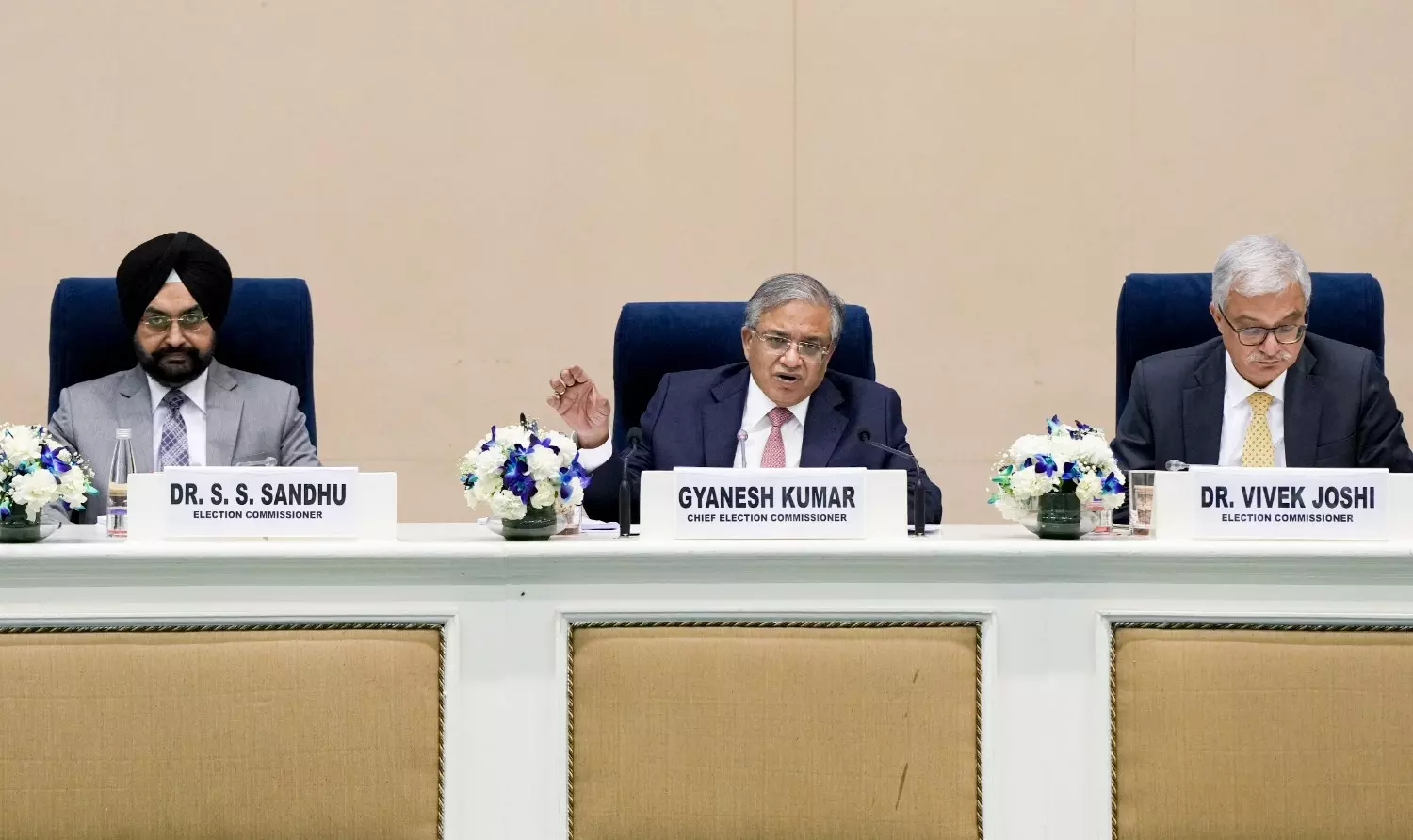
Chief Election Commissioner Gyanesh Kumar (centre) with other poll commissioners at a press conference to announce the Assembly election schedule for West Bengal, Tamil Nadu, Kerala, Assam and Puducherry in New Delhi on March 15, 2026. Photo: Photo
EC releases 2-phase Bengal poll even as over 60 lakh voters' fate remains unknown
Departing from 2021, the poll panel consolidates the state's polling itinerary while the court-monitored review of the ‘disputed’ voters races against time

In a departure from the eight-phase polling held amid the COVID-19 pandemic in 2021, the Election Commission (EC) on Sunday (March 15) scheduled elections to the 294-member Assembly in West Bengal in just two phases, even as the fate of over 60 lakh voters remains “under adjudication”.
Also read: EC unveils election schedule for 4 states, 1 UT
Chief Election Commissioner (CEC) Gyanesh Kumar announced that polling will take place on April 23 and April 29, and counting will take place on May 4.
The first phase will cover 152 constituencies, including districts in North Bengal and the Junglemahal region in the south-western parts of the state, while the remaining 142 seats will vote in the concluding phase.
Will over 60L voters be able to cast ballots?
The announcement comes amid an unusual legal and administrative situation involving the state’s voter list. A post-Special Intensive Revision electoral list unveiled on February 28 said about 60.6 lakh voters were marked as “under adjudication”, meaning their eligibility has not yet been finally determined.
With the election schedule being released now, political parties and observers in Bengal would be even keener to know what’s in store for those people.
EC's measures for Bengal elections 2026
♦ Likelihood of ordering a repoll if violence erupts within 100 metres outside a polling station
♦ Deploying thousands of micro-observers from central govt departments to supervise verification hearings
♦ Assessing past incidents of electoral violence in the state, including incidents that were reported about
♦ Announcing 100% webcasting from polling stations, enabling live monitoring of voting across booths
♦ Preparing to track the movement of central armed police forces deployed for election duty
♦ Deploying one general observer for each of the state’s 294 Assembly seats
The review process is being conducted under the supervision of the Calcutta High Court following directions from the Supreme Court.
Also read: 10 key seats to watch in West Bengal elections 2026
More than 700 judicial officers are examining the disputed entries, with Chief Justice Sujoy Paul monitoring the progress. Officials say about 18 lakh names had been processed as of Saturday (March 14), though many cases remain unresolved, particularly in districts such as Murshidabad, Malda, North Dinajpur and South 24 Parganas.
The ruling Trinamool Congress (TMC) has alleged that minority voters have been disproportionately affected by the adjudication process.
CEC speaks about supplementary list
Kumar said names cleared through the adjudication process before the election would be added to the electoral roll through a supplementary list.
“Once the adjudication process is completed and the additional list is published, those names will be added to the current voter list,” he added.
Election officials indicated that supplementary voter lists may be released in stages until the deadline for filing nominations.
Also read: SIR, infiltration, women’s safety: 10 factors set to dominate Bengal polls
Those excluded would be able to appeal before a special tribunal. However, there are apprehensions that many genuine voters may end up being unable to cast their ballots if the adjudication process is not completed in time. The first phase of the election is less than 40 days away.
'Valid voters should not be excluded'
Reacting to the announcement, Bengal Pradesh Congress President Subhankar Sarkar said the key issue was ensuring that legitimate voters were not excluded from the rolls.
“Whether it is one phase or two, the Congress’s only stance is that the names of valid voters should not be removed from the voter list,” he told The Federal.
“Our sole demand is that there should be clear clarification on 60 lakh names under adjudication before the first phase of elections on April 23. Only after this is clarified can this election become a festival. The Election Commission said this is an electoral festival. How can it be a festival if valid voters find their names missing from the voter list?”
Generally, elections are conducted only after the publication of a final voter list, making the current situation unusual.
Parties hail two-phase polls
The political parties, meanwhile, welcomed the two-phase elections.
Several opposition parties, including the Communist Party of India (Marxist)-led Left Front and the BJP, had earlier demanded that polling in the state be conducted in one or two phases, arguing the long schedule heightened tensions and political violence.
Also read: Hours before MCC sets in, Mamata gives hike to priests and clerics, clears DA arrears
“The commission feels that the number of phases should be reduced to a level that is convenient for everyone,” Kumar said.
The EC also defended its security preparations, saying central paramilitary forces had already been deployed across the state and had begun route marches and area domination exercises in sensitive locations.
Security arrangements were being made with the aim of ensuring violence-free voting, officials said.
Analysts say by concentrating polling into two days and deploying large numbers of central forces early, the EC appears to have addressed the key opposition demands for shorter elections.
“Opposition parties argue that multi-phase elections benefit the ruling TMC by allowing it to redeploy its cadres from areas where voting has concluded to those where polling is yet to take place. The commission seems to have agreed to this hypothesis,” said political commentator Debasish Chakraborty.
EC's Bengal-specific moves other than reduced phases
Besides the reduced phases, the EC has also made special efforts to ensure that the Bengal elections go smoothly, in terms of transparency, effectiveness and safety.
Among one of the steps is the possibility of ordering a repoll if violence erupts within 100 metres outside a polling station, according to informed sources. The proposal would expand existing repoll provisions, which typically apply when disturbances occur inside polling booths or when voting is disrupted.
Also read: Has SIR controversy hijacked West Bengal’s pre-election buzz? | AI With Sanket
The move is aimed at tackling a recurring pattern that often haunts elections in Bengal — intimidation or clashes outside polling centres.
The move also brings to the fore the speculation that the EC is up to applying electoral measures that are specific to Bengal, something similar to changes in rules made for the state’s SIR exercise.
During the exercise, the poll panel introduced a “logical discrepancy” category to flag voter entries with alleged inconsistent details such as mismatches in age, parent names or other information.
The EC also deployed thousands of micro-observers drawn from central government departments to supervise the verification hearings, an unusual move in a voter-roll revision process.
It is planning a series of technological and administrative measures to tighten security monitoring of polling.
For the first time in the state, it has announced 100 per cent webcasting from polling stations, enabling live monitoring of voting across all booths. The EC has directed state authorities to identify “sensitive” and “hyper-sensitive” polling booths in advance, based on factors such as past violence, unusually high voter turnout patterns, or complaints from political parties.
During a recent visit to Kolkata, the CEC warned officials and political parties that the EC would adopt a strict approach toward any attempts to disrupt voting.
CEC warned of zero tolerance for violence, intimidation
“The Election Commission has zero tolerance for any kind of violence or intimidation,” Kumar told reporters after a two-day review of election preparedness with state officials and political parties. “Our only priority is to ensure that the elections are conducted in a free, fair and peaceful manner.”
Officials said the EC is also examining past incidents of electoral violence in the state, including incidents reported during previous parliamentary, Assembly and local elections, to refine its monitoring strategy.
Authorities are also preparing to track the movement of central armed police forces deployed for election duty using GPS devices fitted to their vehicles, people familiar with the plan said.
The EC has also directed state authorities to identify “sensitive” and “hyper-sensitive” polling booths in advance, based on factors such as past violence, unusually high voter turnout patterns, or complaints from political parties.
Bengal has over 80,000 polling stations, making it one of the largest election monitoring exercises in the country.