



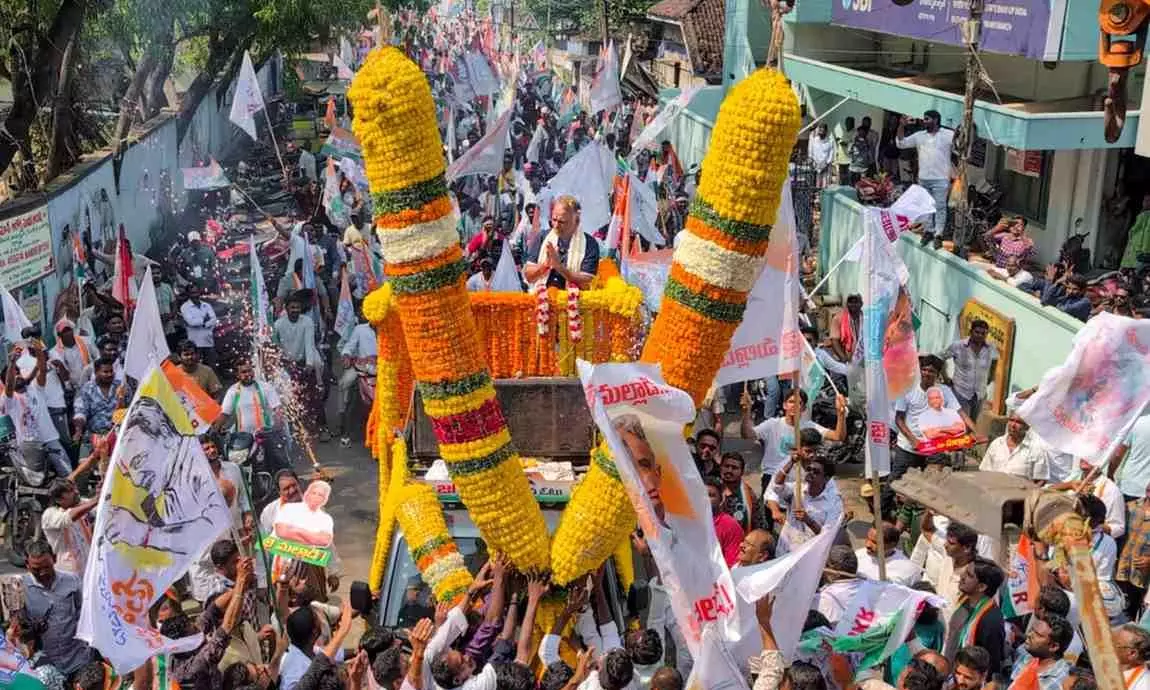
Congress candidate from Muthialpet constituency, Malladi Krishna Rao, during an election rally on Thursday (March 26). Photo: PTI
Criminal cases and crorepatis surge among Puducherry poll candidates: ADR report
Analysis finds rising share of candidates with serious criminal charges and sharp jump in declared wealth, highlighting deepening criminalisation and monetisation of electoral politics

A significant proportion of candidates contesting the upcoming Puducherry Assembly elections have declared criminal cases and substantial assets, according to an analysis by the Association for Democratic Reforms (ADR) and Puducherry Election Watch.
The report, based on self-sworn affidavits of 291 out of 294 candidates, highlights a notable increase in both criminal antecedents and financial holdings compared to the 2021 elections. Out of the 291 candidates analysed, 66 (23 per cent) have declared criminal cases against themselves, up from 54 (17 per cent) out of 323 candidates in 2021. Among them, 38 (13 per cent) face serious criminal cases, compared to 28 (9 per cent) in the previous polls.
Criminal backgrounds
The party-wise breakdown of candidates with criminal backgrounds:
Registered unrecognised parties: 26 out of 79 analysed (33 per cent)
National parties: 9 out of 33 (27 per cent)
State parties: 12 out of 62 (19 per cent)
Independents: 19 out of 117 (16 per cent)
Also Read: Puducherry 2026 elections: New party LJK faces bribery, 'B' team allegations
Among the major political parties, DMK and BJP fielded the highest percentages of candidates with criminal cases at 50 per cent each (6 out of 12 for DMK and 5 out of 10 for BJP), followed by All India NR Congress at 25 per cent, and Indian National Congress (INC) at 14 per cent.
For serious criminal cases, DMK led with 42 per cent (5 out of 12), while All India NR Congress stood at 19 per cent and INC at 10 per cent. Three candidates have declared cases related to crimes against women, and two have cases involving murder (IPC Section 302).
Parties ignore SC directives
The ADR report criticises political parties for fielding candidates with tainted backgrounds despite Supreme Court directives issued on February 13, 2020. These directives require parties to provide specific reasons linked to qualifications, achievements, and merit when selecting such candidates.
The organisation notes that parties often cite vague justifications such as "popularity" or "politically-motivated cases”, which fail to meet the court's standards.
Sharp surge in candidates’ wealth
The analysis points to a sharp surge in the wealth of candidates.
119 (41 per cent) of the 291 candidates are crorepatis, a significant jump from 74 (23 per cent) in 2021. The total assets declared by all candidates amount to Rs 2,099 crore, with an average asset value of Rs 7.21 crore per candidate, more than three times the 2021 average of Rs 2.14 crore.
Also Read: 'Friendly fights' mask a deepening INDIA alliance crisis in Puducherry
Party-wise, major parties show a strong preference for wealthy candidates:
All India NR Congress: 100 per cent crorepatis (16 out of 16)
BJP: 100 per cent (10 out of 10)
DMK: 92 per cent (11 out of 12)
INC: 81 per cent (17 out of 21)
Financial disparities among contestants
The distribution of assets reveals deep economic disparities among contestants:
62 candidates (21 per cent) declared assets of Rs 5 crore and above
23 candidates (8 per cent) between Rs 2–5 crore
64 candidates (22 per cent) between Rs 50 lakh–2 crore
79 candidates (27 per cent) between Rs 10–50 lakh
63 candidates (22 per cent) below Rs 10 lakh
Also Read: Why BJP's lotus blooms in Puducherry, but struggles in Tamil Nadu
The top three candidates with the highest declared assets are:
Jose Charles Martin (Latchiya Jananayaka Katchi, Kamaraj Nagar) — Rs 609 crore+
VP Ramalingame (BJP, Raj Bhavan) — Rs 115 crore+
A Namassivayam (BJP, Mannadipet) — Rs 85 crore+
Candidates’ liabilities
Notably, 183 candidates (63 per cent) have declared liabilities. The same top three also lead in liabilities, with Jose Charles Martin reporting over Rs 210 crore. Income tax return data further underscores the financial profile of candidates, with Jose Charles Martin declaring the highest income of approximately Rs 59 crore in the 2024-25 financial year.
Three candidates declared zero assets, while the lowest non-zero assets, held by independents, ranged from Rs 300 to Rs 7,618.
Rise in assets among re-contesting MLAs
Re-contesting MLAs show substantial asset growth:
The report also compares the assets of 22 re-contesting MLAs. Their average assets rose from Rs 11.10 crore in 2021 to Rs 20.22 crore in 2026, reflecting an average growth of Rs 9.12 crore (82 per cent) over five years.
Also Read: From French legacy to saffron shift: Is Puducherry changing? | Talking Sense With Srini
Party-wise asset growth among re-contesting MLAs:
BJP: 164.11 per cent increase (average from Rs 15.20 crore to Rs 40.16 crore)
DMK: 89.86 per cent increase
All India NR Congress: 44.85 per cent increase
INC: 11.43 per cent increase
Other key findings
Education: 134 candidates (46 per cent) are graduates or above, while 125 (43 per cent) have qualifications between 5th and 12th standard. Four candidates declared themselves illiterate.
Age: 57 per cent are aged 41–60 years, 25 per cent between 25–40, and 18 per cent between 61–80.
Gender: Only 40 candidates (14 per cent) are women, a slight increase from 11 per cent in 2021.
ADR’s recommendations
The ADR has urged stronger measures to curb criminalisation and monetisation of politics. Key recommendations include permanent disqualification for candidates convicted of heinous crimes, disqualification for those with serious charges framed at least six months before polls, bringing political parties under the RTI Act, and stricter enforcement of Supreme Court guidelines on candidate selection disclosures.
Also Read: Double engine govt in Pondy: Political myth or real growth? Namasivayam interview
The organisation also called for time-bound trials in cases involving politicians, mandatory display of summarised candidate affidavits at polling booths, and enhanced voter awareness campaigns against cash and freebies.